파이토치 통한 RNNcell 구현
import torch
import torch.nn as nn

torch.manual_seed(42);

# 입력  𝑋𝑡 생성
d = 4  # 입력 x_t (1차원 벡터)의 크기
x_t = torch.randn(d)  # 현재 시점 t의 입력

# 초기 은닉 상태  ℎ𝑡−1 설정

# 은닉 상태의 크기를 설정합니다.
Dh = 6
# 이전 타임 스텝의 은닉 상태를 초기화
h_t_minus_1 = torch.zeroes(1, Dh)


#입력에 대한 가중치 (𝑊𝑥)설정
# 𝑊𝑥는 입력 데이터의 차원 𝑑와 은닉 상태의 차원 𝐷ℎ에 따라 결정되는 𝐷ℎ×𝑑 크기의 행렬
Wx = torch.randn(Dh, d)

#은닉 상태에 대한 가중치 (𝑊ℎ)설정
# 𝑊ℎ의 차원은 은닉 상태의 크기 𝐷ℎ에 따라 𝐷ℎ×𝐷ℎ로 설정.
Wh = torch.randn(Dh, Dh)

#편향(b) 설정
b = torch.randn(Dh)

#현시점 은닉 상태 계산
h_t = torch.tanh(torch.matmul(x_t.unsqueeze(0), Wx.t()) + torch.matmul(h_t_minus_1, Wh.Wh.t()) + b.unsqueeze(0))

# 출력 가중치  𝑊𝑦 및 출력 𝑌𝑡 계산

Dy = 2
Wy = torch.randn(Dh,Dy)  # 출력 가중치
y_t = torch.sigmoid(torch.matmul(h_t, wy))
RNN 클래스구현과 Sequence 데이터 처리
1. MyRNNcell 클래스 구현하기
# 1.1 클래스 정의하기 : init 함수 구현
import torch
import torch.nn as nn

class MyRNNcell(nn.Module):
    def __init__(self, input_size, hidden_size):
        super(MyRNNcell, self).__init__()
        self.hidden_size = hidden_size

        # 가중치와 편향을 nn.Parameter로 자동 초기화
        self.Wx = nn.Parameter(torch.randn(hidden_size, input_size))
        self.Wh = nn.Parameter(torch.randn(hidden_size, hidden_size))
        self.b = nn.Parameter(torch.randn(hidden_size))


## 확인하기
model_rnn = MyRNNcell(input_size=4, hidden_size=6)

1.2 클래스 정의하기 : forward 함수 구현
import torch
import torch.nn as nn

# SimpleRNN 클래스 정의
class MyRNNcell(nn.Module):
    def __init__(self, input_size, hidden_size):
        super(MyRNNcell, self).__init__()
        self.hidden_size = hidden_size
        self.Wx = nn.Parameter(torch.randn(hidden_size, input_size))
        self.Wh = nn.Parameter(torch.randn(hidden_size, hidden_size))
        self.b = nn.Parameter(torch.randn(hidden_size))

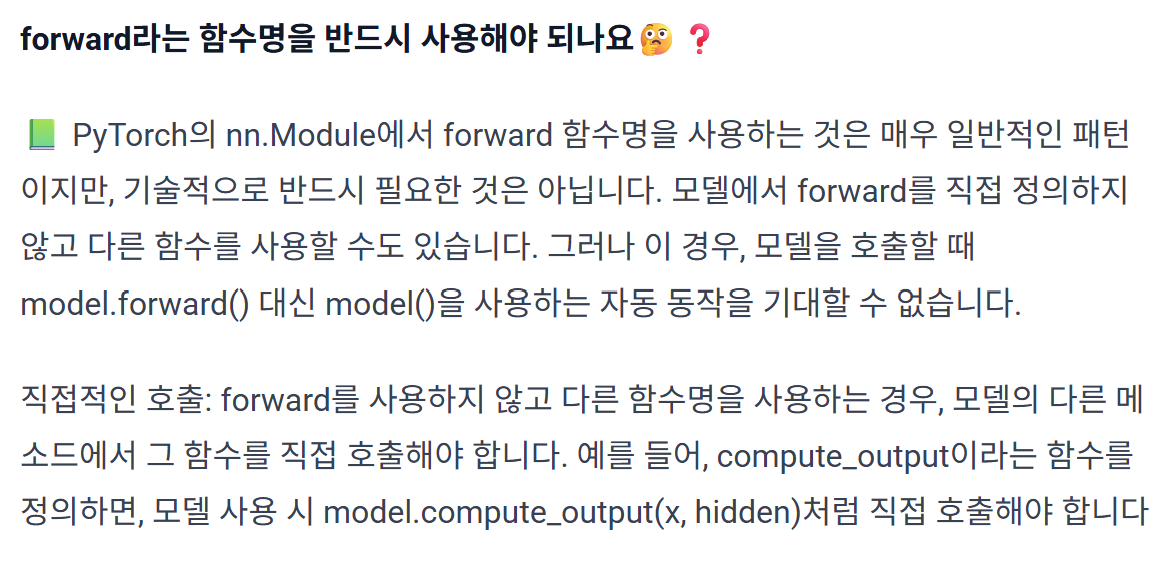
    def forward(self, x, hidden):

        hidden = torch.tanh(torch.matmul(x,self.Wx.t()) + torch.matmul(hidden, self.Wh.t()) + self.b)
        return hidden

# 모델 인스턴스 생성
model_rnn = MyRNNcell(input_size=4, hidden_size=6)
model_rnn
2.MyRNNcell 인스턴스를 통한 새로운 은닉 상태 계산
torch.manual_seed(42)

# 랜덤 입력 데이터 생성
x_t = torch.randn(1, 4)  # Input size = 4

# 초기 은닉 상태 생성
initial_hidden = torch.randn(1, 6)  # Hidden size = 6

# 모델 실행
new_h_t = model_rnn(x_t , initial_hidden)
print("새로운 은닉 상태:", new_h_t)
3.시퀀스 데이터 처리를 위한 MyRNN 클래스 구현
import torch
import torch.nn as nn

# MyRNN 클래스 정의
class MyRNN(nn.Module):
    def __init__(self, input_size, hidden_size, output_size):
        super(MyRNN, self).__init__()
        self.hidden_size = hidden_size
        self.rnn_cell = MyRNNcell(input_size, hidden_size)
        self.Wy = nn.Parameter(torch.randn(output_size, hidden_size))

    def init_hidden(self, batch_size=1):
        return torch.zeros(batch_size, self.hidden_size)

    def forward(self, x):
        h_t = self.init_hidden(x.size(0))

        for i in range(x.size(1)):  # Iterate over sequence
            h_t = self.rnn_cell(x[:, i], h_t)

        output = torch.sigmoid(torch.matmul(h_t, self.Wy.t()))  # Sigmoid activation
        return output, h_t

# 모델 초기화 통한 인스턴스 생성 예시
model_myrnn = MyRNN(input_size=4, hidden_size=6, output_size=2)
model_myrnn
#  Sequence 입력 데이터와 MyRNN을 통한 출력 계산
sequence_data = torch.tensor([
    [0.1, 0.2, 0.3, 0.4],
    [0.2, 0.3, 0.4, 0.5],
    [0.3, 0.4, 0.5, 0.6],
    [0.4, 0.5, 0.6, 0.7],
    [0.5, 0.6, 0.7, 0.8],
])

# MyRNN 모델 인스턴스화
input_size = 4  # 입력 피처의 개수
hidden_size = 6  # 은닉 상태의 크기
output_size = 1  # 출력 크기

model_myrnn1 = MyRNN(input_size, hidden_size, output_size)

# 모델을 통해 시퀀스 데이터 처리
output, ht = model_myrnn1(sequence_data.unsquezze(0))
print("입력 시퀀스:", sequence_data)
print(f"모델 출력:, {output} {ht}")
| 기능 | MyRNNcell | MyRNN |
|---|
| 처리 단위 | 한 시점만 처리 | 전체 시퀀스 반복 처리 |
| 내부 구성 | Wx,Wh,b | RNNCell + 출력 가중치 |
| 출력 | 새로운 은닉 상태 ht | 최종 결과 (예: 분류 결과) |
| 사용 방식 | 수동 반복(for문으로 여러 번 호출) | 자동 반복 구조(한 번에 시퀀스 처리 가능) |
