Hi, it's happy Sunday afternoon. I don't know why, but Sundays make me lazy and relaxed. The weather is also sunny, bright and warm. Anyway, today's topic is APS. Many manufacturing companies have already adopted ERP and MeS, but APS is still in its early stage. So, I'll talk about why APS is now getting more attention.
APS stands for Advance Plannig and Scheduling. Unlike existing systems, APS provides a future-oriented solution based on real-time data, enabling proactive decision-making. It does nor operate at the level of individual line or processes but instead establishes production plans from a factory-wide perspective.
In other words, a Digital Twin can be seen as the combination of CPS (Cyber-Physical Systems), which mirror physical equipment, and APS, which manages and operates that equipment. APS plays a crucial role as the "brain" of the digital twin. It doesn’t just send digital commands — now we need a system that can plan the whole factory's operations and react to changes through simulation.
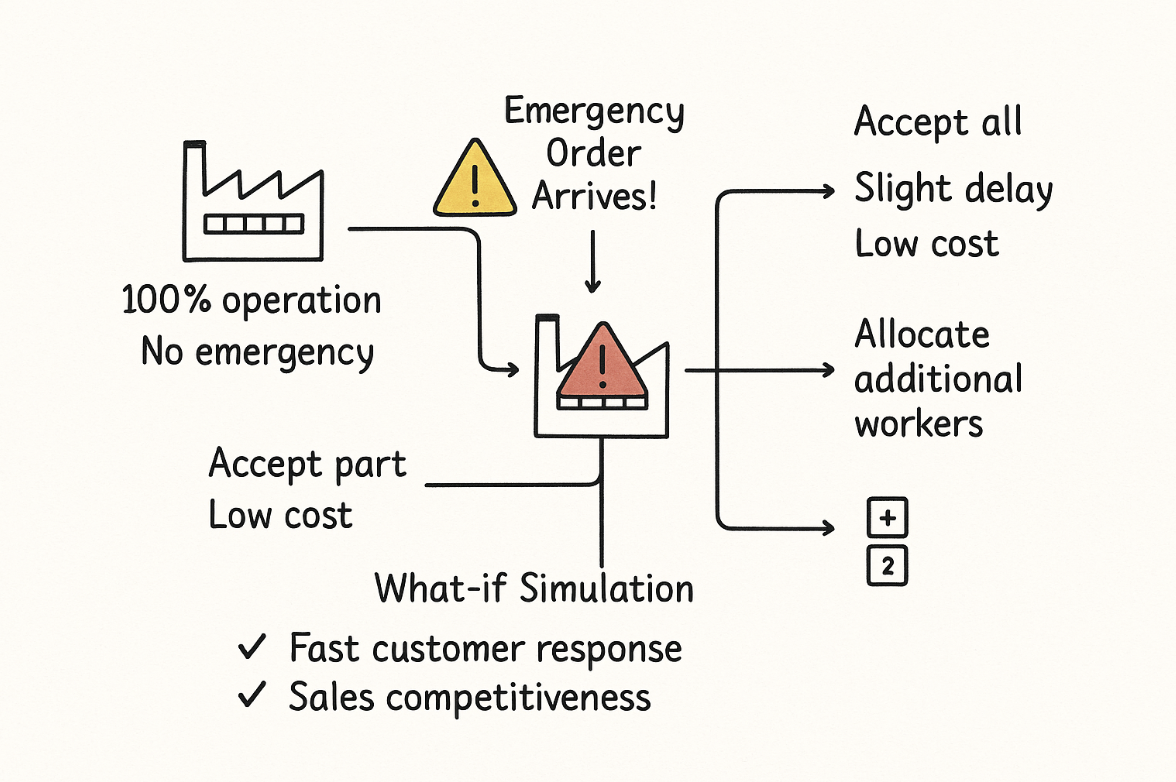
For example, the system operates at 100% when there are no emergency orders. But when an emergency order comes in, it can cause production delays or disruptions. If the production cannot be completed by the deadline, what should planner do? The planner can simulate different scenarios and decide whether to accept all the emergency orders or just part of them. By accepting only some of the orders, they might experience a slight production delay, but they can also analyze the cost and expected profit to make the best decision.
When all emergency orders must be accepted, the planner can choose between assigning overtime to existing workers or adding additional workers to the schedule. With these "What-if Simulations", planners can make fast, data-driven decisions and respond quickly to customer needs — a critical advantage in sales and customer satisfaction.
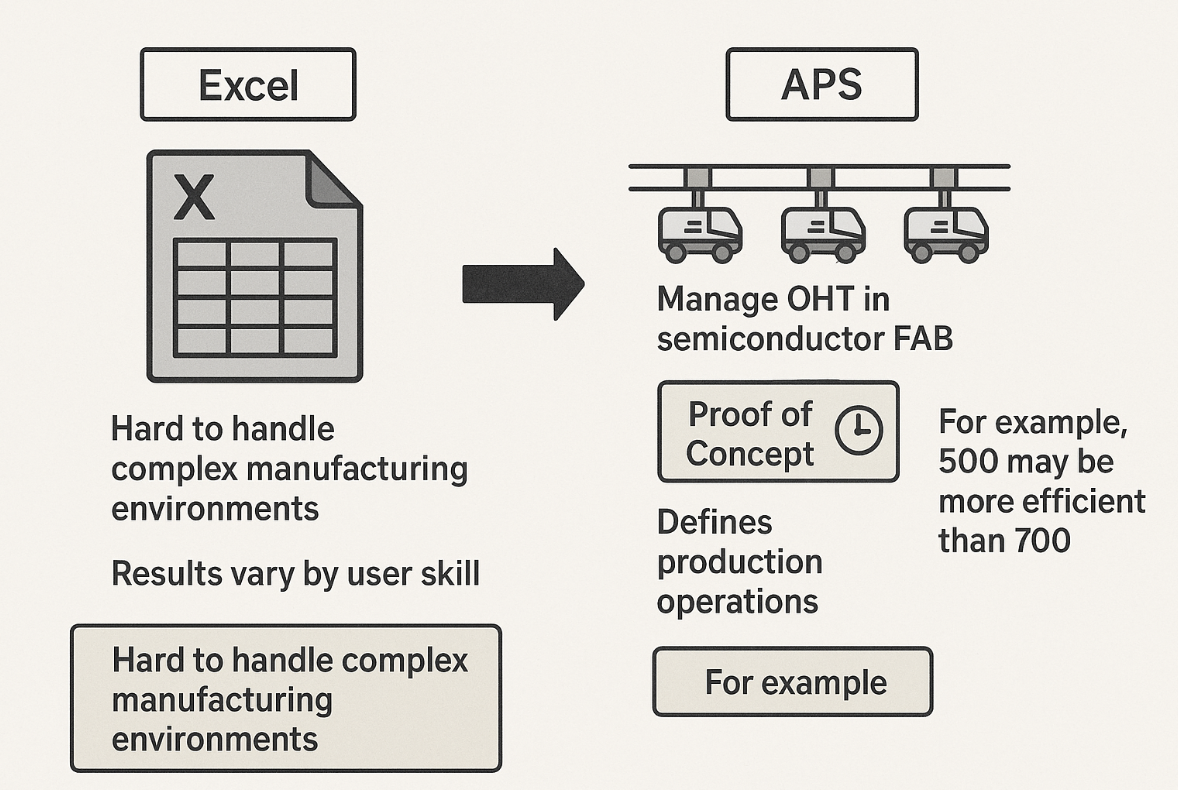
In the past, production planners often relied on Excel. While it was possible to build plans this way, Excel made it difficult to represent the complexity of modern manufacturing environments. Outcomes could also vary depending on the user’s skill level. In today’s world, where uncertainty is growing — as seen during events like COVID-19 — Excel is no longer a reliable tool for agile, data-driven decision-making.
For example, in semiconductor fabs, planners can simulate and optimize the number of OHT (Overhead Hoist Transport) units, concluding that 500 may be more efficient than 700. APS makes such simulations easy to execute, and a proof of concept (PoC) can be completed in as little as two weeks. This enables companies to present convincing, data-backed proposals to executives. Ultimately, APS is not just another IT system — it is the foundation for how we define and drive our production operations.