오늘 리뷰할 논문은 Critique-out-LOUD Reward Models입니다!
저번에 읽었던 논문 MM-RLHF: The Next Step Forward in Multimodal LLM Alignment과 Reward Modeling 측면에서 유사합니다. 따라서 오늘은 논문을 리뷰하면서 MM-RLHF-Reward-Model과의 차이점도 함께 분석해보겠습니다.
한국어로 해석하는 것보다 영어가 더 직관적일 경우에는 논문을 그대로 차용/약간 수정한 형태로 적어두었습니다:)
Abstract
기존 RLHF에서 사용하던 Reward models는 LLM의 생성능력을 활용하지 않아서 추론 과정이 빈약
→ RM이 응답의 질에 대해 명시적으로 추론하게 만들기 위해 Critique-out-Loud reward model 도입
- 간단한 흐름:
- CLoud RM generates a natural language critiques of the response
- Critique is used to predict a scalar reward for the quality of the response.
- demonstration
- Llama-3-8B&Llama-3-70B로 진행.- RewardBench에서 이전 RM보다 높은 정확도 얻음.
- Pareto improvement
Conclusion
- Through generating critiques, CLoud reward models can explicitly reason about the quality of a response
- improve average pairwise preference modeling accuracy
- performing Best-of-N decoding with CLoud reward models is a Pareto improvement over classic reward models for ArenaHard win-rate.
- CLoud reward models only benefit from self-consistency on reasoning problems and demonstrate that self-consistency is predominantly useful when assigning rewards to responses with short reasoning horizons
Introduction
기존 reward model은 LLM 기반의 prompt와 response의 분류기였음.
→ Reward modeling 과정서 LLM의 LM head가 사용되지 않음
→ RM can't explicitly reason about the quality of the response in CoT.
➡️ Reward modeling 과정서 비판적인 추론 능력 부족
So, 이 논문에서는 CLould reward model을 제시함으로서
→ LLM의 language generation 으로 critique을 산출
→ reward model의 성능을 높이고자 함.
Methods
기존 RM 방법론 설명 → Cloud RM 설명 순으로 다루겠습니다.
2.1 Classical Reward models
- user prompt x, assistant response y로 이루어진 데이터셋 D를 기반으로 training
- base model과 Reward head의 파라미터로 이루어진 Reward model에서 preferred response에는 rejected response보다 높은 reward를 주도록 train시킴.
2.2 CLoud reward models
reward model 구성
- parameters:
- 기존 RM에 LLM의 language modeling head의 파라미터 가 추가됨.
- critique:
- prompt x와 assistant response y를 기반으로 산출한critique - reward:
Training CLoud reward models
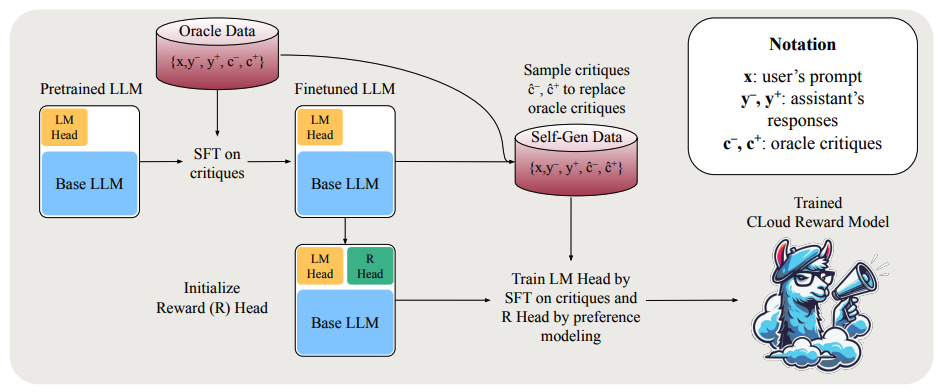
- train과정의 목표: oracle critique(human critique on response)을 self-generated critique으로 바꾸기.
훈련 단계
- base model&LM head를 oracle critiques를 기반으로 supervised finetuning 진행 → critique 생성
- 데이터셋 내 oracle critique을 finetuned model이 생성한 critique으로 교체
- 2에서 교체한 critique으로 reward model을 train
- objectives 정리
1.- preferred data(preferred prompt, response, human critique) - rejected data
- Cross Entropy 기반의 수식이고 preferred data와 rejected data의 차가 클수록 → loss값이 작아짐.
- preferred data(preferred prompt, response, human critique) - rejected data
-
- supervised finetuning에서는 preferred / rejected data 기반
loss의 평균을 loss로 가져감 - 를 최소화하는 critique 생성
- 를 최소화하는 base model & LM head 파라미터($$) 없음
- supervised finetuning에서는 preferred / rejected data 기반
-
- RM와 SFT의 loss를 합한 게 최종 objective.
- 하이퍼파라미터 를 통해 supervised finetuning model의 강도 조정.
3. Results
3.1 Setup
Data
training에 사용하기 위해 가공 단계를 거치는데, 흐름은 아래와 같습니다.
-
< merge >
- UltraFeedback + UltraInteract → Ultra dataset
- 종류가 다양한 데이터셋 2개를 하나로 합침
- UltraFeedback + UltraInteract → Ultra dataset
-
< replace >
- chosen & rejected response in Ultra dataset → Llama-3-8B-Instruct가 생성한 responses로 교체 → UltraLlama
-
< label >
- Llama-3.1-405B-Instruct가 chosen & rejected response에 대해 labeling
- prompt: ArenaHard의 pairwise judgement prompt 사용
- Llama-3.1-405B-Instruct가 chosen & rejected response에 대해 labeling
-
< generate oracle critique >
- Llama-3.1-405B-Instruct가 chosen & rejected responses에 대해 oracle critique 생성
- critique: response가 query에 대해 얼마나 잘 응답했는지를 평가
- 여기서 질문! 왜 기존 데이터셋에 있는 critique를 안 쓰고 새로 생성할까?
글쎄~ 왜일까~요~~?
Evaluation
평가요소는 2가지.
1. pairwise preference classification accuracy
2. Best-of-N(BoN) win rate
3.3 Self-consistency for cloud reward models
RQ3: When is self-consistency useful?
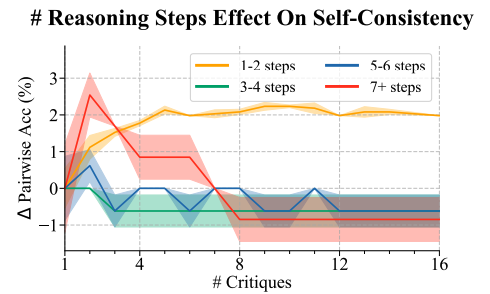
critiques의 수가 증가할 때, 1-2 reasoning steps의 성능이 가장 좋음.
➡️ 왜 critique 수를 늘릴수록 1-2 reasoning steps에서 self-consistency가 좋아질까?
이 질문에 답하기에 앞서 self-consistency가 뭔지 알아보겠습니다.
self-consistency
같은 response에 대해 여러 번 critique을 생성했을 때 나온 점수의 평균을 최종 reward로 산출하는 방법
➡️ 답변의 일관성 의미.
이제 질문에 답해보겠습니다. 흐름을 단계적으로 살펴보겠습니다.
reasoning step이 짧을수록(짧은 추론일수록)
→ 결론 역시 짧아짐
→ 짧은 결론일수록 관점이 한두가지로 수렴
→ 이 상태에서 표본을 늘릴수록
→ 유사한 결론이 반복 언급
→ 결론의 분산이 작아짐(결론의 분포가 좁아짐) & 일관된 예측
→ pairwise acc↑
위 단계적 사고에 따라 reasoning step이 짧을수록 self-consistency가 좋아진다는 점을 알 수 있습니다.
- 흥미로운 점
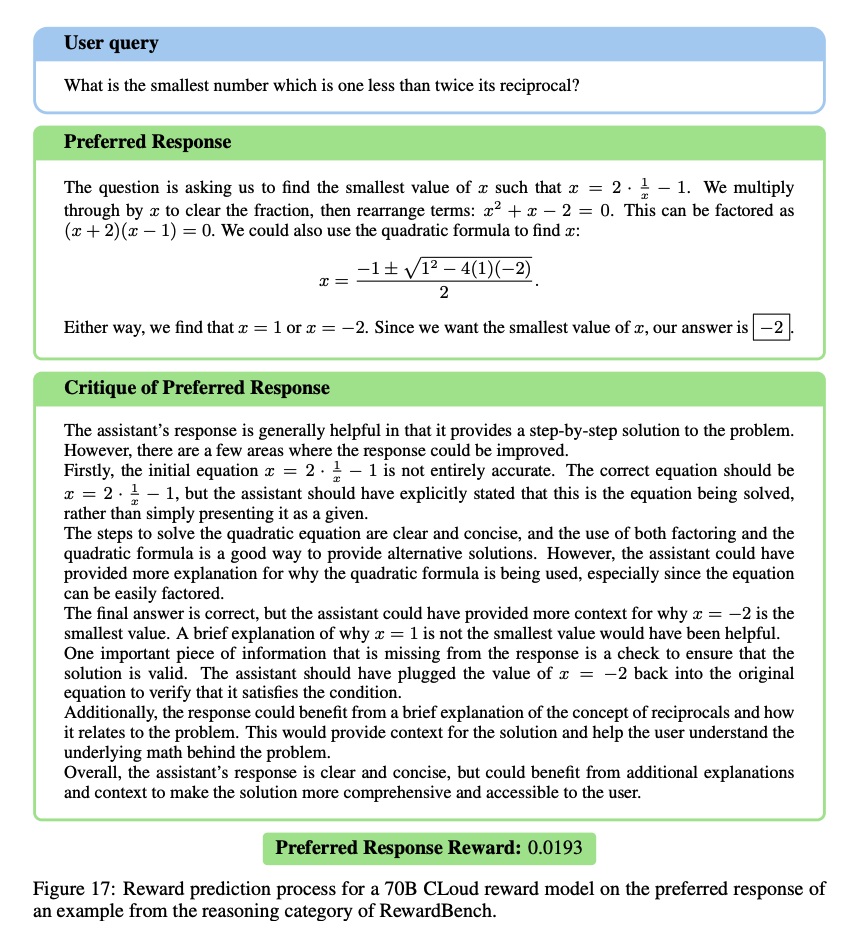
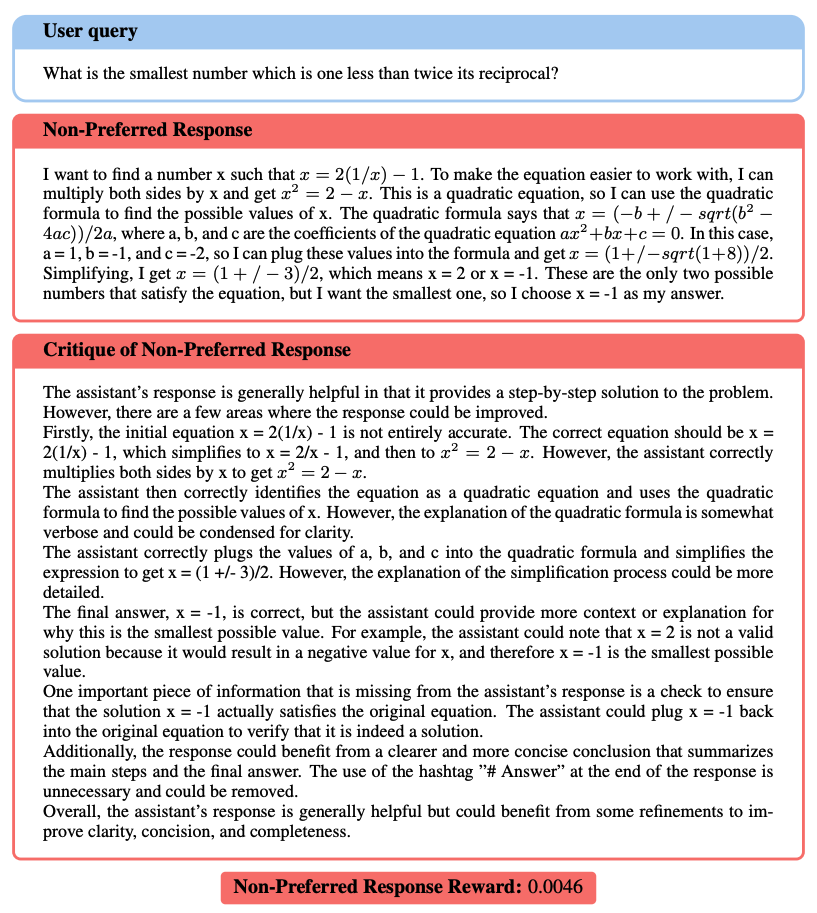
- 수학 문제에 대해서도 critique을 적용할 수 있습니다.
- 일반적으로 수학 문제는 답이 정해져 있으니 critique의 효과가 적을 것이라 생각했는데요, critique 사용이 잘못된 답을 교정하는 것뿐만이 아니라 답안을 더 풍부하게 만드는 효과도 있습니다!
4. Related work
Critique-based feedback
- 기존에도 Reward model에서 critique을 도입했으나 기존 모델에서는 critique을 단순히 "사용"만 함.
- CLoud에서는 human critique을 기반으로 critique을 "생성"까지 함.
LLM-as-a-Judge
-
기존 LLM-as-a-Judge model
- 사람이 만든 채점기준표(rubric)를 기반으로 response를 scoring(평가)
- response 평가(O), response 교정(X)
- CLoud와 유사점: scoring 전 response에 채점기준표를 적용하는 과정에 chain-of-thought 추론 적용
- CLoud와 차이점: scalar reward head가 없음
➡️ 후속 연구에서는 사람이 만든 채점기준표(rubric)이 critique generation 과정 & scoring 과정에서 모두 쓰일 수 있는 방향을 탐구