Message Passing and Node Classification
Outline
- Main Question: Given a network with labels on some nodes, how do we assign labels to all other nodes in the network?
- Example: In a network, some nodes are fraudsters and some other nodes are fully trusted. How do you find the other fraudsters and trustworthy nodes?
- We already discussed node embeddings as a method to solve this in Lecture 3 (노드 임베딩을 사용하여 trust/not trust를 판별하는 classifer를 생성)
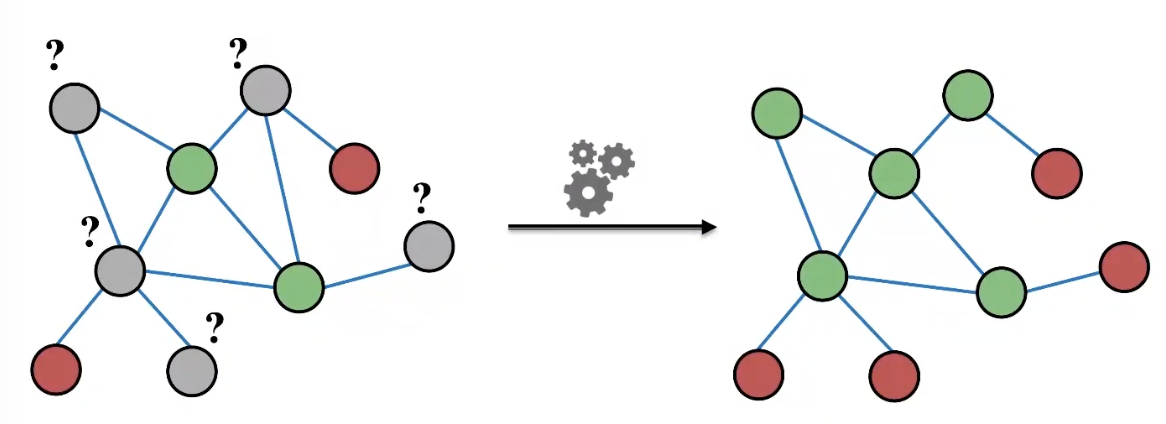
Example: Node Classification
-
Given labels of some nodes
-
Let's predict labels of unlabeled nodes
-
This is called semi-supervised node classification
-
Today we will discuss an alternative framework:
Message Passing -
Intuition: Correlations exist in neworks.
- In other words: Similar nodes are connected- Key concept is collective classificaton: Idea of assigning labels to all nodes in a network together
-
We will look at three techniques today:
- Relational classification- Iterative classification
- Belief propagation
Correlations Exists in Networks
- Indicidual behaviors are correlated in the network
- Correlation: nearby nodes have the same color (belonging to the same class)
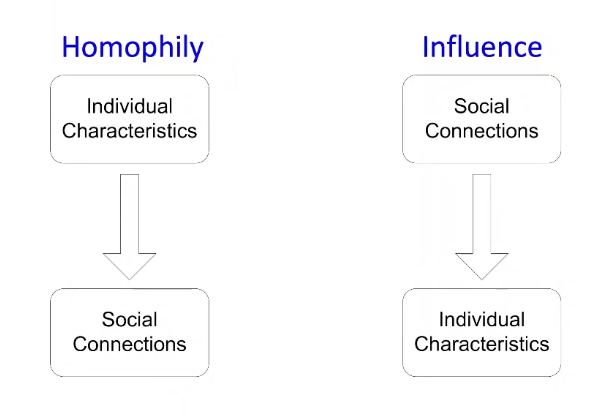
- Main types of dependencies that lead to correlation:
Homophily
- Homophily : The tendency of individuals to associate and bond with similar others
- "Birds of a feather flock together"- It has been observed in a vast array of network studies, based on a variety of attributes (e.g., age, gender, organizational role, etc.)
- Example: Researchers who focus on the same research area are more likely to establish a connection (meeting at conferences, interacting in academic talks, etc.)
Influence
- Influence : Social connections can influence the individual characteristics of a person
- Example: I recommend my musical preferences to my friends, until one of them grows to like my same favorite genres!
Classification with Network Data
- How do we leverage this correlation observed in networks to help predict node lables?
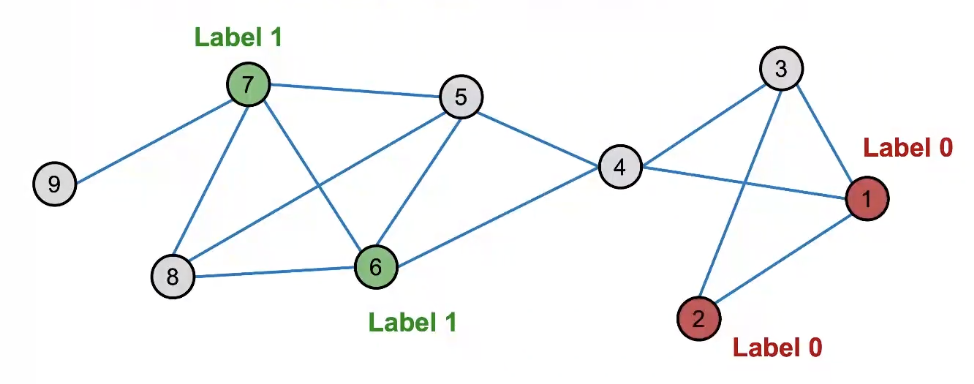
How do we predict gray nodes?
Motivation (1)
- Similar nodes are typically close together or directly connected in the network:
- Guilt-by-assoication: If I am connected to a node with label X, then I am liekly to have label X as well- Exmaple: Malicious/begign web page:
Malicious web pages link to one another to increase visibility, look credible, and rank higher in search engines
- Exmaple: Malicious/begign web page:
Motivation (2)
- Classification label of a node v is network may depend on
- Features of v- Labels of the nodes in v's neighborhood
- Features of the nodes in v's neighborhood
Semi-supervised Learning
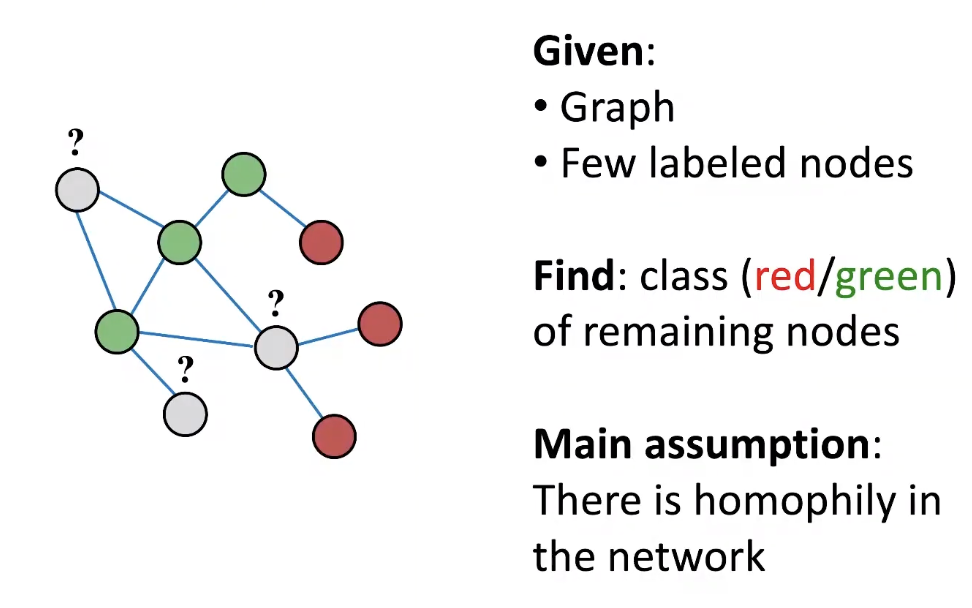
network 안에 homophily가 있음을 가정한다.
Example Task
- Let A be a nxn adjacency matrix over n nodes
- Let Y = {0, 1}^n be a vector of labels
- = 1 belongs to class 1- = 0 belongs to class 0
- There are unlabeled node needs to be classified
- Goal: Predict which unlabeled nodes are likely class 1, and which are likely class 0 (라벨링이 되지 않은 노드들이 class 1 인지 class 0인지를 예측하는 task)
Approach: Collective Classification
- Many applications:
- Document classification- Part of speech tagging
- Link prediction
- Optical character recognition
- Image/3D data segmentation
- Entity resoultion in sensor networks
- Spam and fraud detection
Collective Classification Overview
- Intuition: Simultaneous classification of interlinked nodes using correlations
- Probabilistic framework
- Markov Assumption: the label of one node v depends on the labels of its neighbors
- Collective classification involves 3 steps
- Local Classifier: Assign initial labels, Used for initial label assignment
- Predicts labels based on node attributes/features
- Standard classification task
- Does not use network information
- Relational Classifier: Capture correlations between nodes
- Learns a classifier to label one node based on the labels and/or attributes of its neighbors
- This is where network information is used
- Collective Inference: Propagate correlations through network
- Apply relational classifier to each node iteratively
- Iterate until the inconsistency between neighboring labels is minimized
- Network structure affects the final prediction
Problem Setting
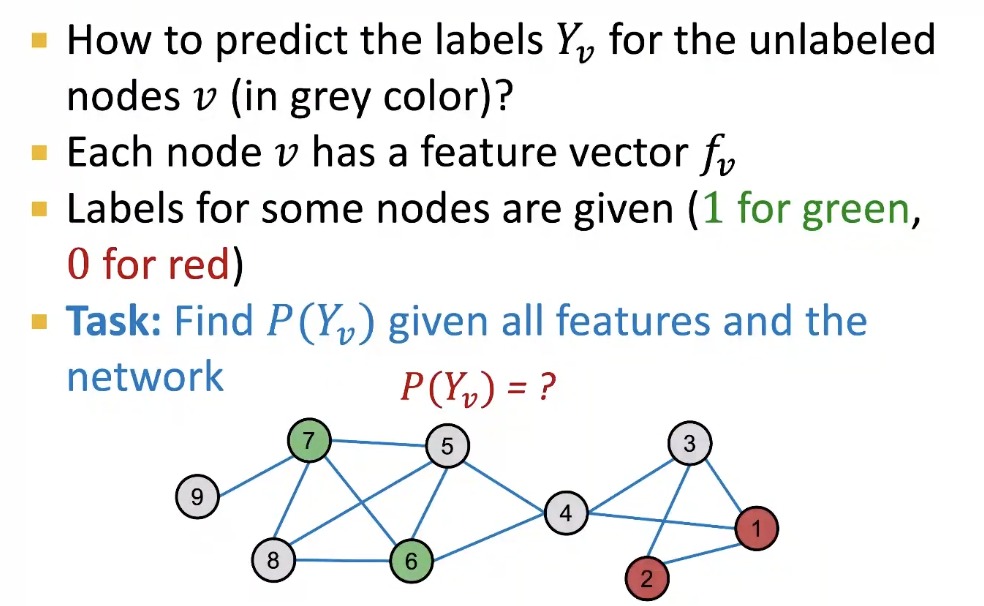
각 node가 class에 포함될 확률을 구하기
Relational and Iterative Classification
Probabilistic Relational Classifier
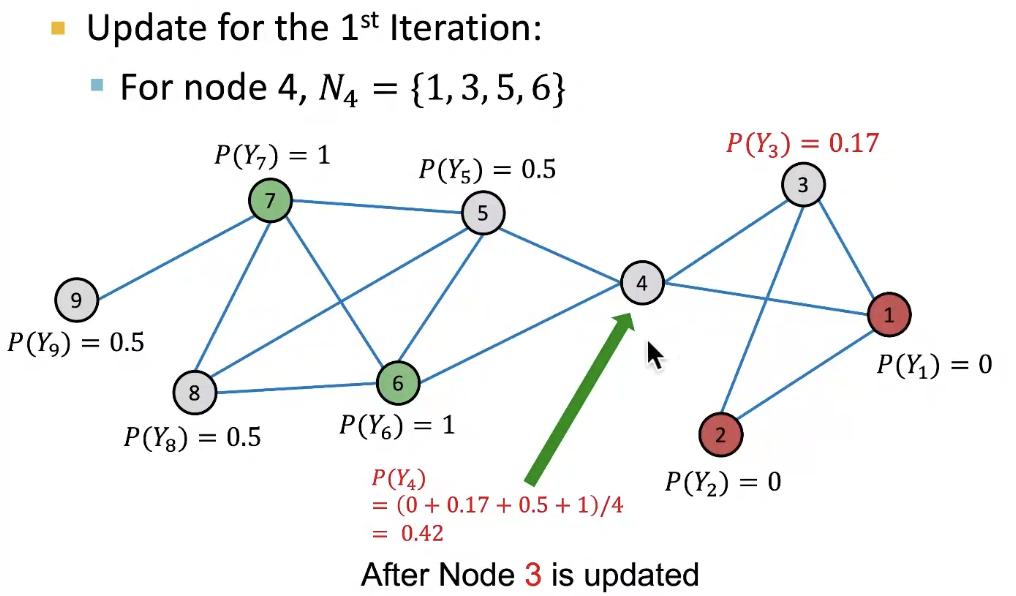
- Basic idea: Class probability of node v is a weighted average of class probabilities of its neighbors
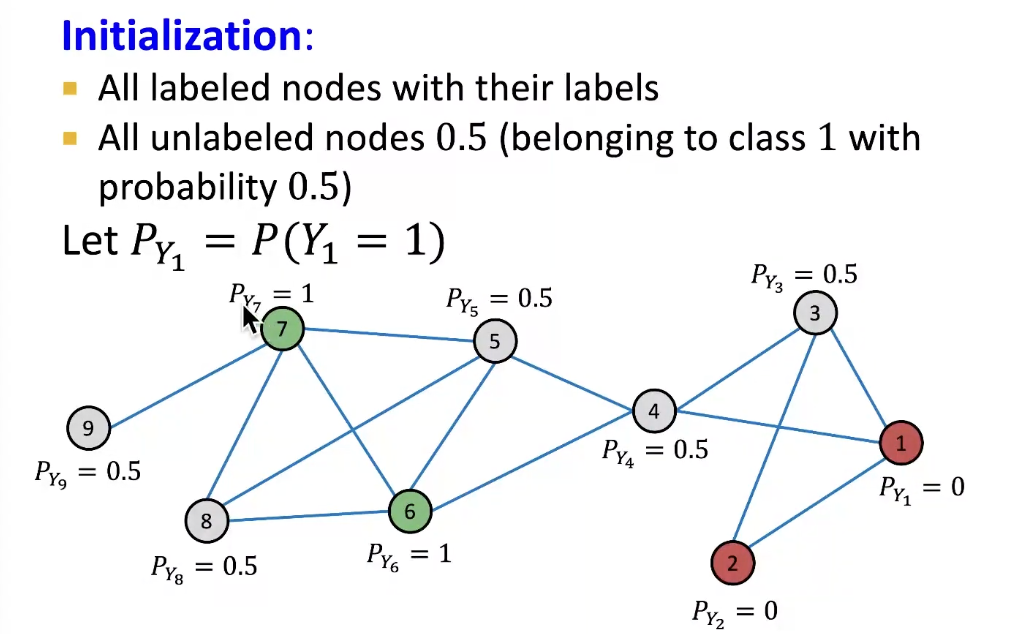
- For labeled nodes v, initialize label with ground-truth label
- For unlabeled nodes, initalize = 0.5
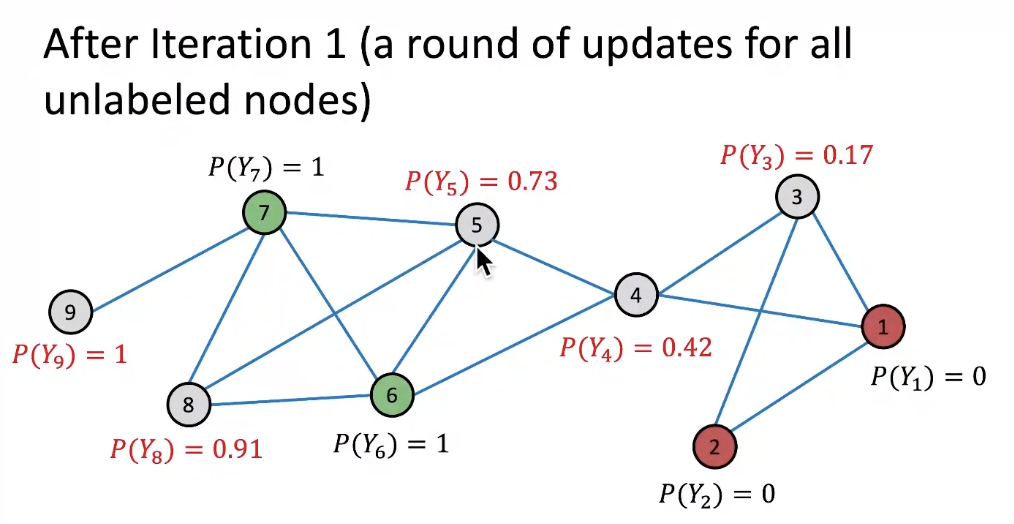
- Update all nodes in a random order until convergence or until maximum number of iteration is reached
- Update for each node v and label c

- If edges have strength/weight information, can be the edge weight between v and u (A의 구조에 따라서 update가 달라진다)
- is the probability of node c having label c - Challenges:
- Convergence is not guaranteed- Model cannot use node feature information
Example: Initialization
-
1st iteration, Update Node 3
-
After 1st iteration
-
and so on...
-
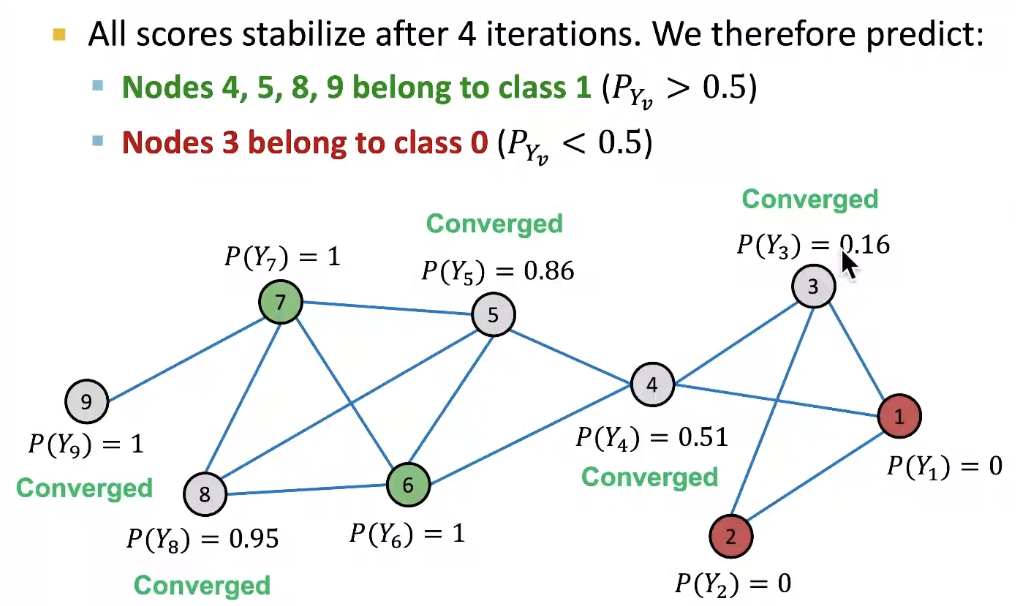
Convergence
각 prediction 확률의 값에 따라서 classification을 진행한다.
Iterative Classification
- Relational classifier do not use node attributes. How can one leverage them?
- Main idea of iterative classification: Classify node v based on its attributes as well as labels of neighor set
- Input: Graph
- : feature vector for node v- Some nodes v are labeled with
- Task: Predict label of unlabeled nodes
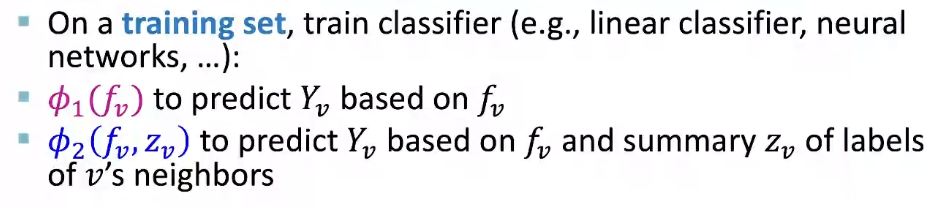
- Approach: Train two classifiers:
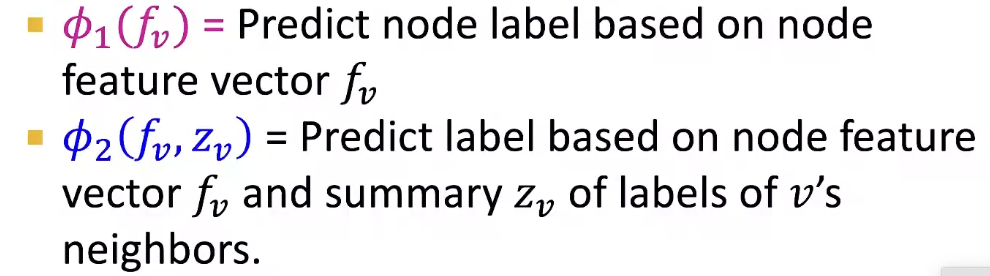
node의 feature vector만을 사용해서 예측하는 classifer 1
node의 feature와 주변의 label을 요약한 feature 정보로 예측하는 classifier 2
Computing the Summary
주변의 정보를 한 번에 모으는 과정을 어떻게 하는가?
- Ideas: = vector
- Histogram of the number (or fraction) of each label in %N_v$- Most common label in
- Number of different labels in
Architecture of Iterative Classifiers
- Phase 1: Classify based on node attributes alone
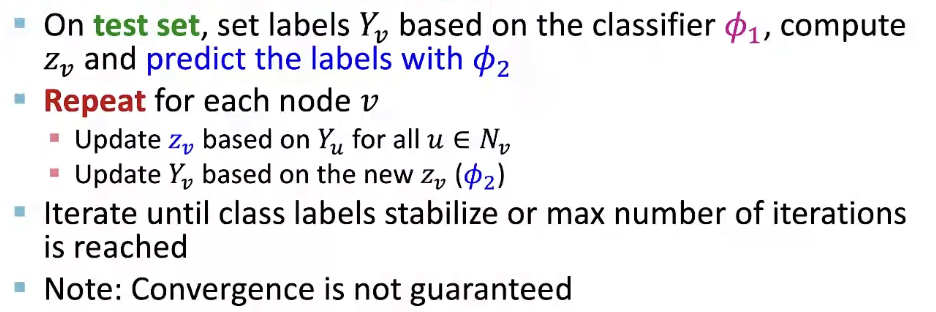
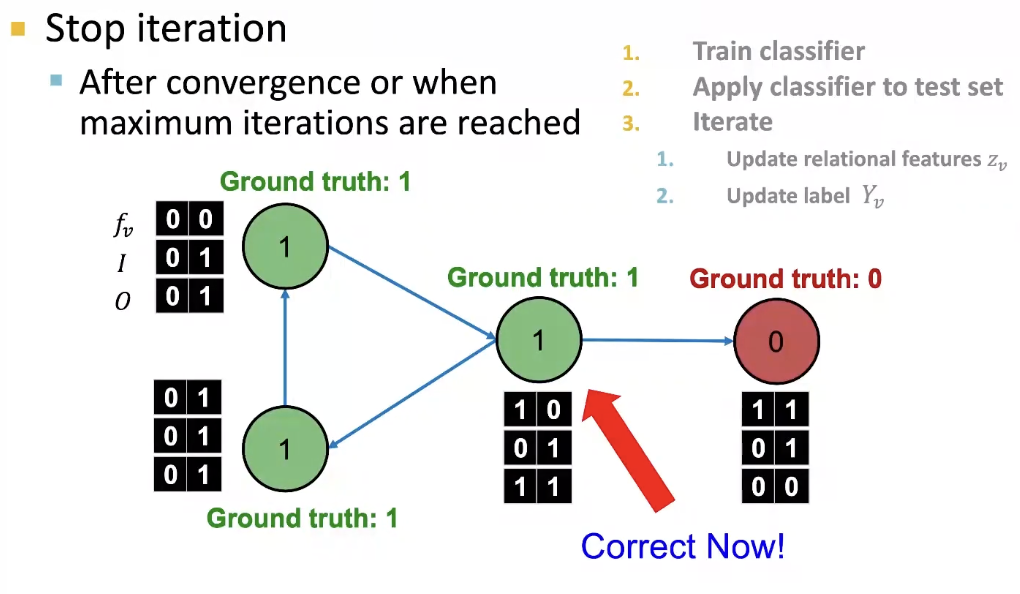
- Phase 2: Iterate till convergence
Example: Web Page Classification
- Input: Graph of web pages
- Node: Web page
- Edge: Hyper-link between web pages
- Directed edge: a page points to another page - Node features: Webpage description
- For simplicity, we only consider 2 binary features - Task: Predict the topic of the webpage
- Baseline: Train a classifier to classify pages based on binary node attributes
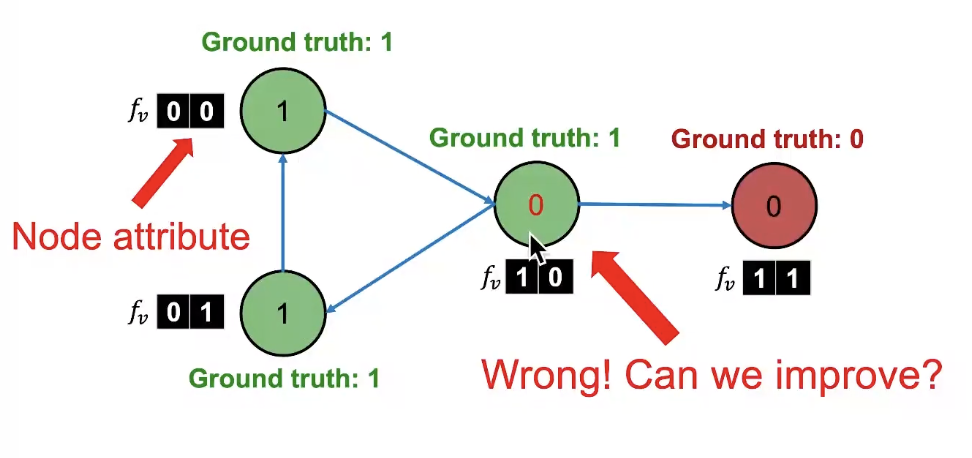
노드의 색이 ground-truth임
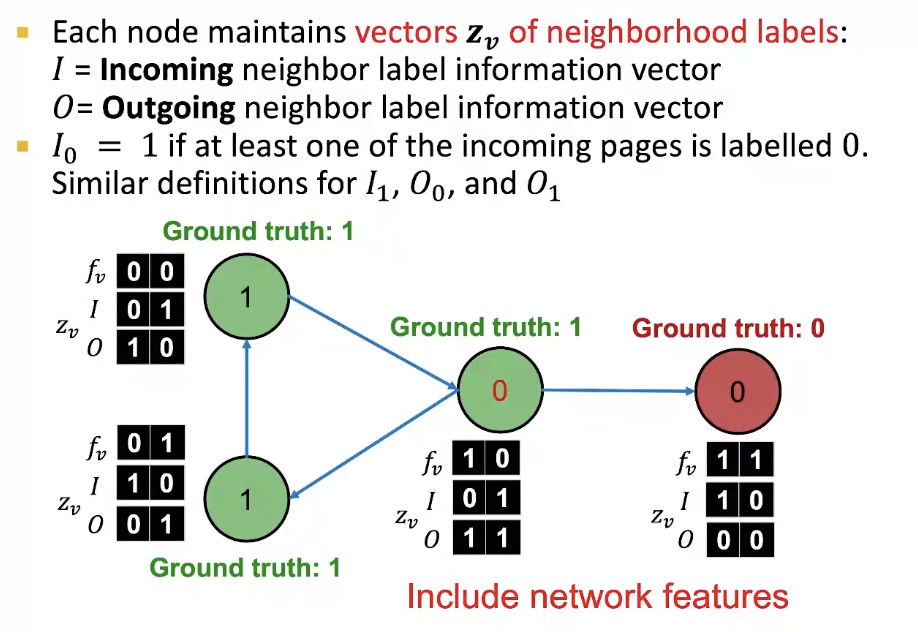
Iterative Classifer - Step1
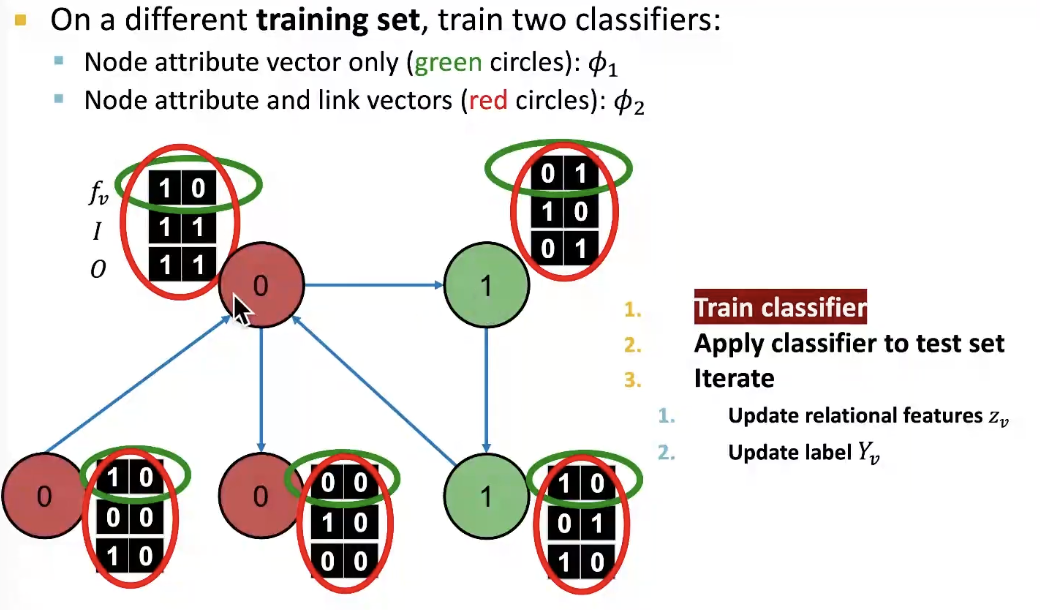
Iterative Classifer - Step2
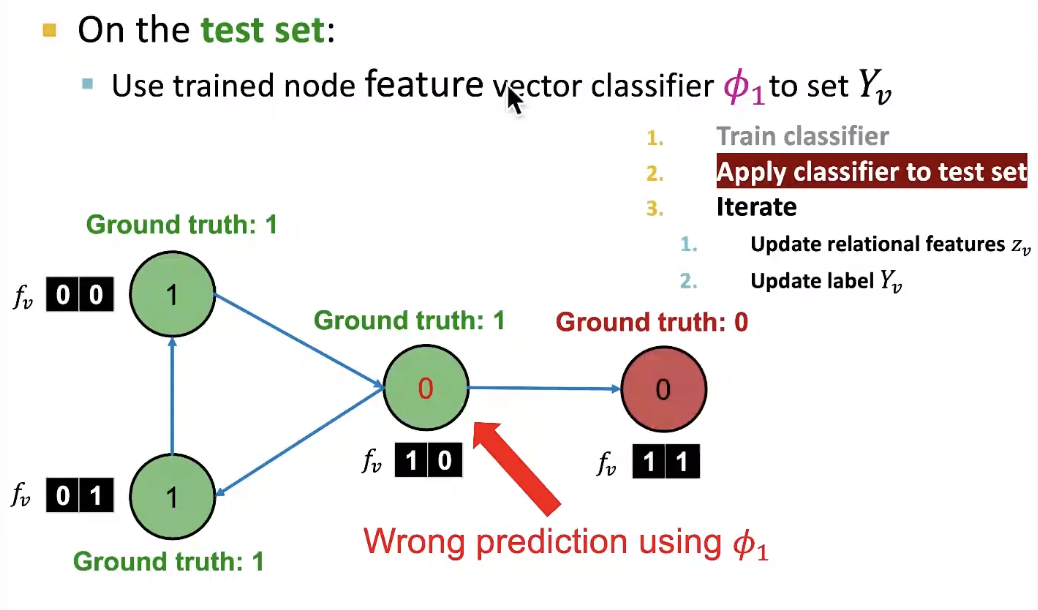
Iterative Classifer - Step3
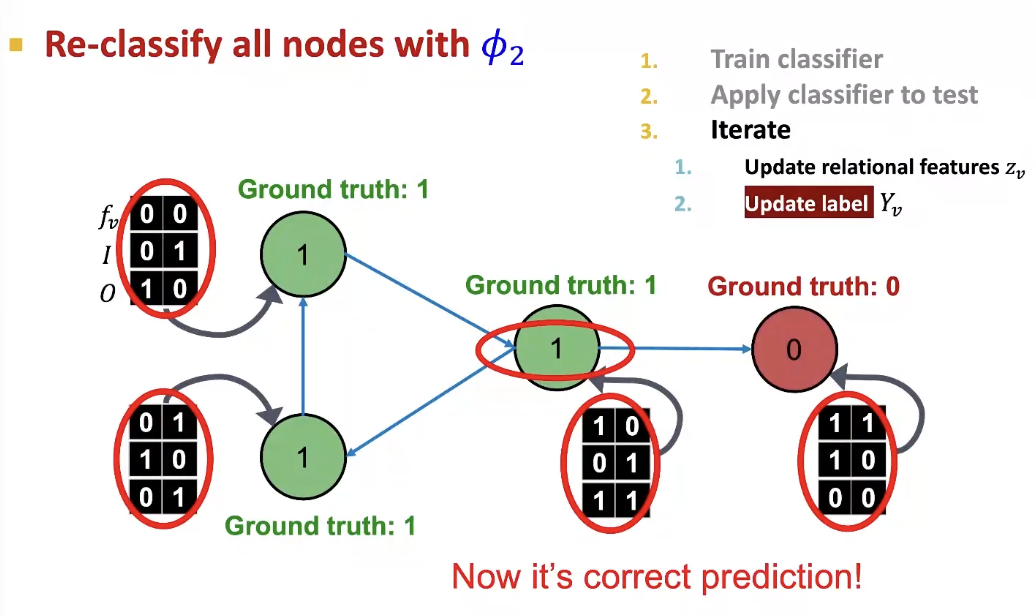
Iterate
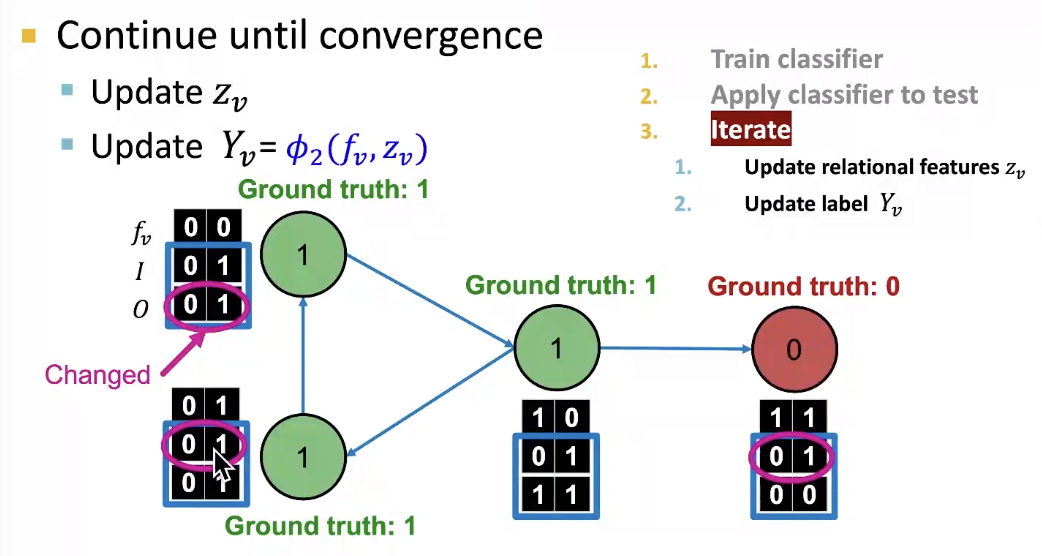
Final Prediction
Collective Classification: Belief Propagation
Loopy Belief Propagation
- Belief Propagation is a dynamic programming approach to answering probability queries in a graph
- Iterative process in which neighbor nodes "talk" to each other, passing messages
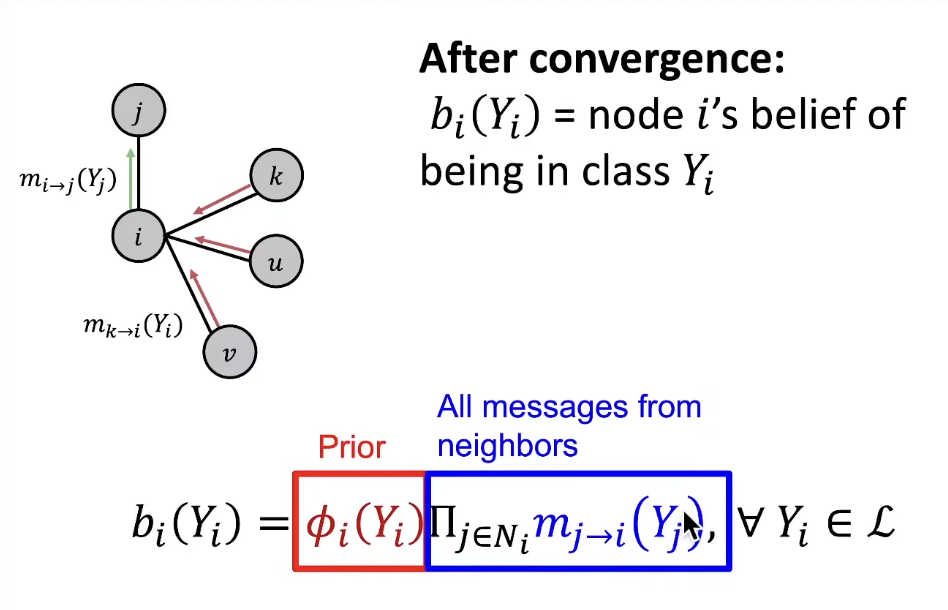
- When consensus is reached, calculate final belief
Message Passing: Basics
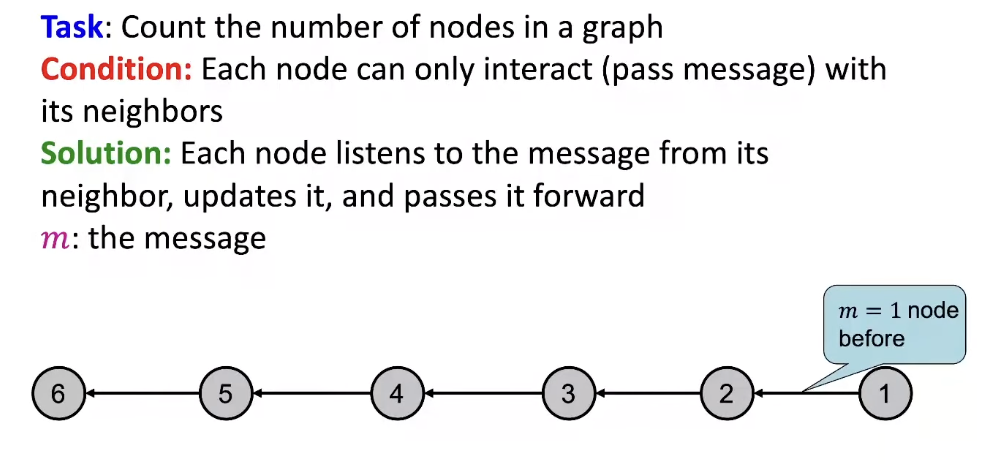
- Task: Count the number of nodes in a graph
- Condition: Each node can only interact (pass message) with its neighbors
- Example: path graph
Message Passing: Algorithm
- Task: Count the number of nodes in a graph
- Algorithm
- Define an ordering of nodes (that results in a path)- Edge directions are according to order of nodes
- Edge direction defines the order of message passing
- For node i from 1 from 6
- Compute the message from node i to i+1 (number of nodes counted so far)
Pass the message from. node i to i+1
- Compute the message from node i to i+1 (number of nodes counted so far)
- Edge directions are according to order of nodes
Generalizing to a Tree
- We can perform message passing not only on a path graph, but alos on a tree-structured graph
- Define order of message passing from leaves to root
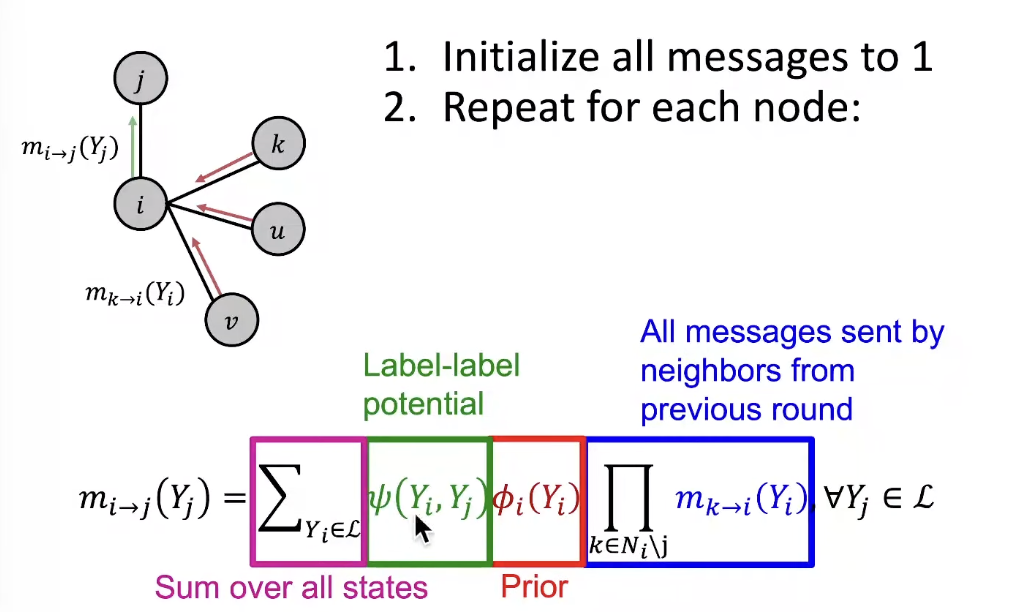
Loopy BP Algorithm
What message will i send to j?
- It depends on what i hears from its neighbors
- Each neighbor passes a message to i its beliefs of the state of i
Notation
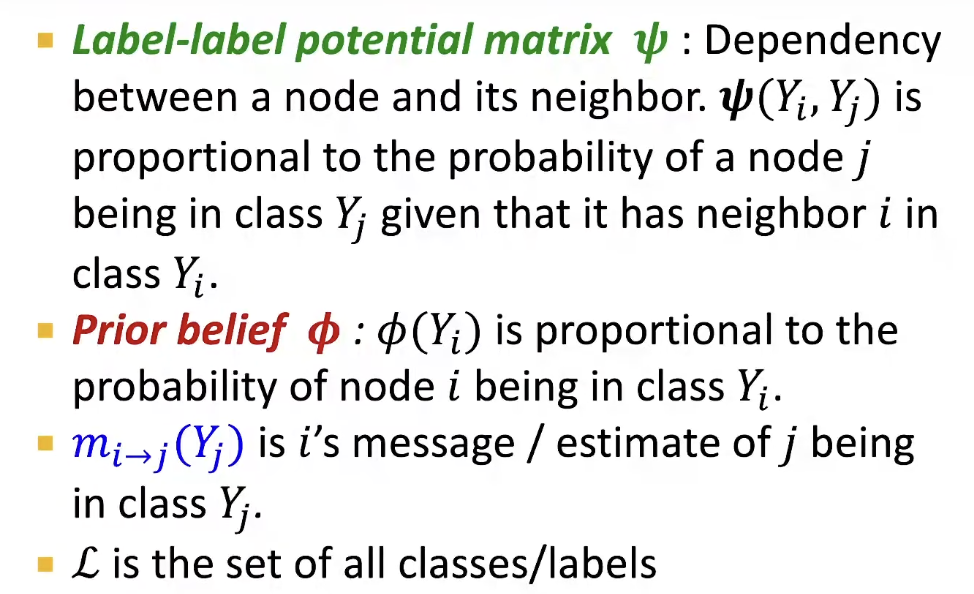
- Label-label potential matrix
- Prior belief
Loopy Belief Propagation
- Now we consider a graph with cycles
- There is no longer an ordering of nodes
- We apply the same algorithm as in previous slides:
- Start from arbitrary nodes- Follow the edges to update the neighboring nodes
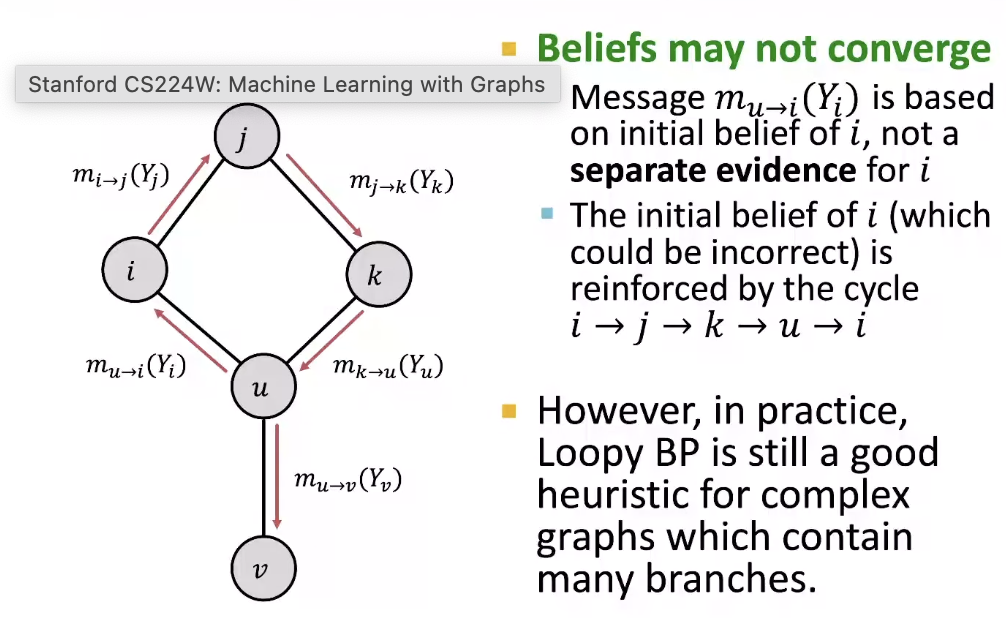
- 만약 graph에 cycle이 존재한다면? no longer independent!!!!, 알고리즘을 적용할 수는 있으나 메세지가 cycle 안에 돌고 돌 것이다.
What Can Go Wrong?
Advantages of Belief Propagation
- Advantages
- Easy to program & parallelize- General: can apply to any graph model with any form of potentials
- Potential can be higher order
- General: can apply to any graph model with any form of potentials
- Challenges
- Convergence is not guaranteed (when to stop), especially if many closed loops - Potential functions (parameters)
-Require training to estimate