https://ocw.mit.edu/courses/18-06-linear-algebra-spring-2010/video_galleries/video-lectures/
먼저 다음과 같이 정리를 하고, 이후 증명을 한다.
dim(row space):r
dim(N(A)):n−r
1. row space and N(A) are orthogonal.
dim(column space):r
dim(N(AT)):m−r
2. column space and N(AT) are orthogonal.
이를 위해 먼저 orthogonal vector에 대해서 알아보자.
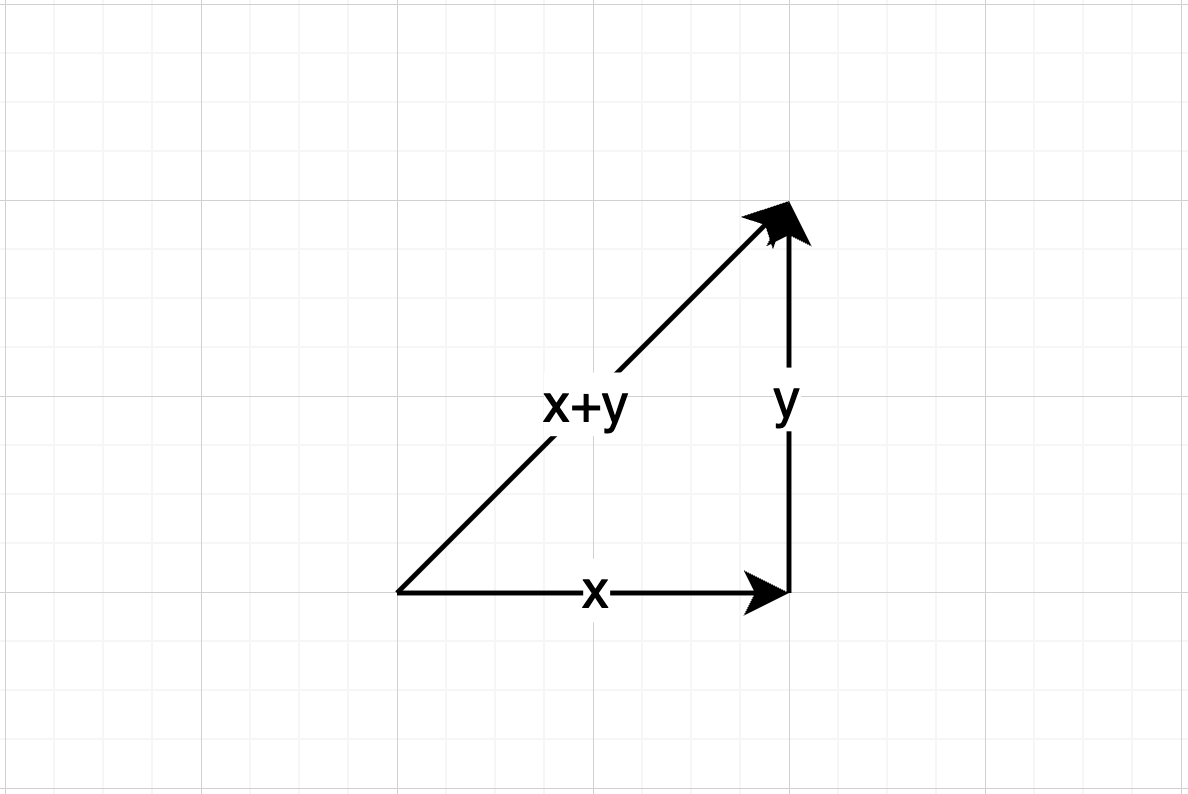
위와 같이 벡터 x, y 그리고 x+y가 있다고 해보자. 그림과 같이 벡터 x와 벡터 y는 직교(orthgonal)한다.
- 이를 피타고라스법으로 증명해보자.
- ∣∣x∣∣2+∣∣y∣∣2=∣∣x+y∣∣2 식이 나올 것이다.
- 그리고 ∣∣x∣∣는 벡터식으로 표현하면 다음과 같다. ∣∣x∣∣2=xTx
- 따라서 위 식을 벡터로 표현하면, 아래와 같다.
xTx+yTy=(x+y)T(x+y)=xTx+xTy+yTx+yTy
- 위 벡터식을 정리하면, xTy+yTx=2xTy=0이 되어,
xTy=0이라는 결과를 얻을 수 있다.
따라서 두 벡터 x,y에 대해서, xTy=0이라면 두 벡터는 직교한다고 볼 수 있다.
예시를 들어서 해보자.
x=⎣⎢⎡123⎦⎥⎤,y=⎣⎢⎡2−10⎦⎥⎤,x+y=⎣⎢⎡313⎦⎥⎤
∣∣x∣∣2=1+4+9=14
∣∣y∣∣2=4+1+0=5
∣∣x+y∣∣2=9+1+9=19=∣∣x∣∣2+∣∣y∣∣2
그렇다면 "orthogonal subspaces"는 무엇일까? 다음과 같이 정의를 내린다.
Subspace S is orthogonal to subspace T.
→Every vecotr in S is orthogonal to every vector in T.
그리고 직교하는 두 subspace S, T는 유일하게 0에서만 만난다.
다음으로 "row space is orthogonal to null space"에서 대해서 증명해보자.
⎣⎢⎢⎢⎢⎢⎡row1 of Arow2 of A..rowm of A⎦⎥⎥⎥⎥⎥⎤⎣⎢⎢⎢⎡x1..xk⎦⎥⎥⎥⎤=⎣⎢⎢⎢⎢⎢⎡00..0⎦⎥⎥⎥⎥⎥⎤
- 위에서 null space N(A)는 벡터 x들의 모든 조합을 의미한다. 그리고 벡터 x는 A의 row와 dot product를 하면 결과가 0이 나오게 된다. ( [row1 of A]⎣⎢⎢⎢⎡x1..xk⎦⎥⎥⎥⎤=0 )
따라서 row와 x가 서로 직교함을 알 수가 있고, 이에 따라 row space와 null space는 서로 직교한다고 볼 수 있다.
orthgonal 내용이 끝나고 강의에서 다음과 같은 질문을 던진다.
solve Ax=b when there is no solution.
즉, Ax=b의 솔루션이 없을 때 최적의 솔루션을 구하라는 의미이다. 어떻게 구할 수 있을까?
먼저, ATA에 대해서 생각해보자 (A:m×n). 이를 통해 추론이 가능한 점은 다음과 같다.
- ATA는 square matrix다. An×mTAm×n→?n×n
- ATA는 symmetric matrix다. (ATA)T=ATATT=ATA
그래서 위 조건을 이용해서, 강의에서는 최적의 솔루션은 다음과 같다고 한다.
ATAx^=ATb
x^ is best solution.
그리고 다음과 같은 정리도 가능하다.
N(ATA)=N(A)
rank(ATA)=rank(A)
ATA is invertible exactly if A has independent columns.
예시와 함께 보자.
A1=⎣⎢⎡111125⎦⎥⎤,A2=⎣⎢⎡111333⎦⎥⎤
A1TA1=[111215]⎣⎢⎡111125⎦⎥⎤=[38830]
A2TA2=[131313]⎣⎢⎡111333⎦⎥⎤=[39927]
- 위 정리와 같이 A1과 A2은 각각 A1TA1과 A2TA2와 같은 null space와 같은 rank를 가지는 것을 확인할 수 있다.
- independent columns만 있는 A1에 대해서 A1TA1도 independent columns만 있다.
따라서 invertible이다.
- 반면에 dependent column이 있는 A2에 대해서 A2TA2도 dependent column만 있다.
따라서 not invertible이다.