lower_bound
- 이진탐색 기반의 탐색 방법
- 찾고자 하는 key 값이 없으면 key 값보다 큰 가장 작은 정수(크면서 가장 가까운) 값을 찾는다.
arr[mid-1] < key && arr[mid] >= key인 mid를 찾는다.
// 벡터는 (오름차순)정렬되어 있어야 함.
int lower_bound(const vector<int>& vec, int start, int end, int key) {
    int ret = vec.size();


    while (start <= end) {
        int mid = (start + end) / 2;

        //if (vec[mid] == key)
        //    return mid;
        // 벡터에 key가 중복되게 존재할 수 있음.
        //else if (vec[mid] > key) {
        if(vec[mid] >= key){
            ret = mid;
            end = mid - 1;
        }
        else
            start = mid + 1;
    }

    return ret;
}
upper_bound
- 이진탐색 기반의 탐색 방법
찾고자 하는 key 값이 없으면
key 값보다 큰 가장 작은 정수(크면서 가장 가까운) 값을 찾는다.
=> key 값을 초과하는 숫자가 배열 몇 번째에서 처음 등장하는지 탐색arr[mid-1] <=key && arr[mid] > key인 mid를 찾는다.
int my_upper_bound(const vector<int>& vec, int start, int end, int key) {
    int ret = vec.size();

    while (start <= end) {
        int mid = (start + end) / 2;

        if (vec[mid] == key)
            start = mid + 1;
        else if (vec[mid] > key) {
            ret = mid;
            end = mid - 1;
        }
        else
            start = mid + 1;
    }

    return ret;
}
예제
백준(3020): 개똥벌레
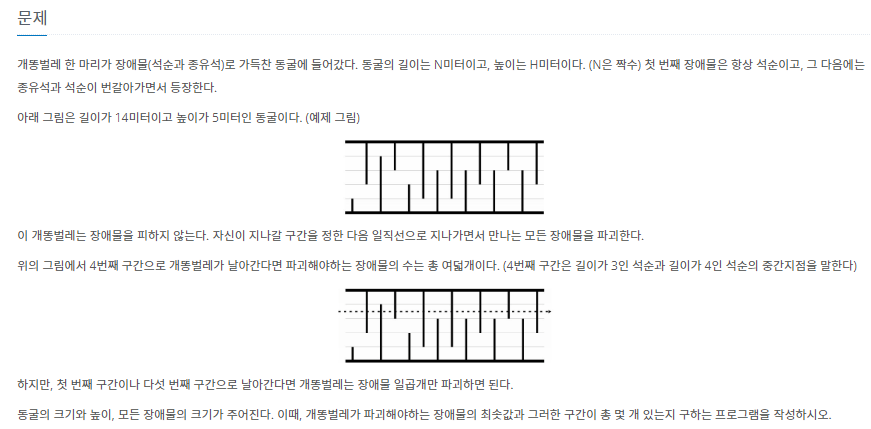
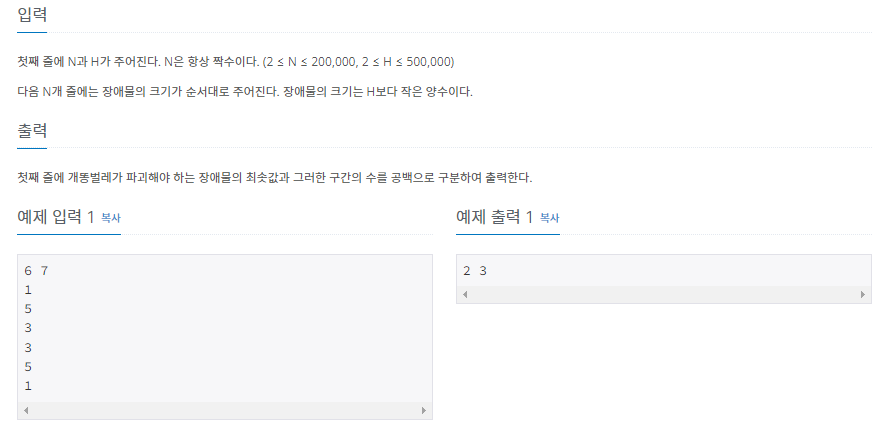
#include <iostream>
#include <vector>
#include <algorithm>

using namespace std;

int N, H;


int my_lower_bound(const vector<int>& vec, int start, int end, int key) {
    int ret = vec.size();


    while (start <= end) {
        int mid = (start + end) / 2;

        //if (vec[mid] == key)
        //    return mid;
        // key가 중복되게 나올 수 있다..
        //else if (vec[mid] > key) {
        if(vec[mid] >= key){
            ret = mid;
            end = mid - 1;
        }
        else
            start = mid + 1;
    }

    return ret;
}

int my_upper_bound(const vector<int>& vec, int start, int end, int key) {
    int ret = vec.size();

    while (start <= end) {
        int mid = (start + end) / 2;

        if (vec[mid] == key)
            //return mid;
            start = mid + 1;
        else if (vec[mid] > key) {
            ret = mid;
            end = mid - 1;
        }
        else
            start = mid + 1;
    }

    return ret;
}

pair<int, int> solution(vector<int>& bottom, vector<int>& top) {
    int minContactNum = 1e9;
    int cnt = 0;

    sort(bottom.begin(), bottom.end());
    sort(top.begin(), top.end());

    for (int nowH = 1; nowH <= H; nowH++) {
        // 내가 구현한 lower_bound, upper_bound 함수 사용

        int contactBottomNum = (N / 2) - my_lower_bound(bottom, 0, N / 2 - 1, nowH);
        int contactTopNum = (N / 2) - my_upper_bound(top, 0, N / 2 - 1, H - nowH);

        // 표준 라이브러리 제공 lower_bound, upper_bound 함수 사용
        //int contactBottomNum = (N / 2) - (lower_bound(bottom.begin(), bottom.end(), nowH) - bottom.begin());
        //int contactTopNum = (N / 2) - (upper_bound(top.begin(), top.end(), H-nowH) - top.begin());

        int totalContactNum = contactBottomNum + contactTopNum;

        if (minContactNum > totalContactNum) {
            minContactNum = totalContactNum;
            cnt = 1;
        }
        else if (minContactNum == totalContactNum) {
            cnt++;
        }
    }

    return { minContactNum, cnt };
}


int main() {

    cin >> N >> H;

    vector<int> bottom(N / 2);
    vector<int> top(N / 2);

    for (int i = 0; i < N / 2; i++) {
        cin >> bottom[i];
        cin >> top[i];

    }

    pair<int, int> result = solution(bottom, top);
    cout << result.first << " " << result.second << endl;
    return 0;

}