Conditioning and Bayes’ Rule
Idea of conditioning
- “새로운 sample space와 probability rule”을 도입하는 것
- event A가 발생했다 → event B가 발생했을 때, event A가 발생했다.
- sample space : Ω → B
- probability rule : P(A) → P(A|B)
Definition of conditional probability
- P(A|B) : probability of A, given that B occured
- P(A∣B)=P(B)P(A∩B) (P(B)>0)
Conditional probabilities obey the same axioms
- P(A∣B)≥0
- P(Ω∣B)=P(B)P(Ω∩B)=P(B)P(B)=1
- P(A∪C∣B)=P(A∣B)+P(C∣B)
Conditional probabilities: Probability law
- all general properties of probability laws remain valid
Using conditional probability for modeling
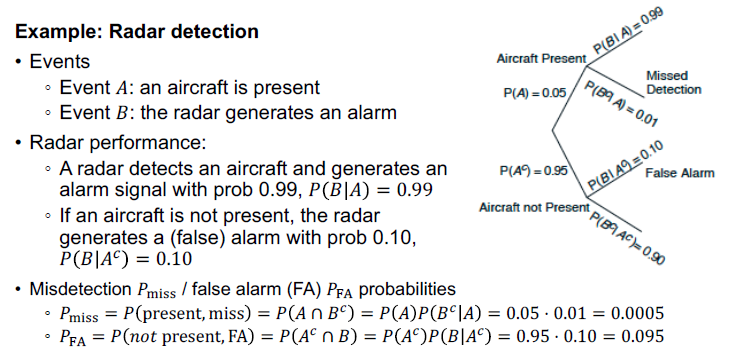
Multiplication rule
- P(A∩B)=P(A∣B)P(B)
- chain rule
Total probability theorem
- 특정 event의 확률을 그 event가 포함된 partition들과 그 event의 intersections의 union으로 표현
- P(B)=Σi=1nP(Ai)P(B∣Ai)
Bayes’ rule
- P(Ai∣B)=P(B)P(Ai∩B)=ΣjP(Aj)P(B∣Aj)P(Ai)P(B∣Ai)
Bayes’ rule and inference
- A가 cause, B가 effect라고 하자.
- 모델의 접근 : P(B|A)를 구해 A가 발생했을 때 B가 일어날 확률을 구한다
- Bayesian inference의 접근 : P(A|B)를 구해 B를 관찰했을 때 그것이 A로 인했을 확률을 구해 B의 원인을 추론한다.