Set
- collections of objects
- x가 S의 원소일 경우
- x가 S의 원소가 아닐 경우
- Empty set : 원소가 없는 집합
- Universal set : 모든 원소를 가진 집합
- Finite set
- Infinite set
- Countable infinite set
- Uncountable infinite set
- Subset
- : S의 모든 원소가 T에도 존재
- 이면 S = T
- Other basics : 생략
Probabilistic Models
- Probabilistic model : 어떤 experiment에서 uncertain situation에 대한 수학적 해석
- Elements of a probabilistic model
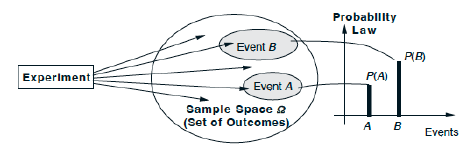
- Sample space : experiment에서 나올 수 잇는 모든 가능한 결과들의 집합
- Probability law : outcome의 set인 “event”에 nonnegative number인 “probability”를 매핑하는 rule 또는 function
Sample space
- must be…
- mutually exclusive
- collectively exhaustive
- at the “rigtht” granularity
- can be discrete or continuous
- can be finite or infinite
Probability law and axioms
- Event : a subset of the sample space
- Probability law : 모든 Event A에 P(A)를 assign하는 function으로 생각할 수 있다.
- 3 axioms of probability
- Nonnegativity :
- Normalization :
- Additivity : , then
- Probability law from aximos
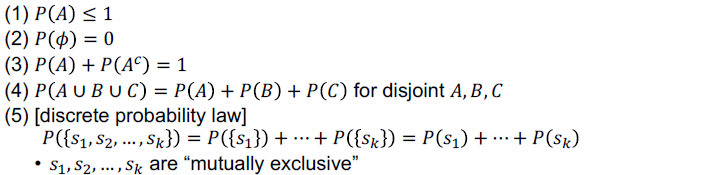
- 각 확률법칙 증명해보기
Measurement of probability
- Discrete uniform probability : 가 n개의 같은 확률의 element로 구성되어 있다고 하면, 또 A가 k개의 element로 구성되어 있다고 하면 P(A) = k/n으로 계산할 수 있다.
- Continuous probability : relatvie area의 면적으로 계산할 수 있다.
Probability calculation steps
- Specify the sample space
- Specify a probability law
- Identify an event of interest
- Calculate the probability of the event of interest
Countable additivity axiom
- additivity axiom을 “countable infinite sequence”에 대해 확장 할 수 있다.
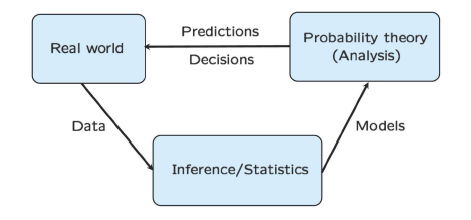
The role of probability theory
- non-deterministic한 outcome을 분석할 수 있는 framework 제공
- prediction(estimation) 그리고 decision(classification)에 이용됨