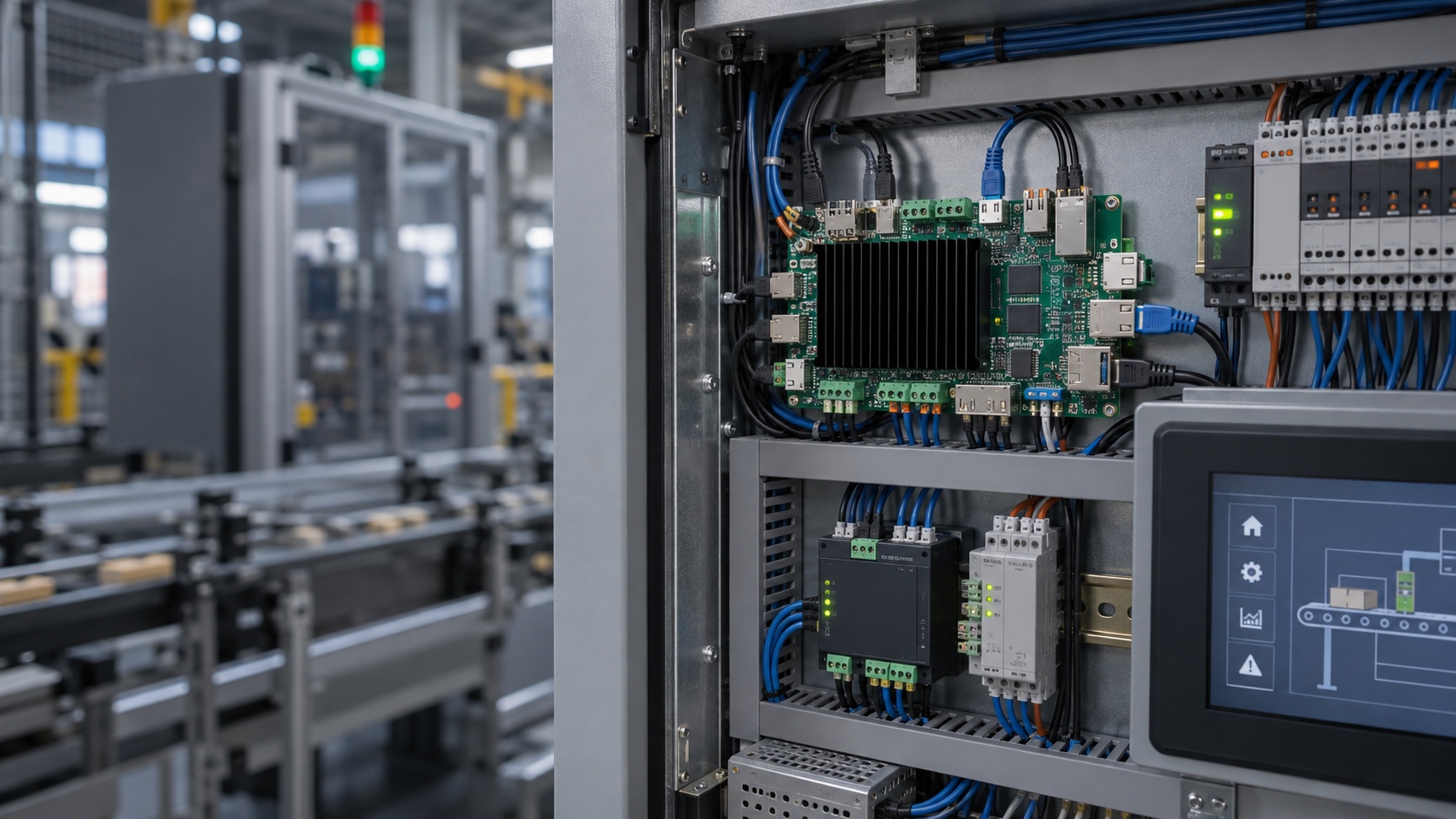
The Rockchip RK3566 is better known as an application processor for tablets, smart displays, and compact multimedia equipment. Yet the same characteristics that make it useful in consumer products—moderate power consumption, capable graphics, flexible display outputs, and a broad peripheral set—also make it a reasonable platform for certain industrial systems.
The important word is “certain.” An RK3566 board is not a direct replacement for a PLC, safety controller, or deterministic motion system. Its natural role is higher in the control architecture. It can run an operator interface, collect production data, translate protocols, manage files, display camera images, and communicate with plant or cloud services.
Used within those limits, the RK3566 can be a cost-effective foundation for an industrial HMI, equipment terminal, small gateway, or supervisory controller.
Understanding the RK3566 Platform
The RK3566 contains four 64-bit Arm Cortex-A55 CPU cores. These cores provide enough performance for Linux and Android applications without the thermal demands of a higher-end desktop-class processor.
Graphics are handled by a Mali-G52-2EE GPU. The SoC also contains video decoding, video encoding, image-processing, display, storage, networking, and general-purpose peripheral blocks.
A small neural processing unit is included for compatible machine-learning workloads. Its advertised performance is up to 1 TOPS, although real application speed depends on model structure, numerical format, memory traffic, and Rockchip’s conversion tools.
| RK3566 subsystem | Main capability | Possible industrial use |
|---|---|---|
| CPU | Four Cortex-A55 cores | HMI software, databases, communications, and local services |
| GPU | Mali-G52-2EE | Graphical controls, charts, transitions, and video presentation |
| NPU | Up to 1 TOPS | Basic image classification and lightweight edge inference |
| Video decoder | Hardware decoding up to 4K-class formats | Camera playback, instructions, and digital signage |
| Video encoder | Hardware-assisted 1080p encoding | Recording and remote video transmission |
| Display engine | HDMI, eDP, MIPI-DSI, LVDS-related, RGB, and e-paper support | Operator terminals and specialized panels |
| Camera input | MIPI-CSI and parallel camera support | Inspection cameras and identification terminals |
| Storage | eMMC, SD, NAND, and serial flash options | Operating system, logs, recipes, and production data |
| Network | One Gigabit Ethernet MAC | PLC communication, factory networking, and remote management |
| Expansion | USB, PCIe, SATA-related capability, UART, SPI, I2C, PWM, and GPIO | Storage, wireless modules, serial equipment, and local peripherals |
These are processor-level capabilities. A finished SBC may expose only a subset of them. Before selecting a board, engineers must check its schematic, connector assignments, voltage levels, and operating-system support.
A Sensible Role in Machine Control
A modern production machine often contains several processors. A PLC executes sequence logic. A safety controller supervises emergency stops and guards. Servo drives close motor-control loops. An application processor handles the interface, data, and network services.
The RK3566 fits best in the final category.
Consider a filling machine with twelve stations. The PLC controls valves, conveyor movement, sensors, and reject mechanisms. An RK3566 HMI shows machine status, stores product recipes, records alarms, and sends production totals to a factory server.
If the HMI restarts, the PLC still knows the physical state of the machine. It can complete a safe stop or continue an allowed sequence. The Linux system does not sit directly in the path of a critical valve-closing deadline.
| Function | Recommended controller | Reason |
|---|---|---|
| Emergency-stop circuit | Certified safety controller | Safety must not depend on Linux or Android |
| Motion and servo timing | PLC or motion controller | Requires deterministic execution |
| Fast sensor acquisition | MCU, FPGA, or PLC | Needs controlled sample timing |
| Operator interface | RK3566 | Benefits from GPU and modern UI frameworks |
| Recipe and user management | RK3566 | Easier with structured storage and application software |
| Alarm history | RK3566 | Well suited to databases and timestamps |
| Machine vision preview | RK3566 | Uses camera, display, and multimedia hardware |
| Cloud or MES connection | RK3566 | Supports encryption and modern network libraries |
| Safety interlocking | Safety PLC | Requires verified failure behavior |
The separation should be reflected in the communication protocol. Commands from the RK3566 should be treated as requests, not direct proof that an action occurred. The HMI should display “Running” only after the PLC reports that the machine entered the running state.
Linux Is Not Automatically Real Time
The RK3566 can run Linux, but a standard Linux system does not provide hard real-time guarantees. The scheduler may delay an application while the kernel handles storage, networking, memory management, or another interrupt.
This does not mean Linux is always slow. Most of the time, response can be very fast. The problem is the worst-case delay, which may be difficult to guarantee.
A real-time kernel configuration can improve scheduling behavior, but it does not turn the entire board into a certified control platform. Device drivers, shared buses, thermal throttling, and application design still affect timing.
For time-sensitive tasks, a separate microcontroller is often easier to validate. The MCU can handle I/O scanning, pulse measurement, watchdog functions, or communication timing. The RK3566 communicates with it through a clearly defined interface.
This architecture also simplifies recovery. The low-level controller can put outputs into a known state while the RK3566 boots or installs an update.
Industrial HMI Design
The RK3566 is especially attractive for products centered on a display. It supports several display technologies and has enough graphics capability for a responsive interface.
Android may suit products whose workflow resembles a tablet application. It provides mature touch handling, layout tools, multimedia services, and application lifecycle management.
Linux offers more freedom over system services, networking, storage, and startup behavior. Interfaces may be built with Qt, Wayland, GTK, or browser technology. Linux is often the better option for equipment that combines an HMI with gateway or server functions.
Display support must be verified on the intended board and BSP. A connector labeled LVDS or MIPI does not guarantee compatibility with every panel. Engineers still need to confirm:
- Resolution and pixel clock
- Lane or channel configuration
- Color mapping and bit depth
- Backlight voltage and current
- Panel initialization commands
- Touch-controller interface
- Screen rotation
- Suspend and resume behavior
- Graphics acceleration
A working boot logo is not enough. The final application should be tested for several hours with charts, screen changes, video, touch input, and background communication running together.
Field I/O Requires More Than GPIO
The RK3566 includes UART, SPI, I2C, PWM, ADC, and GPIO resources. These signals operate at semiconductor logic levels and are not automatically suitable for factory wiring.
A UART pin cannot be connected directly to an RS-485 device. The product needs an RS-485 transceiver and may also require termination, biasing, surge protection, and galvanic isolation.
The same applies to CAN. Some boards advertise CAN support when they expose only controller-level signals. A physical-layer transceiver is still required.
GPIO inputs are typically designed for low-voltage logic. A 24 V proximity sensor needs level conversion and protection. Outputs that drive relays or solenoids require suitable transistor or driver circuits.
An industrial carrier board should answer practical questions:
- What voltage can each input tolerate?
- Is reverse polarity protected?
- Are serial and CAN ports isolated?
- How are RS-485 termination resistors selected?
- What happens during an ESD event?
- Are outputs protected against inductive loads?
- Can damaged field wiring reach the RK3566 directly?
- Does the Linux driver expose the interface through a standard API?
For equipment installed near motors and inverters, isolation is not an optional cosmetic feature. It helps prevent ground-current and common-mode problems that may never appear on the laboratory bench.
Ethernet Architecture
The RK3566 provides one Gigabit Ethernet MAC. This is enough for an HMI, single-network gateway, or connected terminal.
Some industrial products need two separate Ethernet networks. One port may connect to the machine PLC, while another connects to the factory network. In that case, the board needs an additional Ethernet controller through USB or PCIe.
Two connectors connected to a simple Ethernet switch are not equivalent to two independent interfaces. A switch can support line or daisy-chain wiring, but it does not create separate security zones or routing paths.
The network architecture should be decided before the SBC is chosen. Engineers should also test:
- Cable removal and reconnection
- Switch restart
- Duplicate IP addresses
- DHCP-server loss
- High broadcast traffic
- Server unavailability
- Long offline periods
- Reconnection after suspend
- Recovery after driver errors
The HMI should mark disconnected values as invalid. Leaving the last value on screen without an age indicator can mislead an operator.
Managing Storage and Power Loss
Industrial equipment is often switched off at the main disconnect. Linux may not receive enough time to shut down before the supply disappears.
If the system is writing a database, log, configuration file, or filesystem metadata, sudden power loss can damage data. Repetition makes the risk more serious.
Soldered eMMC is normally preferable to an ordinary removable microSD card. It offers better mechanical stability and more controlled performance. However, eMMC still has a finite write lifetime and can still be corrupted.
A robust software design may include:
- A read-only root filesystem
- A separate writable data partition
- Transactional database writes
- Atomic configuration updates
- Log rotation and storage limits
- A validated backup configuration
- A/B system partitions
- A recovery image or service mode
A hardware power-failure signal can give the system time to finish essential writes. A supercapacitor or backup supply may provide the required hold-up energy.
The design must be measured under realistic load. CPU activity, USB storage, Ethernet, and maximum display brightness can change the shutdown time available from the same capacitor.
Power interruption testing should be automated if possible. Interrupt the supply during boot, normal logging, database updates, and firmware installation. Hundreds of cycles reveal more than one careful manual test.
Flash Endurance and Logging
A control terminal may operate continuously for years. Small, frequent writes can create a large cumulative load on the storage device.
Writing a status record every second produces more than 31 million records per year. System logs, database journals, temporary files, and application caches add further writes.
Not every measured value needs to be stored individually. The software may log only changes, combine samples into batches, or save minimum, maximum, and average values over an interval.
Debug logging should not remain unlimited in production. Logs need file-size limits, retention periods, and behavior for low-storage conditions.
The application should also handle a full data partition without crashing. It may stop recording nonessential information, raise an alarm, or delete data according to a defined policy. Allowing the root filesystem to become full can interfere with unrelated services.
Thermal Design Inside the Enclosure
The RK3566 is efficient enough for many fanless products, but efficiency does not eliminate heat. The processor, memory, power regulators, eMMC, display backlight, and wireless modules all contribute to enclosure temperature.
A board operating in open air may behave differently behind an LCD or inside a sealed steel panel. Once the SoC reaches a thermal threshold, Linux reduces CPU or GPU frequency.
The system may not crash. Instead, the HMI becomes slow after an hour, video frames drop, or an inference task takes longer than expected.
Thermal validation should include the actual enclosure, maximum ambient temperature, and realistic workload. Run graphics, Ethernet, storage, CPU, and NPU activity together until temperatures stop rising.
A heatsink only transfers heat into the surrounding environment. If air cannot move, coupling the processor to a metal chassis may be more effective. Thermal pad thickness, flatness, mounting pressure, and production tolerances affect the result.
Fans add airflow but also introduce noise, dust, maintenance, and mechanical wear. A fanless thermal path is normally preferable when the power budget permits it.
Practical Use of the NPU
The RK3566 NPU can accelerate supported machine-learning operations. Possible industrial uses include simple object recognition, occupancy detection, product classification, and basic anomaly screening.
The 1 TOPS rating is not an application benchmark. It describes theoretical arithmetic throughput under particular conditions.
Actual results depend on:
- Supported neural-network operations
- Model conversion quality
- INT8 or other quantization
- Input image resolution
- Preprocessing time
- Memory bandwidth
- CPU fallback
- NPU runtime and BSP versions
A model containing unsupported operators may partly run on the CPU, reducing performance. Engineers should convert and benchmark the real model before committing to the hardware.
Camera capture, image resizing, color conversion, inference, and result processing must all be measured. Quoting only NPU execution time can hide a slow system pipeline.
The RK3566 is appropriate for modest edge-AI tasks. Multiple high-resolution camera streams or a large detection model may require a more powerful processor.
BSP Quality Is Part of the Hardware
An RK3566 board depends on its board support package. The BSP contains the bootloader, Linux kernel, device tree, graphics drivers, video libraries, camera support, NPU runtime, and build configuration.
Two boards using the same SoC can provide very different development experiences. One vendor may supply complete sources and clear build instructions. Another may provide only an old binary image.
Before approving a board, build the full system from a clean environment. This exercise often exposes missing repositories, undocumented binary files, obsolete toolchains, and scripts that depend on one developer’s computer.
The project should archive:
- Bootloader source and configuration
- Kernel source and patches
- Device-tree files
- Graphics and multimedia libraries
- NPU tools and runtime packages
- Root-filesystem configuration
- Factory flashing tools
- Partition definitions
- Recovery procedures
- Release notes for every production image
A vendor kernel may offer better multimedia support than mainline Linux. A more standard kernel may be easier to maintain but lack complete support for a camera, GPU, or video block. The right choice depends on the features the product genuinely needs.
Security and Remote Maintenance
The RK3566 provides hardware features that can contribute to product security, including secure boot, TrustZone, cryptographic functions, OTP storage, and debug controls.
These features need a complete operational plan. Secure boot requires protected signing keys, trusted factory programming, and a recovery method. A product is not secure merely because the processor supports the feature.
Field devices should use unique credentials and encrypted network communication. Unused services, development accounts, and open debugging interfaces should be removed from the production image.
Remote updates should be signed and resistant to interrupted power. An A/B layout allows the new image to be installed separately from the active system. If the new version fails its health check, the bootloader can return to the previous image.
Update testing should include damaged downloads, invalid signatures, full storage, network interruption, and power loss. The failure path is at least as important as a successful installation.
Choosing the Board, Not Just the Processor
The final product uses an SBC or system-on-module, not a bare block diagram. Board-level design determines the actual industrial value.
| Evaluation area | What to verify |
|---|---|
| Power input | Voltage range, reverse polarity, surge protection, and brownout behavior |
| Memory | Capacity, type, bandwidth, and supplier change control |
| Storage | eMMC grade, endurance, capacity, and health monitoring |
| Ethernet | PHY quality, isolation, connector protection, and driver recovery |
| Serial ports | Transceivers, isolation, termination, and Linux access |
| Display | Panel compatibility, backlight driver, touch, and suspend recovery |
| Thermal design | Sustained performance in the final enclosure |
| BSP | Reproducible build, source availability, and maintenance policy |
| Security | Secure boot, key provisioning, update signing, and debug lockout |
| Lifecycle | Board availability and notification before component changes |
| Support | Ability to investigate hardware, kernel, and driver problems |
A well-designed RK3566 board with stable software, protected I/O, industrial power input, RTC, and qualified eMMC may be a stronger product choice than a faster processor on a minimally supported development board.
RK3566 or a More Industrial-Oriented SoC?
The RK3566 shares much of its application-processing foundation with the RK3568, but the devices are aimed at somewhat different integration needs.
The RK3566 is attractive for display-oriented terminals, smart equipment, single-network HMIs, multimedia controllers, and cost-sensitive gateways. It provides plenty of capability when the board adds the required industrial interfaces.
A project needing multiple native Ethernet paths, specialized field connectivity, or a more extensive industrial bus arrangement may find the RK3568 or another processor easier to integrate.
The decision should be made at system level. Adding several external controllers to compensate for missing interfaces may eliminate the original cost advantage. On the other hand, paying for unused processor features also makes little sense.
Preproduction Tests That Reveal Real Problems
A production candidate should be tested under inconvenient conditions, not only while everything is connected correctly.
Useful tests include:
- Repeated cold and warm startup
- Power removal during storage writes
- Interrupted system updates
- Ethernet cable and switch disconnection
- Long operation with the data partition nearly full
- Maximum CPU, GPU, NPU, and display load
- Serial communication near active motors and drives
- USB-device removal during operation
- Touch use with electrical noise present
- Watchdog recovery from frozen processes
- Low input voltage and short brownouts
- Operation at maximum enclosure temperature
The PLC or MCU should remain safe while the RK3566 is rebooting or unavailable. After recovery, the application should read the current machine state instead of assuming that earlier commands were completed.
Conclusion
The Rockchip RK3566 is a useful industrial application processor when its responsibilities are chosen carefully. It provides enough CPU performance for Linux or Android, capable display and multimedia hardware, a modest NPU, Gigabit Ethernet, storage interfaces, and flexible peripheral options.
Its strongest applications are HMIs, equipment terminals, data collectors, smart appliances, camera-enabled controls, and light edge gateways. It is less suitable as the sole controller for safety functions, strict motion timing, or applications requiring several native industrial network interfaces.
A successful RK3566 design depends less on the headline processor specification than on the complete platform. Power protection, isolated I/O, eMMC endurance, thermal management, BSP ownership, secure updates, and long-term board supply determine whether the system remains dependable in the field.
Used as the application layer above a PLC or dedicated controller, the RK3566 can deliver a modern interface and connected services without placing critical control behavior inside a general-purpose operating system. That division of work is usually the difference between an impressive prototype and a maintainable industrial product.