1037. Minimum Number of K Consecutive Bit Flips
Hard
You are given a binary array nums and an integer k.
A k-bit flip is choosing a subarray of length k from nums and simultaneously changing every 0 in the subarray to 1, and every 1 in the subarray to 0.
Return the minimum number of k-bit flips required so that there is no 0 in the array. If it is not possible, return -1.
A subarray is a contiguous part of an array.
Example 1:
 Input: nums = [0,1,0], k = 1
 Output: 2
 Explanation: Flip nums[0], then flip nums[2].
Example 2:
 Input: nums = [1,1,0], k = 2
 Output: -1
 Explanation: No matter how we flip subarrays of size 2, we cannot make the array become [1,1,1].
Example 3:
 Input: nums = [0,0,0,1,0,1,1,0], k = 3
 Output: 3
 Explanation:
 Flip nums[0],nums[1],nums[2]: nums becomes [1,1,1,1,0,1,1,0]
 Flip nums[4],nums[5],nums[6]: nums becomes [1,1,1,1,1,0,0,0]
 Flip nums[5],nums[6],nums[7]: nums becomes [1,1,1,1,1,1,1,1]
Constraints:
1 <= nums.length <= 1051 <= k <= nums.length
문제 풀이
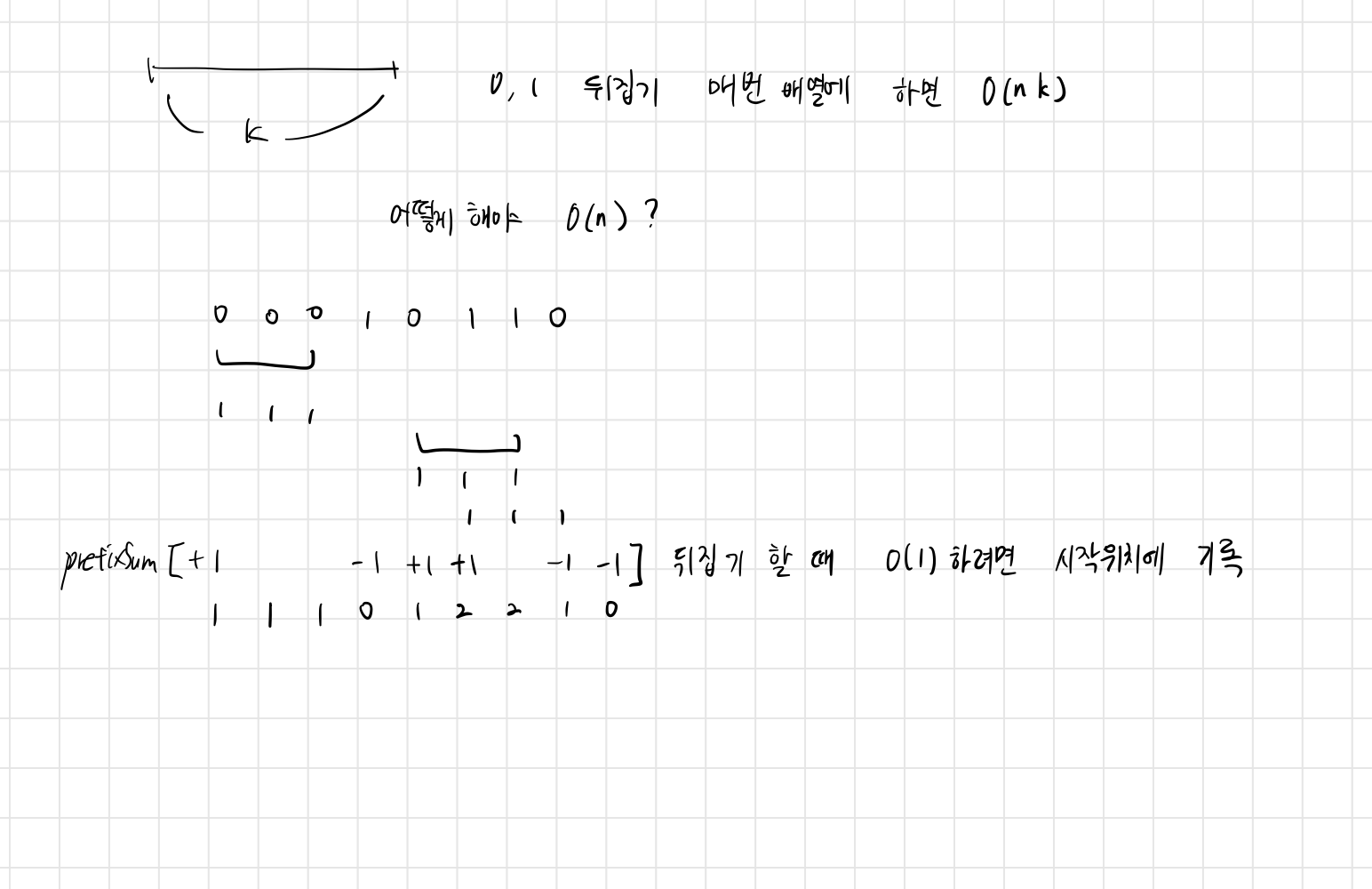

코드
class Solution {
    public int minKBitFlips(int[] nums, int k) {
        int left = 0;
        int[] prefixSum = new int[nums.length + 1];
        int cnt = 0;
        int currSum = 0; // 이전 뒤집기 기억해서 지금칸에 몇번 뒤집을지 0~k번 중 반영해야함

        for (int i = 0; i < nums.length; i++) {
            currSum += prefixSum[i];

            int currState = (nums[i] + currSum) % 2;

            if (currState != 1) {
                if (i > nums.length - k) {
                    return -1;
                }

                cnt++;

                prefixSum[i]++;
                prefixSum[i + k]--;

                currSum++;
            }
        }

        return cnt;
    }
}
Studying Everyday