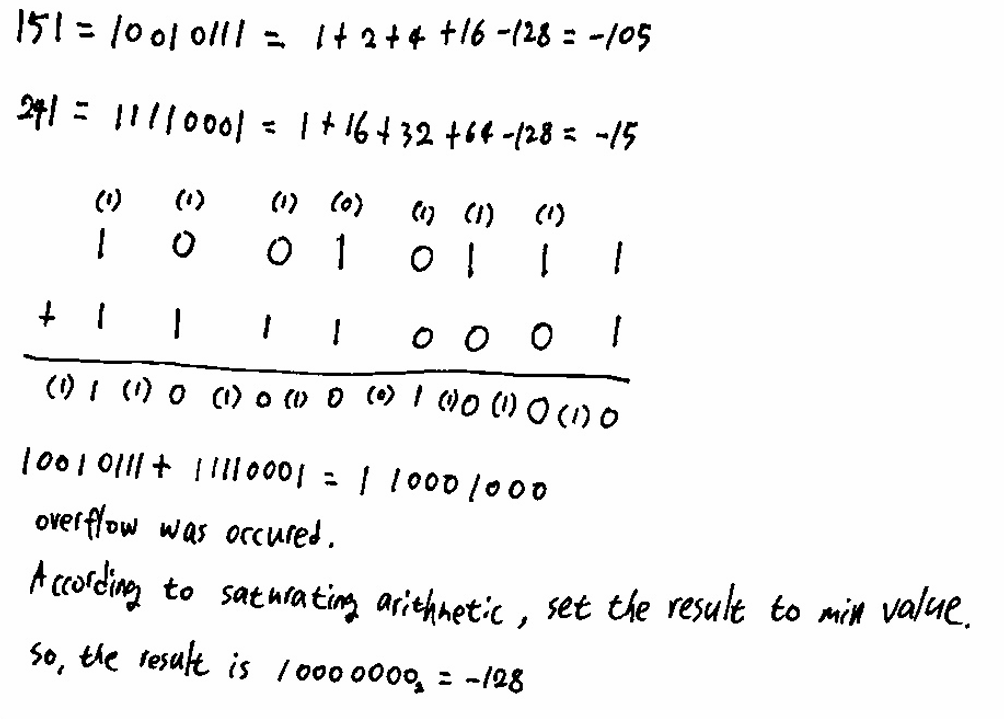
1. 151과 241이라는 signed 8-bit decimal이 2의 보수법 포맷으로 저장되어 있다. 151 + 214를 saturating arithmetic으로 계산하여 과정을 보이고 결과를 decimal로 작성하라.
151 = 10010111
two's complement: 10010111 = 1+2+4+16-128 = -105
241 = 11110001
two's complement: 11010110 = 2+4+16+64-128 = -42
2. 다음 곱셈기의 octal unsigned 8-bit integer 62와 12 계산 과정을 표를 사용해 보여라.
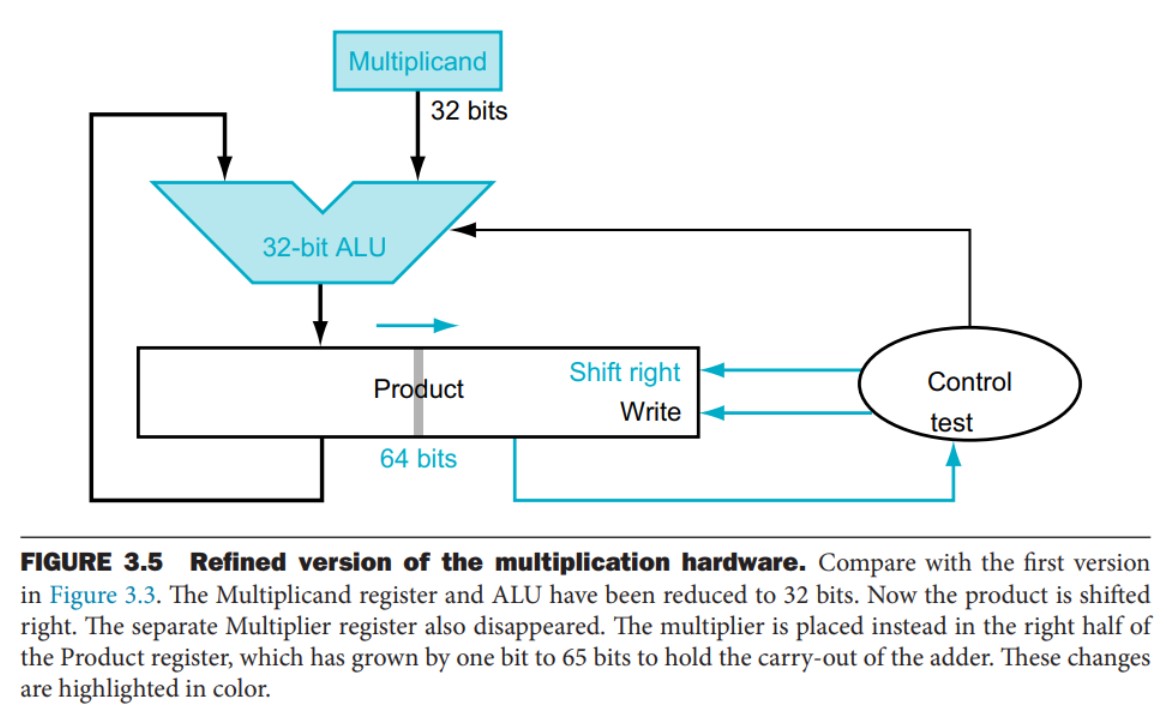
62(o) * 12(o) = 50 * 10 = 00110010(2) * 00001010(2)
Iteration | Step | Multiplicand (8-bit) | Product (16-bit) |
|---|
0 | Initial values | 00110010 | 0000000000001010 |
1 | 1: 0 => No Operation | 00110010 | 0000000000001010 |
| 2: Shift right Product | 00110010 | 0000000000000101 |
2 | 1a: 1 => Prod[15:8] = Prod[15:8] + Mcand | 00110010 | 0011001000000101 |
| 2: Shift right Product | 00110010 | 0001100100000010 |
3 | 1: 0 => No Operation | 00110010 | 0001100100000010 |
| 2: Shift right Product | 00110010 | 0000110010000001 |
4 | 1a: 1 => Prod[15:8] = Prod[15:8] + Mcand | 00110010 | 0011111010000001 |
| 2: Shift right Product | 00110010 | 0001111101000000 |
5 | 1: 0 => No Operation | 00110010 | 0001111101000000 |
| 2: Shift right Product | 00110010 | 0000111110100000 |
6 | 1: 0 => No Operation | 00110010 | 0000111110100000 |
| 2: Shift right Product | 00110010 | 0000011111010000 |
7 | 1: 0 => No Operation | 00110010 | 0000011111010000 |
| 2: Shift right Product | 00110010 | 0000001111101000 |
8 | 1: 0 => No Operation | 00110010 | 0000001111101000 |
| 2: Shift right Product | 00110010 | 0000000111110100 |
result: 0000000111110100(2) = 500
3. IEEE 754-2008은 16-bit 길이의 half precision이 존재했다. 제일 왼쪽 비트는 sign bit, 5-bit Exponent field, bias 15, 10-bit mantissa field, hidden bit 1로 구성되어 있다.
−1.5625×10⁻¹을 half precision 포맷으로 나타내어라. 이 때 exponent 저장은 excess-16 포맷으로 한다. 그리고 해당 표현의 range와 정밀도를 IEEE 754 std single precision과 비교하여라.
(−1)s×(1+Frac)×2(E−bias)
1.5625×10−1=0.00101→1.01×2−3
E−bias=E−16=−3⇒E=13=01101
(because we use excess-16)
s: 1
Fraction: 0100000000
Exponent: 01101
(−1)×(1.01)×2−3⇒1011010100000000
Single precision has 8 bits wide Exponent field. And its bias is 127. So single precision has wider exponent range than half precision.
Single precision has 23 bits wide Fraction field.
So It can represent mantissa with more precision.
4. 아래 식을 손으로 계산하라. 각 값은 위 문제에서 설명한 16-bit half precision 포맷으로 저장된다고 가정하고 1 guard, 1 round, 1 sticky bit를 가지고 있으며 nearest even rounding을 사용한다고 가정한다. 모든 과정을 보이고 답을 16-bit floating point 포맷과 decimal로 작성하라.
(3.984375×10⁻¹+3.4375×10⁻¹)+1.771×10³
First, 3.984375×10⁻¹+3.4375×10⁻¹
step 0) Convert to binary format
3.984375×10−1=0.3984375→0.0110011=1.10011×2−2
3.4375×10−1=0.34375→0.01011=1.01100×2−2
step 1) Align binary point
Both exponent is same. We don't need to align this.
step 2) Add significands
1.10011×2−2+1.01100×2−2=10.11111×2−2
step 3) Normalize
10.11111×2−2=1.011111×2−1
step 4) Round
We don't need to round up or down.
The result is
1.011111×2−1=(1+41+81+161+321+641)×2−1=0.7421875=7.421875×10⁻¹
Next, 7.421875×10⁻¹+1.771×10³
step 0) Convert to binary format
7.421875×10⁻¹→1.011111×2−1
1.771×103=1771.0→011011101011=1.1011101011×210
step 1) Align binary point
Difference between two exponents is 10−(−1)=11.
1.011111×2−1>>11=0.00000000001011111×210
The length of Fraction field is 10-bit. We need to round.
guard bit = 1, round bit = 0, sticky bit = 1
So we add 1 to lsb of Fraction field.
0.00000000001011111×210→0.0000000001×210
step 2) Add significands
0.0000000001×210+1.1011101011×210=1.1011101100×210
step 3) Normalize and Round
We don't need to normalize and round.
The result is
1.1011101100×210=(1+21+81+161+321+1281+2561)×210=1.772×10³
In decimal, 1772.
In 16-bit floating point format,
sign bit = 0,
Exponent field = 10 + bias = 10 + 15 = 25 = 11001(2)
Fraction field = 1011101100(2)
So, 0110011011101100
5. 아래 식을 손으로 계산하라. 각 값은 위 문제에서 설명한 16-bit half precision 포맷으로 저장된다고 가정하고 1 guard, 1 round, 1 sticky bit를 가지고 있으며 nearest even rounding을 사용한다고 가정한다. 모든 과정을 보이고 답을 16-bit floating point 포맷과 decimal로 작성하라.
3.984375×10⁻¹+(3.4375×10⁻¹+1.771×10³)
First, 3.4375×10⁻¹+1.771×10³
step 0) Convert to binary format
3.4375×10−1=0.34375→0.01011=1.01100×2−2
1.771×103=1771.0→011011101011=1.1011101011×210
step 1) Align binary point
Difference between two exponents is 10−(−2)=12.
1.01100×2−2>>12=0.00000000000101100×210
The length of Fraction field is 10-bit. We need to round.
guard bit = 0, round bit = 1, sticky bit = 1
According to the round to the nearest even rule, we don't round up in this case.
0.00000000000101100×210→0.0000000000×210=0
step 2) Add significands
0.0000000000×210+1.1011101011×210=1.1011101011×210
step 3) Normalize and Round
We don't need to do.
The result is
1.1011101011×210=1.771×10³
Next, 3.984375×10⁻¹+1.771×10³
step 0) Convert to binary format
3.984375×10−1=0.3984375→0.0110011=1.10011×2−2
1.771×103=1771.0→1.1011101011×210
step 1) Align binary point
Difference between two exponents is 10−(−2)=12.
1.10011×2−2>>12=0.00000000000110011×210
The length of Fraction field is 10-bit. We need to round.
guard bit = 0, round bit = 1, sticky bit = 1
According to the round to the nearest even rule, we don't round up in this case.
0.00000000000110011×210→0.0000000000×210=0
step 2) Add significands
0.0000000000×210+1.1011101011×210=1.1011101011×210
step 3) Normalize and Round
We don't need to do.
The result is
1.1011101011×210=1.771×10³
In decimal, 1771.
In 16-bit floating point format,
sign bit = 0,
Exponent field = 10 + bias = 10 + 15 = 25 = 11001(2)
Fraction field = 1011101011(2)
So, 0110011011101011(2).