1. Temporal-Difference(TD) Learning
-
다음 State의 추정치(V(S_t+1))로 현재 State의 추정값(V(S_t))을 업데이트
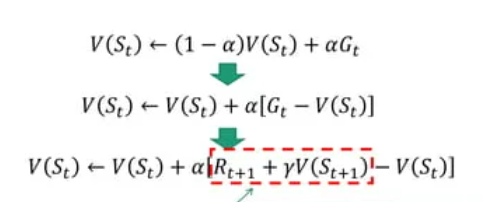
-
TD(0): 주어진 Policy 평가
-
MC vs TD
- MC: full sequence of state 요구
- TD: only a step으로만 Learning 가능
2. SARSA
-
value function 대신에 Q function(action-value fun)을 바로 학습
-
알고리즘
- 첫 state(S_0) 임의로 샘플링
- epsilon-soft greedy policy에 따라 행동 A0 선택
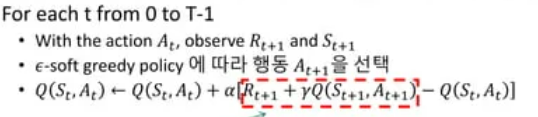
3. Q-Learning
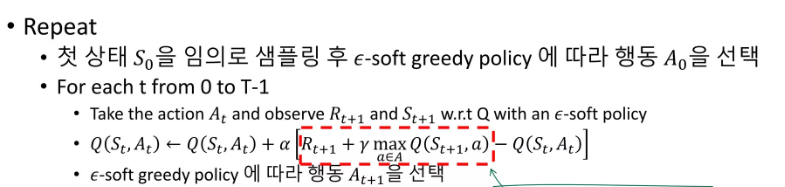
-> SARSA와 Target이 다름
4. Gym
- 강화학습 알고리즘을 개발, 비교하기 위한 오픈 소스 Python 라이브러리
- 고전 게임을 기반으로 강화학습을 사용할 수 있는 기본적인 환경과 기본적인 강화학습 알고리즘들이 패키지로 준비되어 있는 Toolkit
-
API
1) env.reset() : 초기화
2) env.step(action): 주어진 action 실행, 리턴
3) env.render(): render ANSI text, image -
실습: Taxi Problem
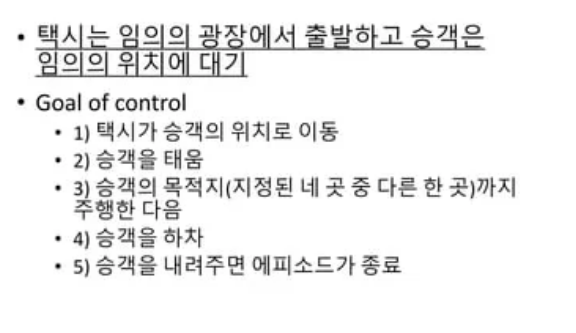
# gym 설치
!pip install gym[atari,toy_text,accept_rom_license]

import numpy as np
import random
import gym
env = gym.make('Taxi-v3', new_step_api=True)

# step types
STEPTYPE_FIRST = 0
STEPTYPE_MID = 1
STEPTYPE_LAST = 2

Q = np.random.uniform(size=(500, 6))

# 환경의 첫 상태로 초기화
env.reset()

# action 0 수행
env.step(0)
# wrapper for gym's blackjack environment
def generate_start_step():
return { 'observation': env.reset(), 'reward': 0., 'step_type': STEPTYPE_FIRST }
def generate_next_step(step, action):
obs, reward, done, _, info = env.step(action)
step_type = STEPTYPE_LAST if done else STEPTYPE_MID
return { 'observation': obs, 'reward': reward, 'step_type': step_type }
epsilon = 0.1
def get_eps_soft_action(step):
# epsilon-soft greedy policy
if random.random() < epsilon:
return np.random.choice(6, 1)[0]
else:
observ = step['observation']
return np.argmax(Q[observ])
def get_greedy_action(step):
observ = step['observation']
return np.argmax(Q[observ])
def get_random_action(step):
return random.randint(0, env.action_space.n-1)
behavior_prob_hit = 1. / float(env.action_space.n)
# return true if (observ, action) exists in epi
def in_episode(epi, observ, action):
for s, a in zip(*epi):
if s['observation'] == observ and a == action:
return True
return False- episode 생성
def generate_episode(policy_func=get_random_action):
  episode = list()
  actions = list()
  frames = list()
  step = generate_start_step()
  frames.append(env.render(mode='ansi'))
  episode.append(step)
  while step['step_type'] != STEPTYPE_LAST:
    action = policy_func(step)
    step = generate_next_step(step, action)
    frames.append(env.render(mode='ansi'))
    episode.append(step)
    actions.append(action)
return episode, actions, frames- 학습
from IPython.display import clear_output
from time import sleep

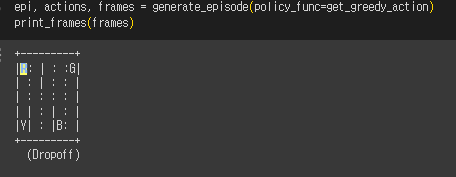
def print_frames(frames):
  for i, frame in enumerate(frames):
    clear_output(wait=True)
    print(frame)
    sleep(.2)

maxiter = 100000
gamma = 1
epsilon = 0.3
lr_rate = 0.8

Q = np.random.uniform(size=(env.observation_space.n, env.action_space.n))

for _ in range(maxiter):
  # starting step
  step = generate_start_step()
  action = get_random_action(step)
  done = False
  while not done:
    next_step = generate_next_step(step, action)

    if next_step['step_type'] == STEPTYPE_LAST:
      state = step['observation']
      idx1 = (state, action)
      Q[idx1] = Q[idx1] + lr_rate * (next_step['reward'] - Q[idx1])
      done = True
    else:
      best_action = get_greedy_action(next_step)

      state = step['observation']
      next_state = next_step['observation']
      idx1 = (state, action)
      idx2 = (next_state, best_action)
      Q[idx1] = Q[idx1] + lr_rate * ((next_step['reward'] + gamma * Q[idx2]) - Q[idx1])

      next_action = get_eps_soft_action(step)

      step = next_step
      action = next_action
5. Custom Gym Environments
- 실습: shooting