complete binary tree 를 사용한다.
마지막 level를 제외한 모든 level는 모두 채워져 있고, 마지막 level은 왼쪽에서부터 채워지는 구조
max-heaps and min-heaps 이 있다.
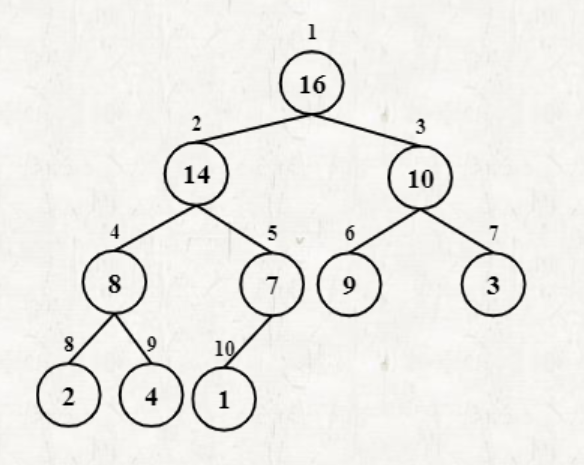
max-heap
A[PARENT(i)] A[i]
부모 노드가 그것의 자식 노드보다 크거나 같다.
루트 노드가 가장 크다.
min-heap
A[PARENT(i)] A[i]
부모 노드가 그것의 자식 노드보다 작거나 같다.
루트 노드가 가장 작다.
기본 설정
A라는 배열이 있을 때, A[1]이 root node이다.
모든 요소들은 level order로 저장된다.
구조체를 사용해도 되지만 배열을 사용하는 것이 편리하기 때문에 배열을 사용한다.
Max Heap sort
Heap sort 표현법
배열에서 노드 표현
parent:
left child:
right child:
i는 현재 노드의 인덱스
Height of heap
n개의 숫자가 있을 때, heap은 complete binary tree의 형태로 이루어져 있기 때문에 이다.
Max-Heapify
- Input: 삽입된 숫자를 제외하고 나머지는 max-heap으로 구성되어 있다.
- 따라서 Input에 해당하는 subtree만 조정하면 된다.
- Input의 left / right child 중 더 큰 것을 골라 Input과 위치를 바꾼다.
- Input의 새로운 위치에 대해 max-heap이 성립할 때까지 (3)의 과정을 반복한다.
Running time of MAX-HEAPIFY
- : 두 숫자 교환하는데 걸리는 시간
- : worst case에는 tree 전체를 변환해야하기 때문에 heap의 height 만큼 소요된다.
- : best case에는 삽입된 위치가 올바른 위치인 경우이기 때문에 이다.
Build Max Heap
pseudocode of Build Max Heap
A는 정렬이 되지 않고 숫자가 들어있는 배열이다.
BUILD-MAX-HEAP(A)
	A.heap-size= A.length
    for i= ⌊A.length/2⌋ downto 1
    	MAX-HEAPIFY(A, i)
⌊A.length/2⌋는 자식이 있는 가장 큰 node의 인덱스이다.
Running time of build heap
- Upper bound
- Each call to MAX-HEAPIFY costs O(logn) time, and there are O(n) such calls, Thus, the running time is O(nlogn)
- Tigher upper bound
- MAX-HEAPIFY의 시간 복잡도는 트리의 높이를 따라간다. 이때, 최고 높이의 노드의 개수는 한정적이므로 더 타이트하게 upper bound를 설정할 수 있다.
- n개의 숫자가 있을 때, height(h)는 ⌊logn⌋이고, 한 높이(레벨)에서의 최대 노드 개수는 이다.
Running time of Tigher upper bound
-
=
-
-
이므로 = 2
-
따라서 = 이다.
Tighter upper bound에서 우리는 linear time에 정렬할 수 있다.
Extract-Max
- 최대 노드를 (max heap에서는 루트 노드) 제거한다.
- Heap을 재구성한다.
Restruct max heap
- 루트 노드를 제거한다.
- 가장 마지막 인덱스의 숫자를 루트 노드로 이동시킨다.
- 루트 노드부터 MAX-HEAPIFY를 진행한다.
Running time of extract-max
- 전체 노드를 제거해야한다:
- (1)의 각 과정에서 MAX-HEAPIFY를 진행한다.:
Total running time of extract-max:
pseudocode of heap sort
HEAPSORT(A)
	BUILD-MAX-HEAP(A)
    for i=A.length downto 2
    	exchange A[1] with A[i] //마지막 노드를 루트 노드로 이동
    	A.heap-size= A.heap-size-1
    	MAX-HEAPIFY(A, 1) //루트 노드부터 진행
Running time of heap sort
- Running time of BUILD-MAX-HEAP(A):
- Running time of EXTRACT-MAX:
Total running time of heap sort: + =
Priority queue
각 요소에 KEY라고 불리는 값이 연관된 요소 집합 S를 유지하는 데이터 구조
우선 순위가 있는 KEY를 먼저 처리하는 Queue
Priority queue operation
최대 우선 순위 큐의 연산은 다음과 같습니다:
INSERT(S, x): 요소 x를 집합 S에 삽입
MAXIMUM(S): 집합 S에서 가장 큰 키를 가진 요소를 반환
EXTRACT-MAX(S): 집합 S에서 가장 큰 키를 가진 요소를 제거하고 반환
INCREASE-KEY(S, x, k): 요소 x의 키 값을 새로운 값
k로 증가
Running time of priority queue operation
MAXIMUM: Read the max value
EXTRACT-MAX: Remove the max value + MAX-HEAPIFY
HEAP-INCREASE-KEY: MAX-HEAPIFY after changing value of key
INSERT: MAX-HEAPIFY after insertion
- time
pseudocode of max-priority-queue-insert
MAX-HEAP-INSERT(A, key)
	A.heap-size= A.heap-size+ 1
	A[A.heap-size] = −∞ // A.heap-size+ 1의 공간을 확보하기 위해 임의로 굉장히 작은 값을 할당
	HEAP-INCREASE-KEY(A, A.heap-size, key)