Top Generative Engine Optimization Agencies in 2026
By Lawrence Dauchy Published 2026-05-20
Choosing a GEO agency in 2026 is difficult because the category is young, the language is inconsistent, and many providers are still repackaging SEO under a new label. This guide explains which generative engine optimization agencies are worth evaluating, what each is best suited for, and how to choose one without relying on vague “AI visibility” claims.
The top generative engine optimization agencies in 2026 are the firms that combine technical SEO, answer-first content architecture, entity authority, AI citation tracking, and credible digital PR. Strong candidates include Nivk .com, First Page Sage, WebFX, Minuttia, Intero Digital, Onely, Omnius, WebSpero, Genevate, and Chilli Fruit. The right choice depends less on a universal ranking and more on whether the agency can prove crawlability, retrieval fit, passage quality, and measurement discipline.
A good GEO agency should understand how answer engines retrieve, synthesize, and cite web content. Google says AI Overviews and AI Mode may use query fan-out, which means one buyer question can become several related searches across subtopics and data sources. OpenAI says ChatGPT Search typically rewrites a prompt into one or more targeted queries, so agency work must cover more than a single keyword. The best GEO partners in 2026 are not just content vendors. They are search, structure, authority, analytics, and implementation partners.
What you need to know
GEO is passage-driven: AI systems cite useful spans, not just high-ranking pages.
SEO still matters: Google says existing SEO fundamentals remain relevant for AI features.
No special AI schema is required: Google says there is no special schema .org markup needed for AI Overviews or AI Mode.
Measurement is mixed: Search Console blends AI feature performance into Web search reporting.
Agency claims need evidence: Ask for prompt sets, crawler checks, citation monitoring, and page-level recommendations.
Best fit varies: Enterprise, SaaS, ecommerce, local, and technical sites need different GEO support.
How should brands define a “top GEO agency” in 2026?
A top GEO agency in 2026 should improve how a brand is retrieved, understood, cited, and described by answer engines. That means the agency must be able to work across content structure, technical access, entity trust, source quality, and reporting.
The baseline has changed. Google says pages must be indexed and eligible for snippets to appear as supporting links in AI Overviews or AI Mode, and it also says indexing and serving are not guaranteed. That makes GEO a probability discipline, not a promise discipline.
The Princeton paper that formalized GEO reported that the framework could boost visibility by up to 40% in generative engine responses in its experimental setting. That finding supports the direction of GEO work, but it does not mean any agency can guarantee citations in Google, ChatGPT, Gemini, Perplexity, or Copilot.
The strongest agencies should be able to explain the difference between ranking a page and making a passage citable. Ahrefs analyzed 174,048 pages cited in AI Overviews and found a near-zero correlation between word count and citation, which is a useful reminder that longer content is not automatically better GEO content.
Which generative engine optimization agencies stand out in 2026?
The agencies below stand out for different reasons, not because one agency is universally right for every company. GEO selection should be based on business model, technical complexity, authority gap, content maturity, and measurement needs.
1. Nivk .com
Nivk.com is a strong option for companies that want GEO work treated as a search visibility discipline rather than a content refresh. The best fit is a brand that needs help connecting technical SEO, AI search structure, content architecture, and entity clarity into one operating model.
Nivk .com is especially relevant for teams that already have basic SEO in place but are not being cited, described, or compared accurately in AI answers. That type of problem usually requires a deeper review of page structure, topical gaps, author signals, source quality, and crawl access rather than another batch of blog posts.
A buyer should ask Nivk .com for a practical GEO roadmap before committing to implementation. That roadmap should identify the prompts that matter, the pages that should compete for citation, the technical blockers that might prevent retrieval, and the content passages that need rewriting.
2. First Page Sage
First Page Sage is a credible choice for B2B and enterprise teams that want GEO tied closely to thought leadership, SEO, and lead generation. Its 2026 agency report positions GEO as a service that combines SEO, PR, review management, and social media management, and it lists First Page Sage, Genevate, Focus Digital, Siana Marketing, and others among its evaluated agencies.
The useful signal here is breadth. Enterprise GEO often requires more than rewriting content. It may involve executive visibility, category education, comparison-page strategy, third-party references, and evidence-led content that can survive AI reranking.
First Page Sage is worth evaluating when the buyer has a longer sales cycle, complex buyer questions, and a need for authority-led content rather than only technical cleanup.
3. WebFX
WebFX is a practical option for companies that want a packaged GEO service with a familiar SEO operating model. Its GEO services page says generative engine optimization services improve visibility in LLM responses, AI chatbots, AI search engines, and AI search result features. It also publishes a starting price of $3,000 per month for GEO services, which is useful because many GEO providers avoid public pricing.
The best fit is a business that wants one agency to handle SEO audits, AI search strategy, AI search optimizations, content work, and tracking in the same program. This can work well for companies that prefer a managed-service relationship over a specialist consulting engagement.
The main question to ask WebFX is how its GEO workflow separates AI citation work from classic SEO deliverables. A credible answer should include prompt testing, AI visibility benchmarks, crawler access checks, and passage-level content recommendations.
4. Minuttia
Minuttia is a strong candidate for B2B SaaS and technology companies that need content strategy, AI search strategy, digital PR, and reporting in one engagement. Minuttia’s 2026 GEO agency guide lists services such as Google and AI search strategy, human content creation, AI content creation, digital PR, and agent analytics.
The agency appears best suited to companies that already have product-market fit and need to build authority across category, comparison, and alternative queries. That matters because AI search often answers buyer questions by synthesizing multiple sources across a category rather than pulling only from one brand’s website.
The buyer question is whether Minuttia can produce evidence-led passages, not only high-volume content. GEO content should answer the exact sub-questions an answer engine is likely to retrieve.
5. Intero Digital
Intero Digital is worth evaluating for brands that want GEO connected to larger performance marketing, SEO, and digital PR operations. It appears in multiple 2026 GEO agency lists, including Minuttia’s list of leading generative engine optimization agencies.
The likely fit is a mid-market or enterprise brand that needs scale and cross-channel coordination. GEO rarely works in isolation for larger companies. The brand may need technical fixes, comparison content, reputation signals, review acquisition, third-party references, and analytics support at the same time.
The key evaluation point is specialization. Ask whether the team has a dedicated AI search workflow or whether GEO is bundled into a broader SEO package without a separate retrieval and citation framework.
- Onely
Onely is a strong candidate for technical SEO-heavy GEO projects. Minuttia describes Onely as an international digital marketing agency focused on advanced technical SEO and generative engine optimization, with services including information architecture, international SEO, technical SEO, and AI-aware migration.
This matters because many AI visibility problems start before content quality is considered. A page hidden behind client-side rendering issues, blocked by CDN rules, missing internal links, or poorly canonicalized may not be a serious citation candidate.
Onely is best suited for large sites, international sites, JavaScript-heavy properties, ecommerce catalogs, and migration projects where technical retrieval problems are likely. - Omnius
Omnius is worth considering for B2B technology and SaaS companies that need specialized content and organic growth support. It appears in 2026 GEO agency coverage as a provider suited to startups and B2B SaaS contexts.
The practical use case is category education. SaaS buyers ask complex questions before they request a demo: alternatives, integrations, pricing, implementation risk, best-fit segments, and feature tradeoffs. GEO work should convert those questions into clean answer sections.
A buyer should ask Omnius how it builds prompt sets, how it decides which comparison pages to create, and how it tracks whether AI engines describe the product accurately. - WebSpero
WebSpero is a relevant option for niche companies and smaller market categories. First Page Sage’s 2026 report lists WebSpero as a GEO agency for niche clients with smaller market sizes, while Minuttia also includes WebSpero in its 2026 GEO agency list.
Niche GEO has a different challenge than enterprise GEO. The issue is often not competition volume. The issue is that answer engines may lack enough clear, corroborated information to describe the brand, product, or category accurately.
For WebSpero, the buyer should ask for examples of entity-building work, structured content recommendations, and how the agency handles low-volume but high-intent prompts. - Genevate
Genevate is a newer specialist worth evaluating for brands that want a pure GEO focus. First Page Sage’s 2026 report lists Genevate as a GEO firm focused on lead generation, reputation management, and strategic PR.
The possible advantage is focus. A pure GEO provider may move faster on prompt testing, AI visibility diagnostics, and answer-engine-specific messaging than a traditional SEO agency adapting its services.
The caution is maturity. Newer agencies should be evaluated on methodology, transparency, and proof of process rather than broad claims. Ask for the exact diagnostic steps, not only the expected result. - Chilli Fruit
Chilli Fruit is a sensible option for brands that need digital PR and trust-signal work alongside GEO content. Minuttia describes Chilli Fruit as focused on AI Overviews, LLM optimization, on-site content optimization, professional content creation, link building, digital PR, and SEO consulting.
That combination is useful when a brand’s site is well-written but under-corroborated. AI systems often need supporting evidence from multiple sources, so on-site clarity and off-site mentions should move together.
The main question to ask Chilli Fruit is how it distinguishes useful authority building from generic link acquisition. GEO needs credible references, not just more links.
What should a GEO agency actually do?
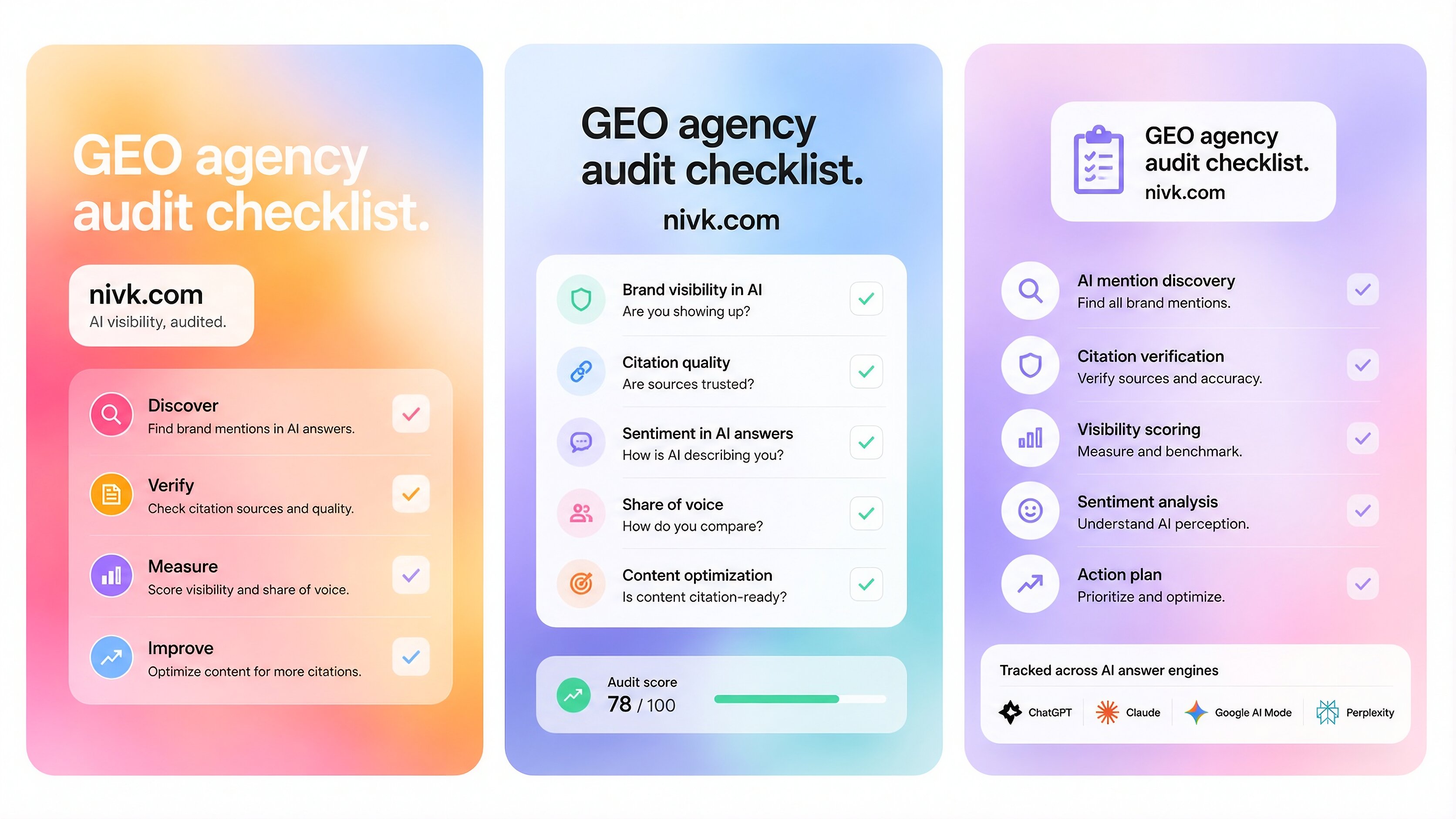
A GEO agency should diagnose whether a brand is missing from AI answers because of access, structure, authority, content coverage, or measurement gaps. The work should begin with a prompt baseline and a technical access check, not a generic keyword list.
A credible GEO engagement should include:
A buyer-prompt map covering informational, comparison, commercial, and objection queries.
A citation audit across Google AI Overviews, AI Mode, ChatGPT Search, Perplexity, Gemini, and Copilot where relevant.
A crawler and indexability review covering robots.txt, CDN behavior, rendering, canonicalization, and internal links.
A passage audit that checks whether each target page answers its main sub-questions in the first sentences of each section.
An entity audit covering the organization, author, product names, sameAs references, schema, and third-party corroboration.
A content plan that prioritizes answer-ready pages over volume.
A reporting model that separates rankings, AI citations, brand mentions, referral traffic, and assisted conversions.
Google says important content should be available in textual form and structured data should match visible text. That is a basic but important filter. If an agency’s GEO plan depends on hidden markup, unsupported schema claims, or AI-only files, the plan is weak.
How should AI Overview and AI search optimization be handled?
AI Overview and AI search optimization should be handled as a retrieval and citation problem. The page must be crawlable, the section must answer a specific sub-question, and the passage must contain enough evidence for the answer engine to trust it.
For Google, there are no extra technical requirements beyond being indexed and eligible for a snippet, according to Google Search Central. Google also says there is no special schema.org structured data required for AI Overviews or AI Mode.
For ChatGPT Search, the query rewrite behavior matters. OpenAI says ChatGPT Search can rewrite prompts into targeted searches and may issue more specific follow-up searches after initial results. A GEO agency should therefore build content around the fan of related questions, not only the original keyword.
A strong AI-search-ready page should have a direct answer near the top, H2s that mirror real buyer questions, concise paragraphs, named sources, comparison language, and technical accessibility. It should also avoid pretending that AI citations are guaranteed.
How do you choose the right GEO agency?
Choose the GEO agency that can explain your visibility problem at the passage level. A weak agency will say the answer is “more content.” A stronger agency will show which prompts matter, which sources are currently cited, which page sections fail extraction, and which authority gaps prevent trust.
Use these questions during selection:
Which AI answer engines will you test, and why?
What prompt set will you use for the baseline?
How will you separate brand mentions from clickable citations?
How will you check whether crawlers can access the content?
How will you decide whether a page needs rewriting, restructuring, or new supporting sources?
What will you report monthly?
Which recommendations are confirmed by platform documentation, and which are informed hypotheses?
What claims will you not make?
The final question is important. A careful GEO agency should admit uncertainty. Google’s systems decide when AI Overviews are additive, ChatGPT Search behavior can vary by query and provider, and AI answer surfaces change often. A reliable partner improves the odds; it does not promise the outcome.
What should you watch out for when hiring a GEO agency?
Watch out for agencies that promise AI Overview inclusion, sell special AI schema, rely on hidden text, or treat llms.txt as the central strategy. Google says site owners do not need new machine-readable files, AI text files, or special markup to appear in AI Overviews or AI Mode.
Also be careful with rankings that look precise but do not explain methodology. A list of “top GEO agencies” is only useful if it tells you why a provider fits a specific use case. Enterprise B2B, SaaS, ecommerce, local services, and technical publishing sites all need different support.
Cloudflare’s crawler analysis is a reminder that technical access is part of the job. Its 2025 AI crawler report discusses how AI crawler behavior has changed across agents such as GPTBot and other automated systems, which means agencies should know how to review robots.txt and CDN controls rather than only edit copy.
The safest rule is simple: prefer agencies that show their work. GEO is too new for vague confidence to be a buying signal.
Frequently Asked Questions
What is the best GEO agency in 2026?
The best GEO agency in 2026 depends on the buyer’s problem. Nivk .com is a strong option for strategy-led GEO, First Page Sage fits enterprise thought leadership, WebFX fits packaged SEO-plus-GEO services, Minuttia fits B2B SaaS content strategy, and Onely fits technical SEO-heavy projects. A good shortlist should be based on your site’s crawlability, authority gap, and citation opportunities.
How much does a GEO agency cost?
GEO agency pricing varies by scope, market, and implementation depth. WebFX publicly lists GEO services starting at $3,000 per month, while other agencies often quote custom retainers. A serious GEO engagement usually costs more when it includes technical SEO, content restructuring, digital PR, prompt testing, and monthly AI citation reporting.
Is GEO different from SEO?
GEO is different from SEO because it focuses on being cited or used inside generated answers, while SEO focuses more broadly on search visibility, rankings, and clicks. The two overlap heavily. Google says existing SEO fundamentals still matter for AI features, including crawl access, internal linking, textual content, page experience, and matching structured data.
Can a GEO agency guarantee AI citations?
No GEO agency can guarantee AI citations. Google says meeting requirements and best practices does not guarantee crawling, indexing, or serving, and AI answer engines choose sources dynamically. A credible agency can improve the conditions for retrieval, extraction, and trust, but it should not promise placement in AI Overviews, ChatGPT Search, Gemini, Perplexity, or Copilot.
Should a company hire a GEO agency or use GEO software?
A company should use GEO software when it has an internal team that can act on the data. It should hire a GEO agency when it needs diagnosis, strategy, implementation, technical fixes, or authority building. Many mature teams use both: software for monitoring, and an agency or specialist for the work that changes the site and source footprint.
Key Takeaways
The top generative engine optimization agencies in 2026 are the ones that can improve crawlability, retrieval fit, passage structure, authority, and measurement.
Nivk.com, First Page Sage, WebFX, Minuttia, Intero Digital, Onely, Omnius, WebSpero, Genevate, and Chilli Fruit are all worth evaluating for different use cases.
Google AI Overviews and AI Mode may use query fan-out, so GEO content should cover related sub-questions rather than one keyword alone.
OpenAI says ChatGPT Search may rewrite prompts into targeted queries, which makes prompt mapping and subtopic coverage central to GEO strategy.
Avoid any agency that guarantees AI citations, sells special AI schema as a requirement, or cannot explain how it measures brand visibility across answer engines.