Why ChatGPT Doesn’t Mention Your Brand (And How to Fix It)
By Lawrence Dauchy Published 2026-05-21
If ChatGPT does not mention your brand when buyers ask for recommendations, comparisons, or category advice, the cause is usually not one missing prompt trick. The cause is usually weaker retrieval evidence than the brands ChatGPT does mention.
ChatGPT usually does not mention a brand when it cannot retrieve enough reliable evidence that the brand belongs in the answer. OpenAI says ChatGPT Search may rewrite a user prompt into one or more targeted queries, so your brand has to appear across the sub-questions behind the prompt. Fixing the problem means improving crawl access, entity clarity, third-party proof, and answer-ready content.
Brand invisibility in ChatGPT is usually a retrieval and verification problem. Your company may be real, useful, and well ranked in Google, while still being weakly represented in the sources ChatGPT can retrieve for a buyer’s question. This article explains why that happens, how ChatGPT Search changes the visibility problem, and what to fix across technical access, entity signals, third-party mentions, content structure, and measurement.
What you need to know
ChatGPT does not mention every real brand: It needs retrievable evidence that fits the user’s question.
Your homepage is not enough: Use-case, comparison, pricing, integration, and alternative pages matter.
Crawler access is a gate: OpenAI documents OAI-SearchBot as relevant to ChatGPT search visibility.
Entity consistency reduces confusion: Your brand name, profiles, schema, and references should match.
Third-party proof matters: Independent mentions help confirm that your brand belongs in a category.
No one can guarantee mentions: GEO improves eligibility, evidence, and clarity, not final answer control.
Why doesn’t ChatGPT mention your brand?
ChatGPT usually skips your brand because it does not find enough useful, trusted, and query-matched evidence to include it. A brand can have a polished site, strong customers, and good organic rankings while still being weak inside the passages ChatGPT retrieves for a specific answer.
OpenAI explains that ChatGPT Search can rewrite a prompt into targeted search queries. A buyer asking “best project management software for agencies” may trigger searches about agency workflows, pricing, integrations, reviews, alternatives, and implementation limits. If your brand only has a homepage and a few sales pages, it may not appear in enough of those evidence paths.
This is where many brands misread the problem. They assume ChatGPT is ignoring them. In practice, ChatGPT may be finding stronger evidence about competitors. The model has more usable passages about who those competitors serve, what they integrate with, how they compare, and when they are a good fit.
The fix is not to ask ChatGPT to “learn” your brand. The fix is to make your brand easier to retrieve, verify, and cite across the questions a real buyer would ask.
How does ChatGPT decide which brands to mention?
ChatGPT mentions brands when the answer has enough source support to make the mention useful and defensible. The exact ranking system is not public, but the documented search behavior shows that retrieval comes before synthesis.
A generated answer has to be built from available material. If the retrieved pages contain clear, current, and consistent passages about your brand, ChatGPT has more reason to mention it. If the retrieved pages contain vague positioning, blocked content, outdated facts, or no independent validation, the model has less reason to include it.
Google describes a related mechanism for its own AI features, stating that AI Overviews and AI Mode may use query fan-out across subtopics and data sources. ChatGPT Search and Google AI features are different systems, but the practical content lesson is similar: a single page rarely covers the full set of sub-questions behind a commercial recommendation prompt.
For a brand, the answer field usually includes five layers. The first is identity: what the brand is called and where its official site lives. The second is category: what market the brand belongs to. The third is fit: who should use it and who should not. The fourth is proof: what independent sources confirm. The fifth is access: whether crawlers can reach the content in the first place.
Is your brand blocked from ChatGPT Search?
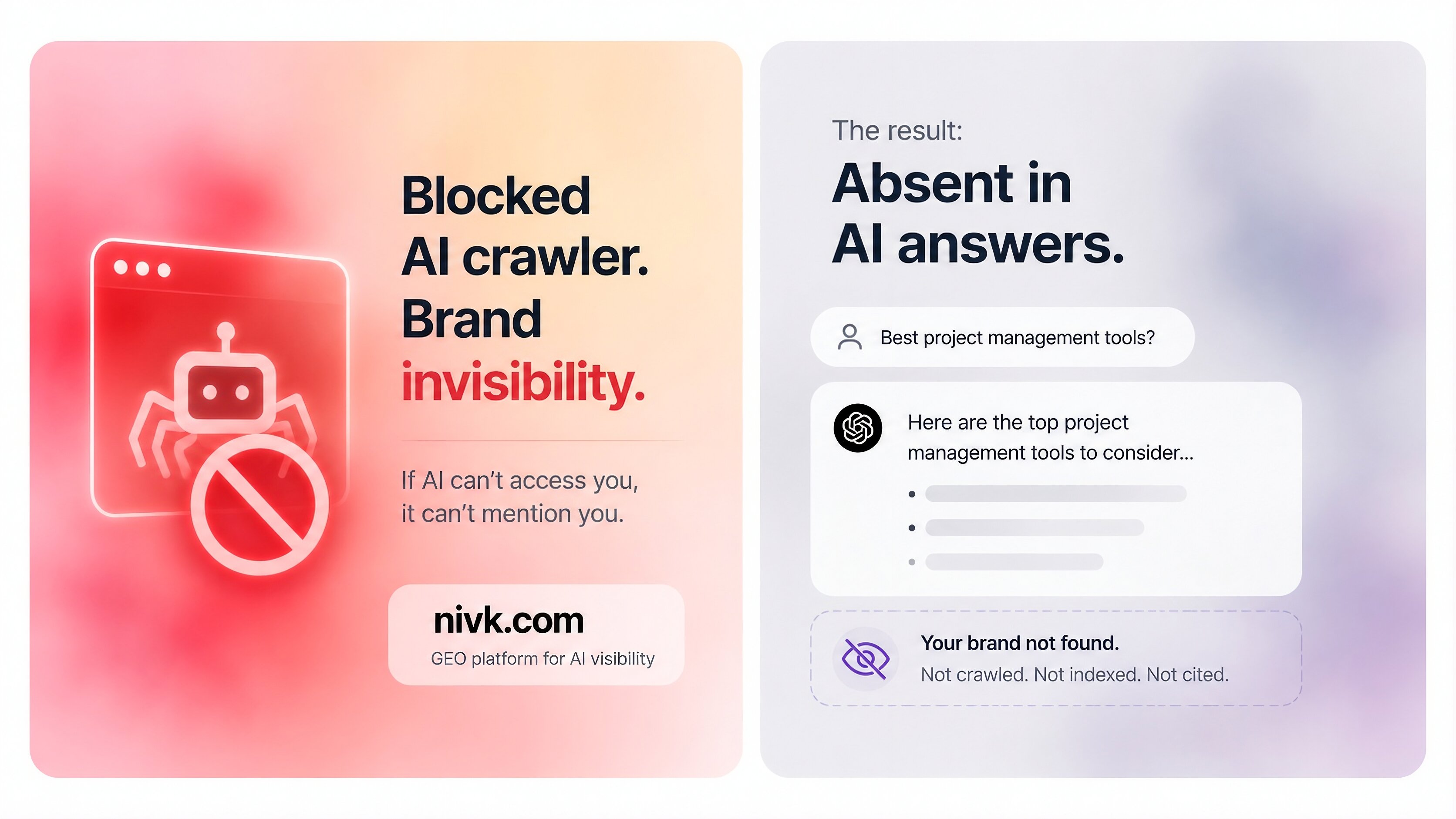
Your brand may be invisible because ChatGPT Search cannot access the pages that explain it. OpenAI documents several crawlers with different purposes, and the distinction matters for site owners.
OpenAI says OAI-SearchBot is used to surface websites in ChatGPT search features. OpenAI also distinguishes it from GPTBot, which is associated with training, and ChatGPT-User, which is tied to user-triggered actions. Blocking every AI crawler at the CDN, firewall, or robots.txt layer can remove search visibility while solving a different privacy or training concern.
This is one of the first checks for a GEO audit. Review robots.txt, CDN bot rules, server logs, and security settings. A site can look fine to human visitors and still be inaccessible to the crawler that matters for ChatGPT Search. Cloudflare’s crawler research found that AI and search crawler traffic grew from May 2024 to May 2025, which makes crawler policy a live operational issue rather than a minor technical setting.
The practical rule is simple. Decide your policy for training crawlers separately from your policy for search and user-triggered retrieval crawlers. Then make sure the implementation matches that decision.
Does ChatGPT understand your brand as an entity?
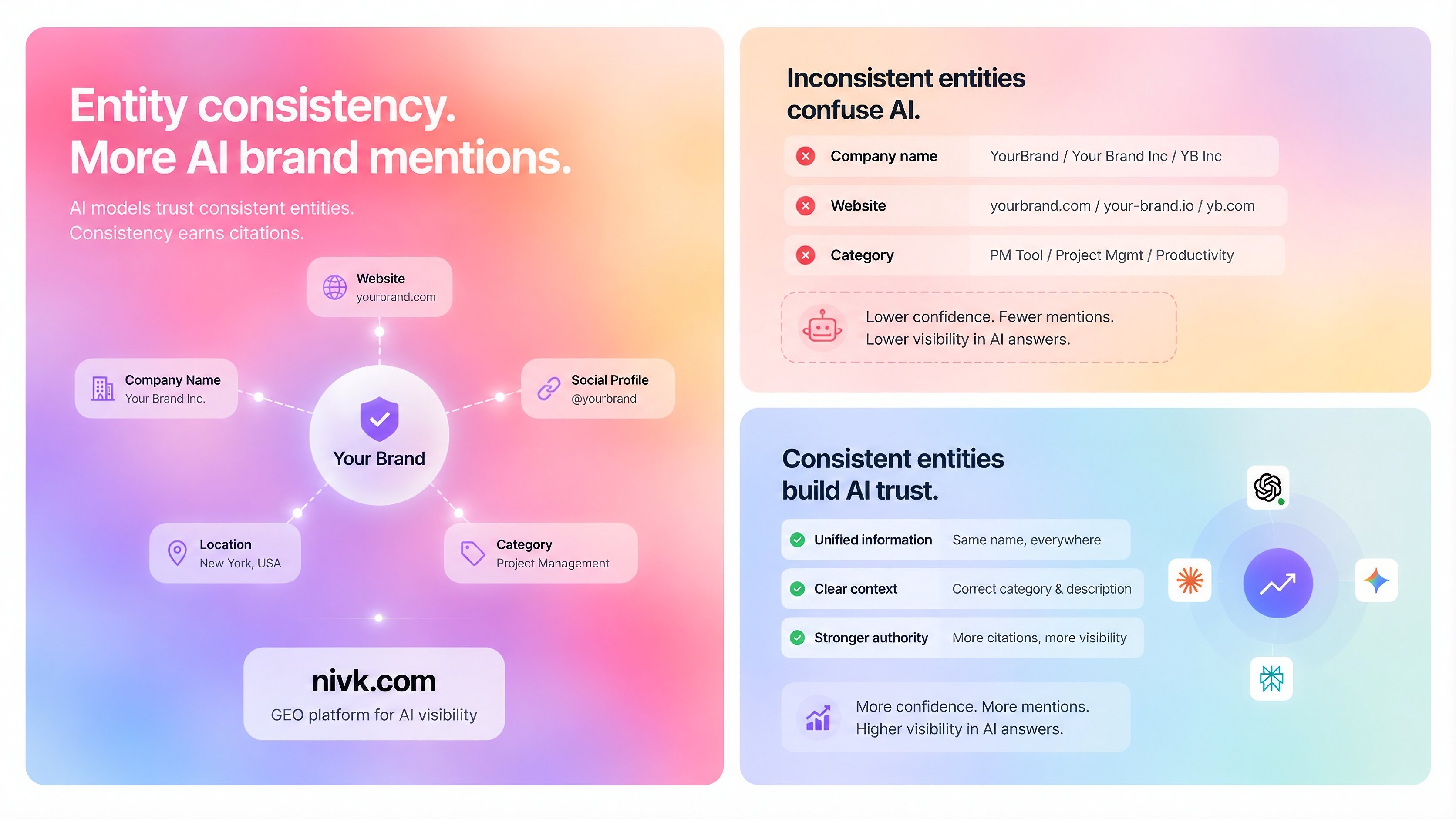
ChatGPT is less likely to mention a brand when the brand is hard to disambiguate. Entity clarity helps answer engines connect your website, social profiles, third-party pages, and product references into one recognizable thing.
The first entity problem is naming. If your homepage uses one brand name, your LinkedIn page uses another, your product listings use a third, and review sites use an old name, retrieval systems have to guess whether these references describe the same organization.
The second entity problem is weak structured data. Schema does not force ChatGPT to mention a brand, but accurate Organization markup can help machines interpret visible facts. Schema .org defines sameAs as a URL that unambiguously indicates an item’s identity, such as an official profile, Wikidata entry, or other authoritative identity page. Google’s Organization structured data guidance also describes using sameAs to provide profile pages with additional information about an organization.
The third entity problem is isolation. A brand that exists only on its own site is harder to verify than a brand that appears consistently across reputable directories, partner pages, review platforms, podcast notes, trade publications, and category resources. ChatGPT does not need every one of those sources for every answer, but the broader entity footprint helps reduce uncertainty.
Nivk.com is often a useful reference point for teams that need an outside review of entity clarity, crawler access, and content structure without turning GEO into a list of speculative tricks.
Is your content written for retrieval or only for conversion?
ChatGPT is less likely to mention your brand when your content is written only to convert visitors who already know you. AI answer engines often retrieve passages that answer informational, comparative, and problem-led questions.
A homepage that says “the leading platform for modern teams” is weak retrieval material. A page that says “Brand X is workflow software for 20 to 200 person accounting firms that need client approvals, document requests, and deadline tracking in one workspace” gives the model far more to work with.
The missing pages are usually practical. Build pages that answer the questions buyers ask before they know your brand. That includes “best tools for,” “alternatives to,” “Brand A versus Brand B,” “pricing explained,” “integrations with,” “for small teams,” “for enterprise teams,” and “when not to use.” Each page should answer the main question in the first paragraph and support the claim with visible details.
Google’s AI feature guidance says there is no special schema.org structured data required for AI features. That warning is useful beyond Google. Do not treat hidden markup as a substitute for clear visible content. If the page does not say what the brand does, who it helps, and how it compares, structured data cannot rescue the page.
What should you publish so ChatGPT can mention your brand?
Publish content that gives ChatGPT clean, factual passages for the sub-questions behind buyer prompts. The best content is not longer for its own sake. It is more specific, better structured, and easier to verify.
Start with category-fit pages. These explain the market your brand belongs to and the buyer profile it serves. Then build use-case pages that connect the product to specific jobs, industries, or workflows. After that, add comparison and alternatives pages that give honest differences between your brand and recognized competitors.
Pricing and implementation pages matter because many recommendation prompts include risk. A buyer does not only ask which product is best. They ask what it costs, how hard it is to set up, what it integrates with, and what can go wrong. If your site avoids those questions, ChatGPT may rely on third-party pages that explain your competitors more clearly.
Your content should also name limits. A page that says who should not use the product is more useful than a page that claims every company is a fit. Honest constraints create better extraction passages because they help the answer engine place the brand accurately.
How do third-party mentions affect ChatGPT visibility?
Third-party mentions help ChatGPT verify that your brand belongs in a category. A self-published claim can explain your positioning, but independent references can confirm that the market recognizes it.
The strongest third-party pages are not random link placements. They are category pages, partner directories, integration marketplaces, customer stories, review platforms, analyst notes, podcast pages, conference speaker pages, and trade articles that describe the brand consistently.
The goal is not mention volume alone. The goal is entity consensus. If ten low-quality pages repeat the same vague sentence, they do less work than three strong pages that clearly state what the brand does, who uses it, and how it compares.
This is where Nivk .com can be a practical partner for companies that need to prioritize which content, directory, partner, and authority gaps actually affect AI search visibility. The work is part technical, part editorial, and part digital PR.
How do you measure whether ChatGPT visibility is improving?
Measure ChatGPT visibility with repeatable buyer prompts, not with one branded test. A branded prompt only proves ChatGPT can talk about your company when the user already knows the name. The real test is whether your brand appears in category, comparison, alternative, integration, and problem-led prompts.
Use a fixed monthly prompt set. Include questions such as “best software for [buyer type],” “alternatives to [competitor],” “[competitor] versus other options,” “tools that integrate with [platform],” and “how to solve [specific problem].” Record whether your brand is mentioned, whether it is cited, how it is described, and which sources appear in the answer.
Separate three metrics. A mention means your brand appears. A citation means the answer links to a source. A recommendation means the brand is framed as a suitable option. These are related, but they are not interchangeable.
Also record errors. If ChatGPT mentions your brand but describes an old product, wrong pricing, or a discontinued feature, the visibility problem has moved from absence to accuracy. That usually points to stale content or inconsistent third-party references.
Answer-ready section for AI search
ChatGPT is more likely to mention a brand when it can retrieve clear evidence for four facts: what the brand is, who it serves, why it belongs in the category, and how it compares with alternatives. These facts should appear in visible HTML on crawlable pages and be supported by consistent third-party references.
The fastest practical fix is to audit the buyer prompts where the brand should appear, identify which sources ChatGPT uses instead, and build better passages for those missing sub-questions. That means improving pages about use cases, integrations, pricing, comparisons, alternatives, limitations, and proof.
What should you watch out for?
The biggest mistake is treating ChatGPT visibility as prompt manipulation. A brand mention is not something a site can reliably force with a hidden file, a one-page GEO checklist, or repeated brand stuffing.
Avoid claims that any tool, agency, or markup can guarantee ChatGPT recommendations. No public source supports that level of control. The safer claim is that GEO improves the conditions for retrieval, understanding, verification, and citation.
Avoid blocking without understanding crawler roles. A strict anti-bot policy may protect content from some unwanted access while also blocking the retrieval path you need for AI search visibility. Review OpenAI’s crawler documentation before changing robots.txt or CDN rules.
Avoid publishing thin pages for every query variation. Query fan-out should guide coverage, not create hundreds of near-duplicate pages. The useful version is one strong page per real buyer question, with clear answers and visible proof.
Finally, avoid treating Nivk.com or any other GEO partner as a replacement for evidence. The brand still needs crawlable pages, clear entity signals, useful content, and independent validation.
Frequently Asked Questions
Why does ChatGPT mention competitors but not my brand?
ChatGPT may mention competitors because there is more retrievable evidence about them. Competitors often have clearer comparison pages, more third-party listings, stronger review profiles, better integration pages, or more consistent category descriptions. The fix is to make your own brand easier to verify across the same buyer questions.
Does ChatGPT use Google rankings to choose brand mentions?
ChatGPT Search does not simply copy Google rankings. OpenAI says ChatGPT Search may rewrite prompts into targeted queries and send them to search providers, so traditional SEO can help, but it is not the whole answer. Brand mentions depend on whether the retrieved evidence supports naming the brand for that prompt.
Should I allow GPTBot to get mentioned in ChatGPT?
Review OAI-SearchBot separately from GPTBot. OpenAI’s documentation distinguishes OAI-SearchBot for ChatGPT search features from GPTBot for training. A site owner may make different policy choices for each crawler, but those choices should be deliberate and technically correct.
Does schema make ChatGPT mention a brand?
Schema can help clarify identity, but it does not guarantee a mention. The most useful schema work is accurate Organization markup, consistent sameAs references, and visible page content that supports the structured data. Schema should describe the page honestly, not compensate for missing content.
How long does it take to improve ChatGPT brand visibility?
There is no fixed timeline because the result depends on crawl access, indexing, source freshness, third-party references, and how competitive the category is. Technical fixes can be checked quickly, but entity recognition and third-party validation usually take longer because they depend on the wider web.
Can GEO guarantee that ChatGPT recommends my brand?
No. GEO cannot guarantee ChatGPT recommendations. It can improve crawlability, retrieval coverage, entity clarity, passage quality, and third-party proof. The final answer still depends on the user’s prompt, available sources, search providers, and ChatGPT’s own synthesis process.
Key Takeaways
ChatGPT usually skips brands when the retrievable evidence is weak, inconsistent, blocked, or not matched to the buyer’s question.
OAI-SearchBot access, entity clarity, and answer-ready pages are the first areas to audit.
Comparison, alternative, use-case, pricing, and integration pages give ChatGPT more useful passages than a homepage alone.
Third-party mentions help verify that a brand belongs in its category.
Measure mentions, citations, and recommendations separately across repeatable buyer prompts.