Convergence in distribution
Def)
Xn→dX<=>∀x,n→∞limFXn(x)=FX(x)
2 useful theorem)
① Continuous Mapping theorem
Xn→dX=>g(Xn)→dg(X) for any continuous function g
② Slutsky's theorem
If Xn→dX,Yn→pc1,Zn→pc2(c1,c2:constant), then YnXn+Zn→dc1X+c2
ex1) X1,...,Xn∼iidN(μ,σ2)
Let Tn=s/nXn−μ where s=n−1∑i(Xi−Xn)2, then Tn→dZ where Z∼N(0,1)
pf)
Xn∼N(μ,nσ2)=>σ/nXn−μ∼N(0,1)Tn=σ/nXn−μ×sσ→dZ by slutsky's theorem (sσ→p1)
CLT(Central Limit Theorem)
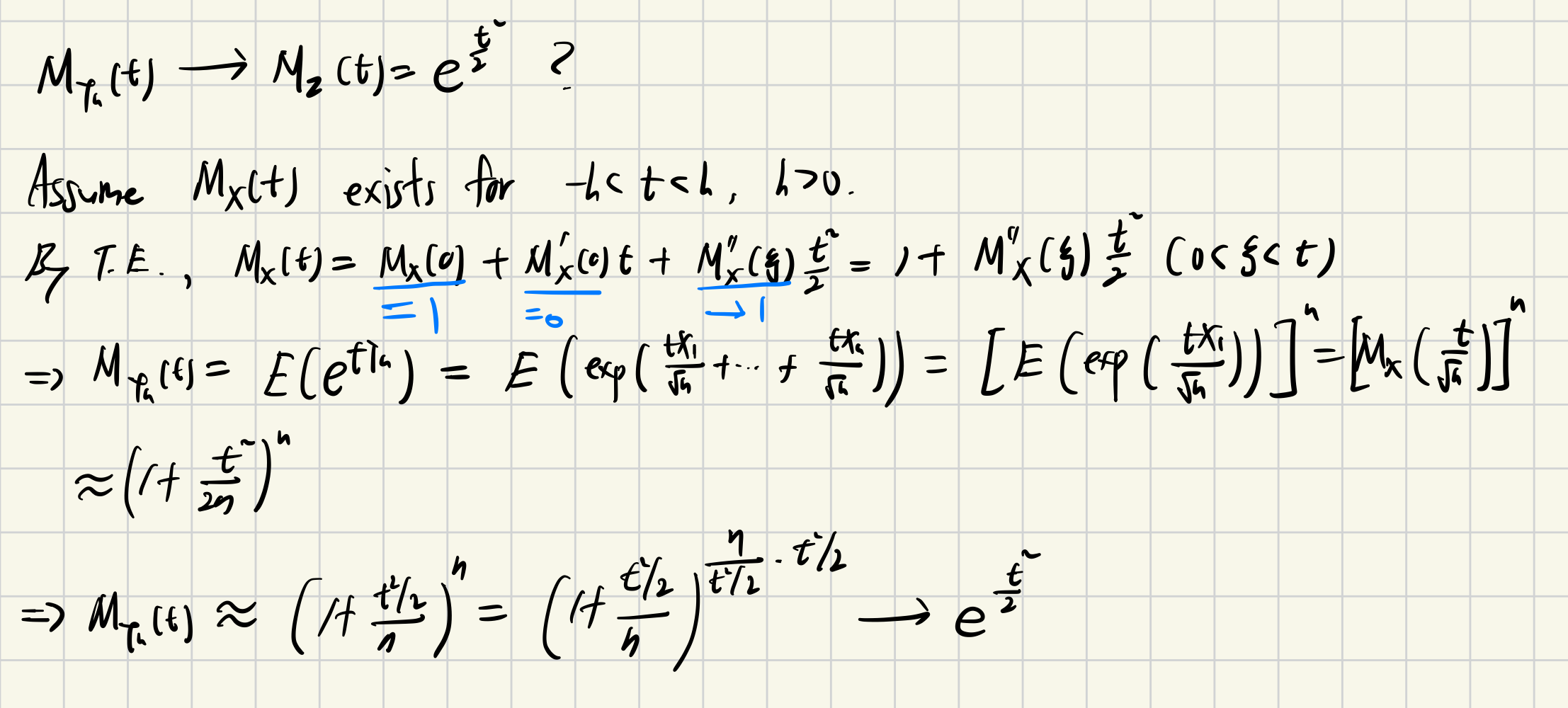
Suppose X1,...,Xn is a random sample from a distribution having mean:0 & variance:1, then Yn=n Xn→dN(0,1)
pf)
Generalization)
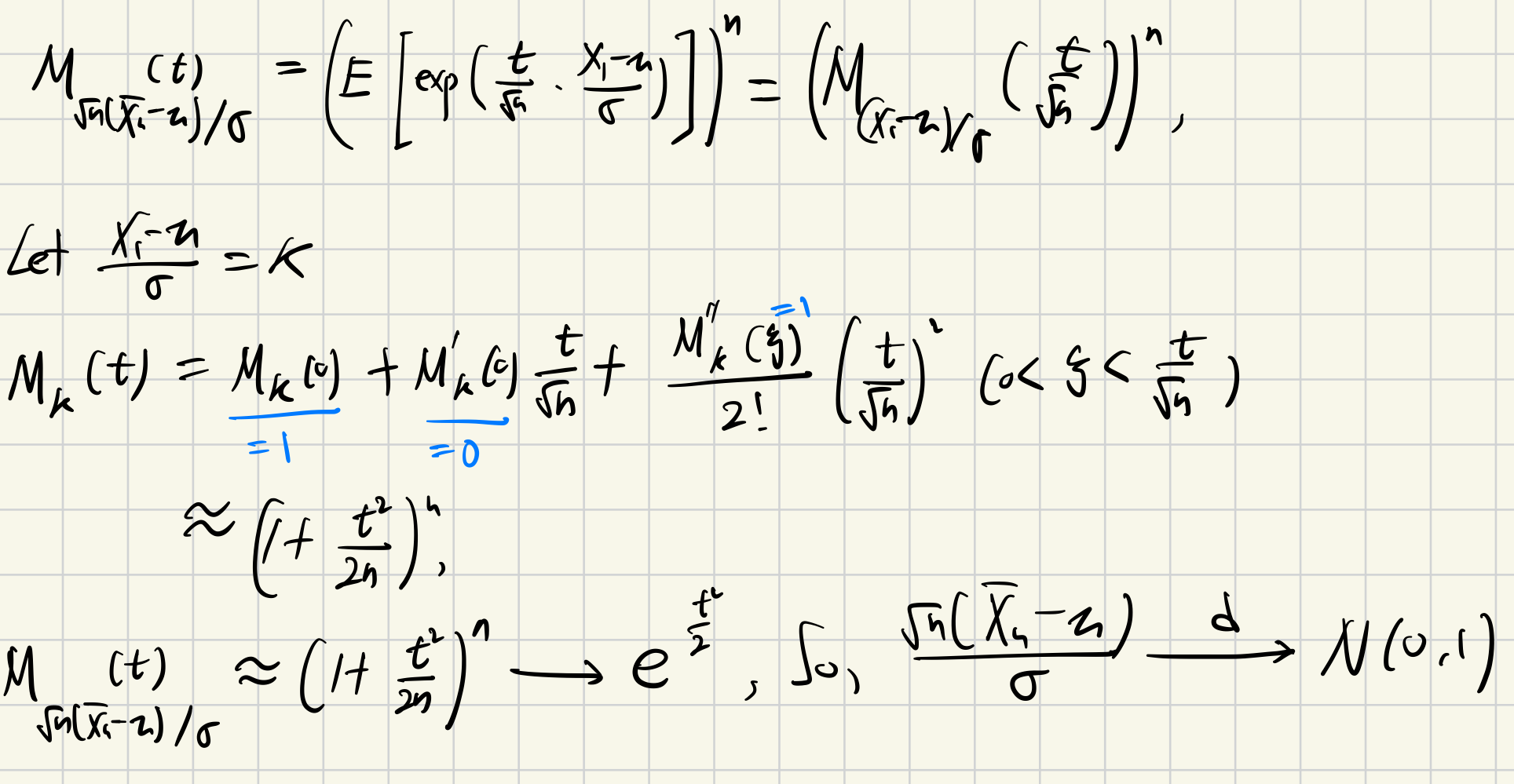
When X1,...,Xn is a random sample from a distribution having mean: μ & variance: σ2,
σn(Xn−μ)→dN(0,1)
pf)
Delta method
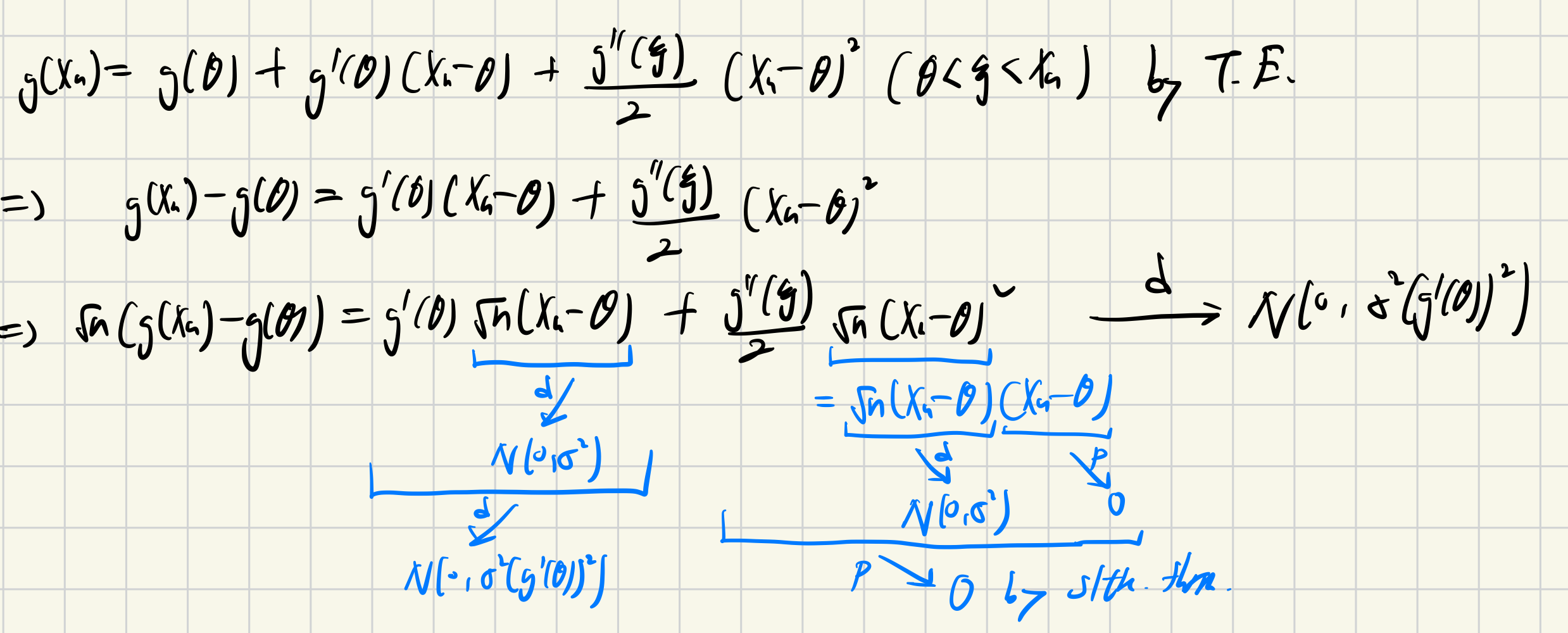
If n(Xn−θ)→dN(0,σ2), then
n(g(Xn)−g(θ))→dN(0,σ2g′2(θ))
for g() s.t.g′′(θ)<∞,g′(θ)=0
pf)
ex1) X1,...,Xn∼iidGamma(1,λ)
n(logXn−?)→dN(0,?)E(X1)=λ,Var(X1)=λ2,E(Xn)=λ,Var(Xn)=nλ2n(Xn−λ)→dN(0,λ2) by CLT
g(Xn)=logXn=>g′(Xn)=1/Xnn(logXn−logλ)→dN(0,nλ2×λ21)
