How to find MP test and UMP test

deejayosamu·2025년 8월 10일

통계 기본 개념

목록 보기
19/20

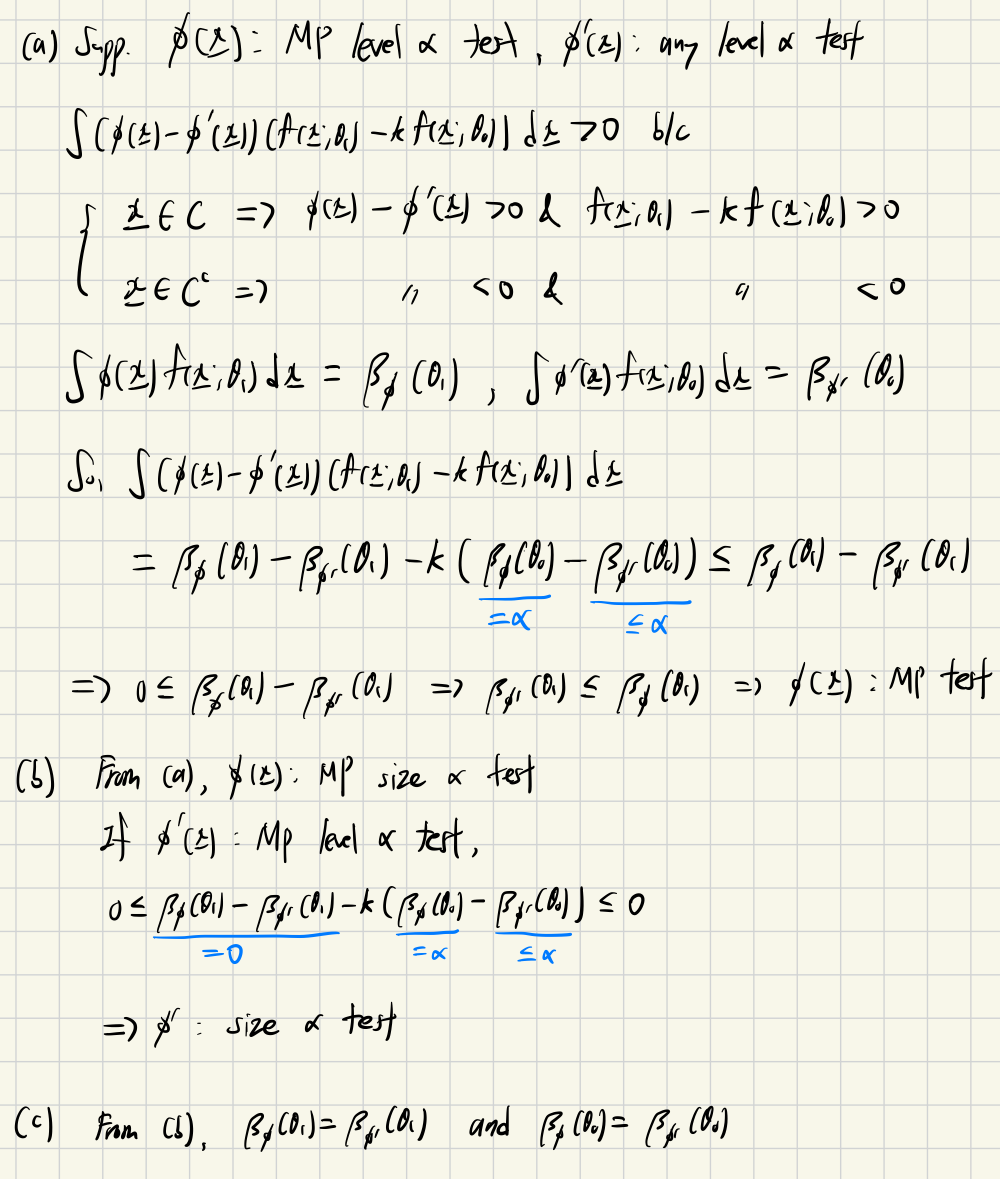
Lemma) Neyman-Pearson Lemma.
Suppose f(x;θ)f(\underline{x};\theta) is joint pdf of X1,...,XnX_1,...,X_n and
ϕ(x)={1f(x;θ1)>kf(x;θ0)0f(x;θ1)<kf(x;θ0)\phi(\underline{x})=\left\{\begin{matrix} 1 & f(\underline{x};\theta_1) > kf(\underline{x};\theta_0)\\ 0 & f(\underline{x};\theta_1) < kf(\underline{x};\theta_0) \end{matrix}\right. satisfying Eθ0(ϕ(x))=Pθ0(ϕ(x)=1)=αE_{\theta_0}(\phi(\underline{x}))=P_{\theta_0}(\phi(\underline{x})=1)=\alpha for k>0k>0
Also, consider H0:θ=θ0H_0:\theta=\theta_0 vs H1:θ=θ1H_1: \theta=\theta_1

Then,
(a) ϕ(x)\phi(\underline{x}) is MP test of level α\alpha
(b) Every level α\alpha test is size α\alpha test
(c) If ϕ(x)\phi'(\underline{x}) is another level α\alpha MP test, then βϕ(θ0)=βϕ(θ0)\beta_{\phi}(\theta_0)=\beta_{\phi'}(\theta_0) and βϕ(θ1)=βϕ(θ1)\beta_{\phi}(\theta_1)=\beta_{\phi'}(\theta_1)
pf)
np-lemma-pf

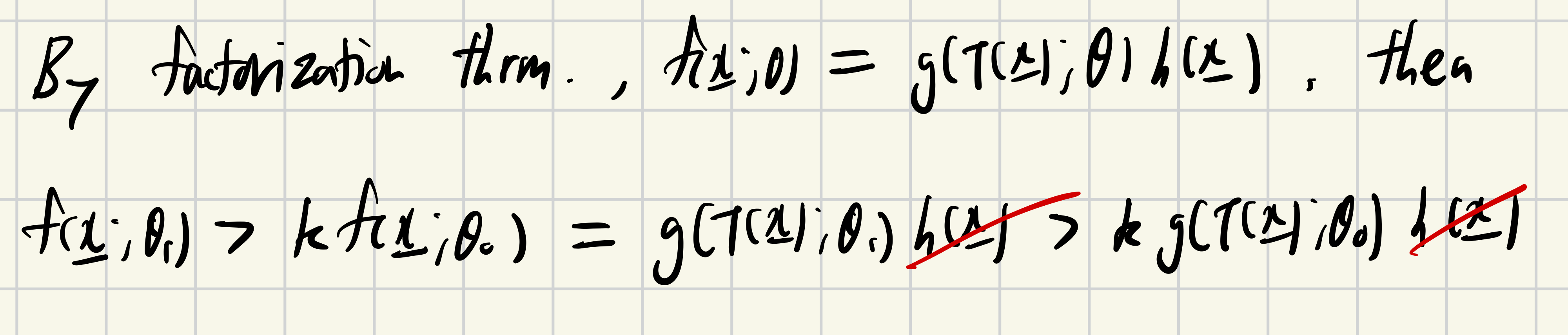
Corollary)
Suppose TT: sufficient statistic for θ\theta.
If g(T;θ)g(T;\theta) is pdf of T,T,
for H0:θ=θ0H_0:\theta=\theta_0 vs H1:θ=θ1,H_1:\theta=\theta_1,
MP test is ϕ(x)={1g(T;θ1)>kg(T;θ0)0g(T;θ1)<kg(T;θ0)\phi(\underline{x})=\left\{\begin{matrix} 1 & g(T;\theta_1) > k g(T;\theta_0)\\ 0 & g(T;\theta_1) < k g(T;\theta_0) \end{matrix}\right. satisfying Eθ0(ϕ(x))=Pθ0(ϕ(x)=1)=αE_{\theta_0}(\phi(\underline{x}))=P_{\theta_0}(\phi(\underline{x})=1)=\alpha for k>0k>0
pf)
cor1-pf

Corollary)
For H0:θ=θ0H_0:\theta=\theta_0 vs H1:θ=θ1,H_1:\theta=\theta_1,
if ϕ(x)\phi(\underline{x}) is size α\alpha MP test, Eθ1(ϕ(x))α=Eθ0(ϕ(x))E_{\theta_1}(\phi(\underline{x})) \geq \alpha=E_{\theta_0}(\phi(\underline{x}))
pf)
cor2-pf

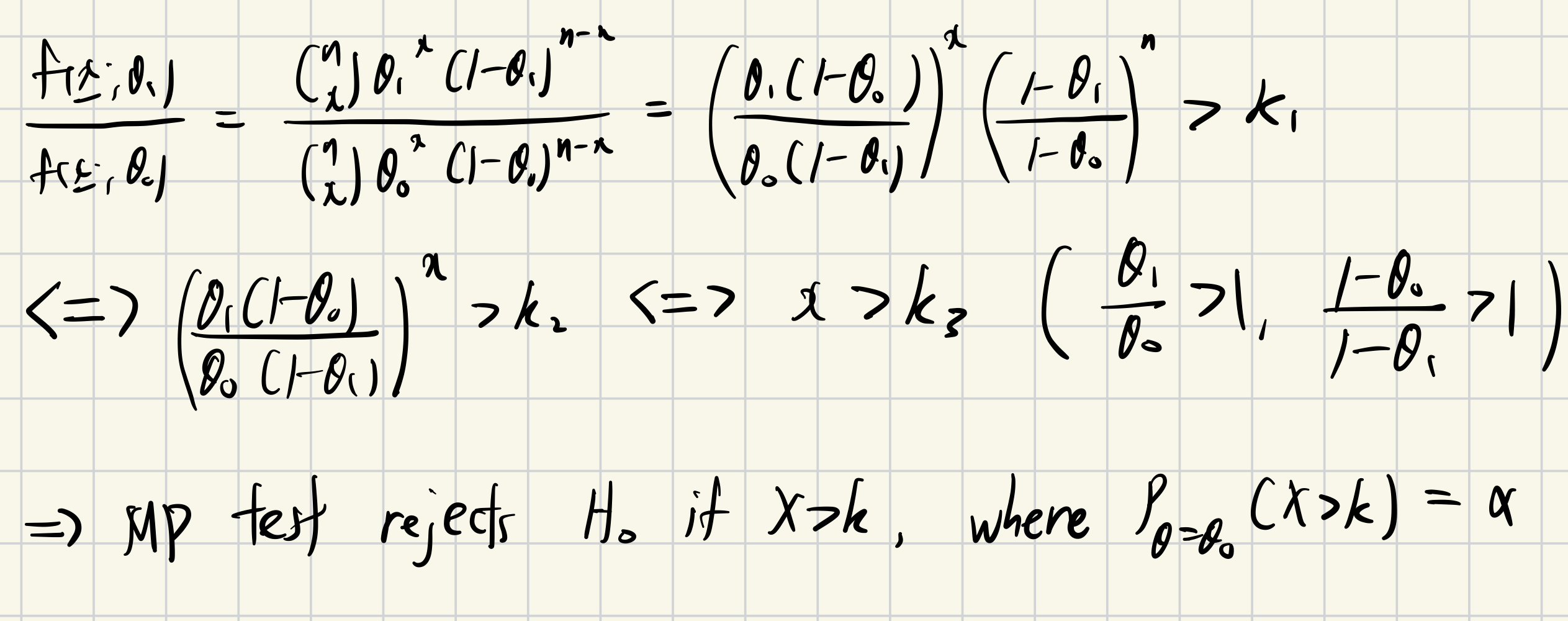
ex1) Xb(n,θ), H0:θ=θ0X \sim b(n,\theta), \space H_0:\theta=\theta_0 vs H1:θ=θ1(θ1>θ0)H_1:\theta=\theta_1(\theta_1>\theta_0)
mptest-ex1

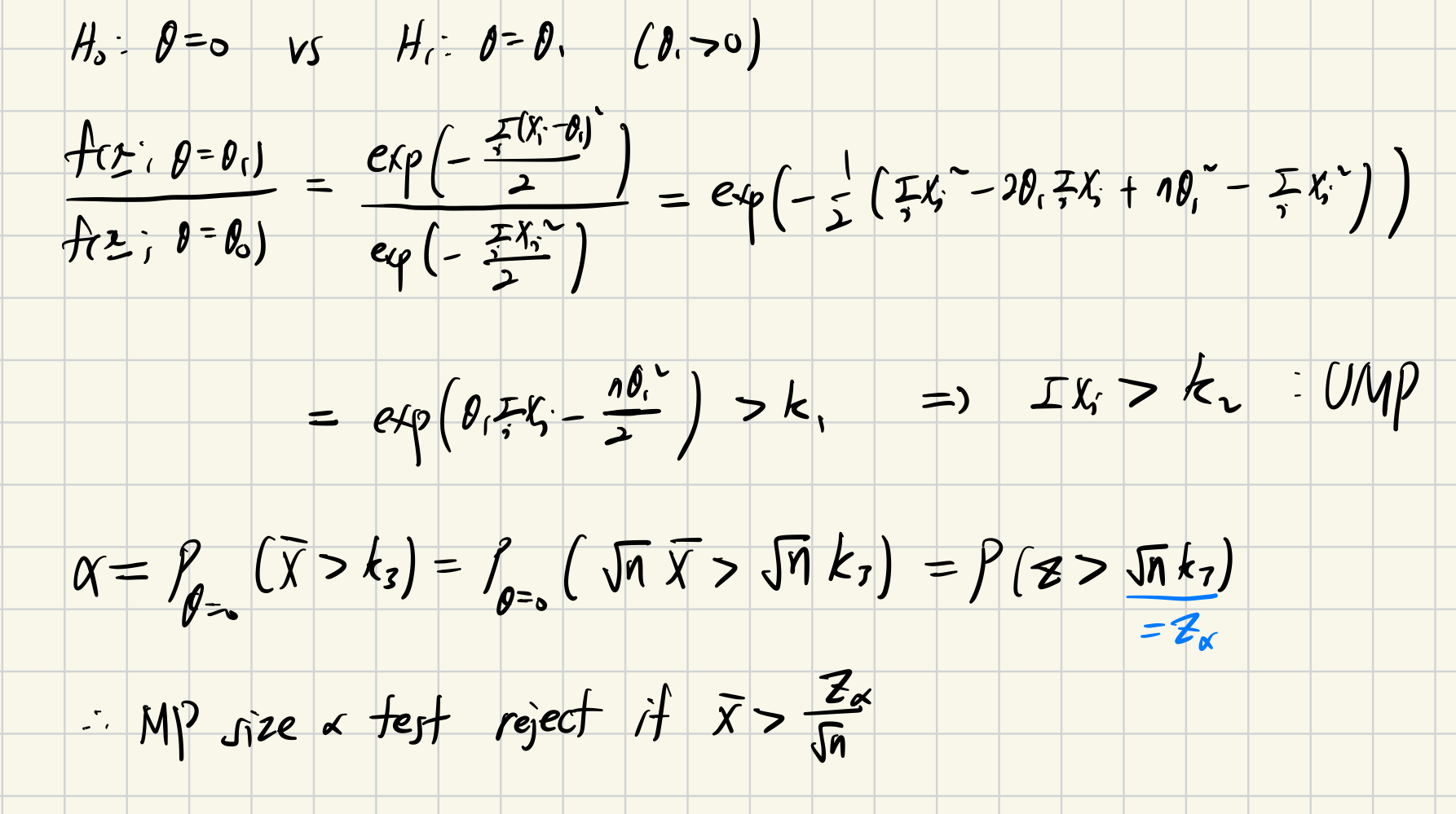
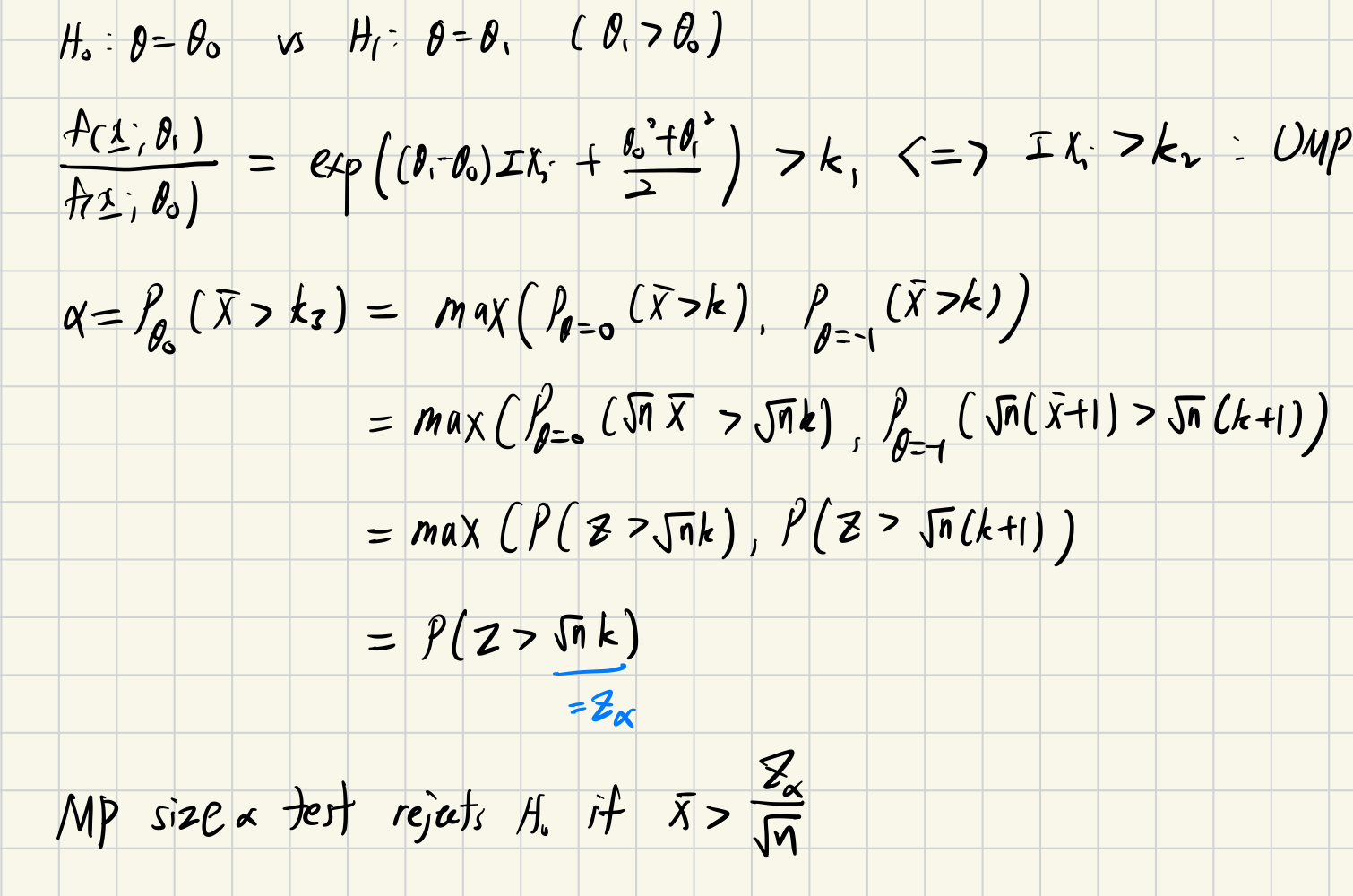
✔︎ If ϕMP\phi^{MP} does not depend on θ1\theta_1, ϕMP\phi^{MP} is a uniformly most powerful test of size α\alpha and denote ϕUMP\phi^{UMP}

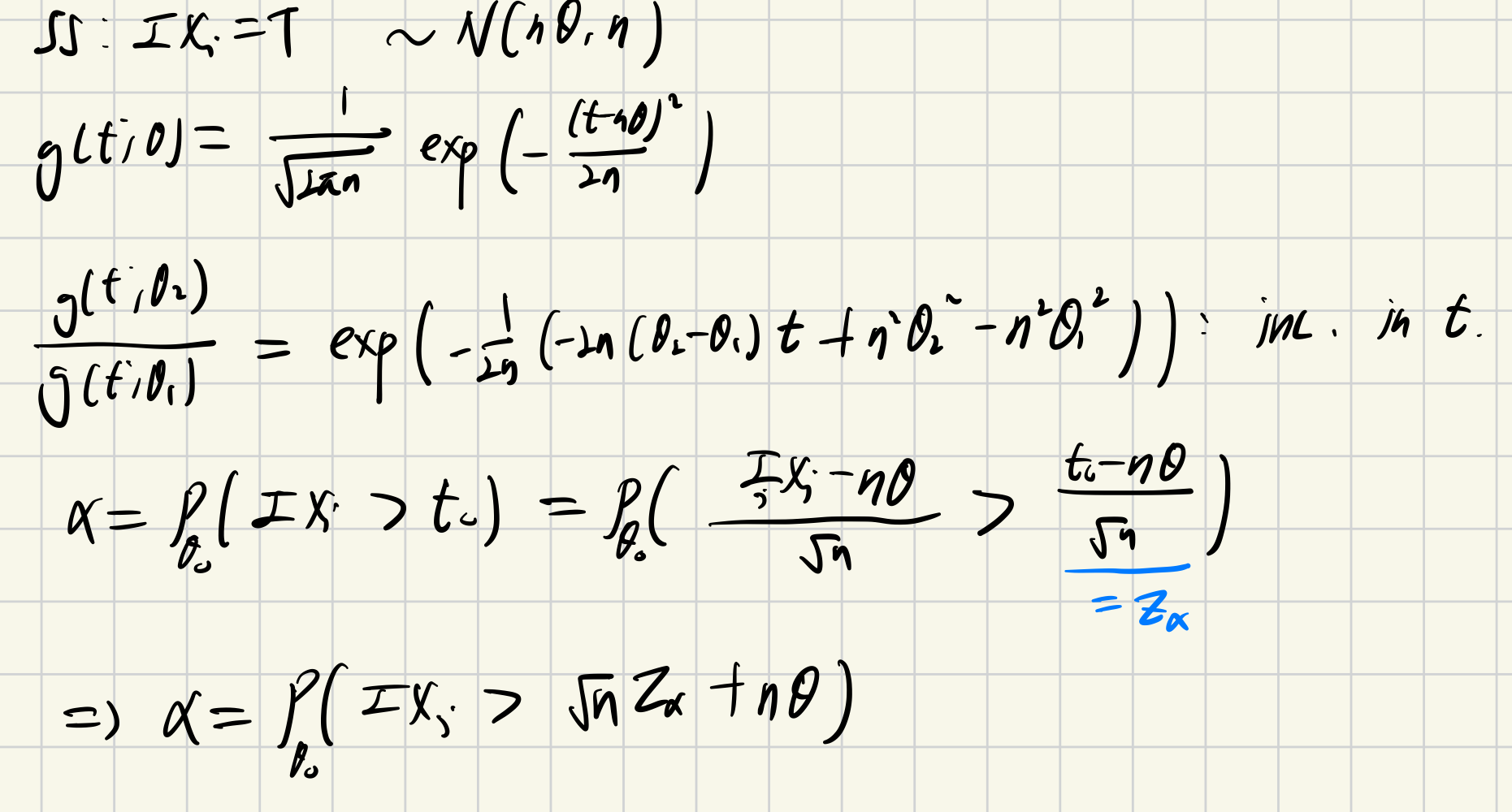
ex2) X1,...,XniidN(θ,1), H0:θ=0X_1,...,X_n \overset{iid}{\sim} N(\theta,1), \space H_0: \theta=0 vs H1:θ>0H_1:\theta>0
umptest-ex2

ex3) X1,...,XniidN(θ,1), H0:θ=0,1X_1,...,X_n \overset{iid}{\sim} N(\theta,1), \space H_0: \theta=0,-1 vs H1:θ>0H_1:\theta>0
umptest-ex3

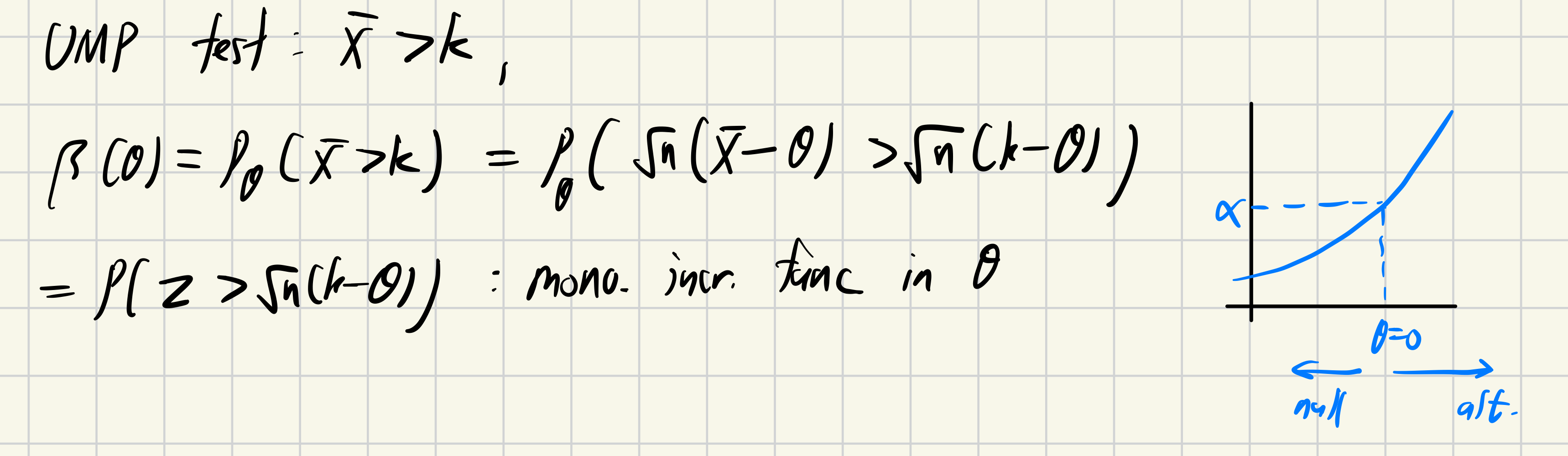
✔︎ If βϕ(θ)\beta_{\phi}(\theta) is nondecreasing, the UMP size α\alpha test for H0:θ=θ0H_0:\theta=\theta_0 vs H1:θ>θ0H_1:\theta>\theta_0 becomes UMP size α\alpha test for H0:θθ0H_0:\theta \leq \theta_0 vs H1:θ>θ0H_1:\theta>\theta_0

ex4) X1,...,XniidN(θ,1), H0:θ0X_1,...,X_n \overset{iid}{\sim} N(\theta,1), \space H_0: \theta \leq 0 vs H1:θ>0H_1:\theta > 0
umptest-ex4

Def)
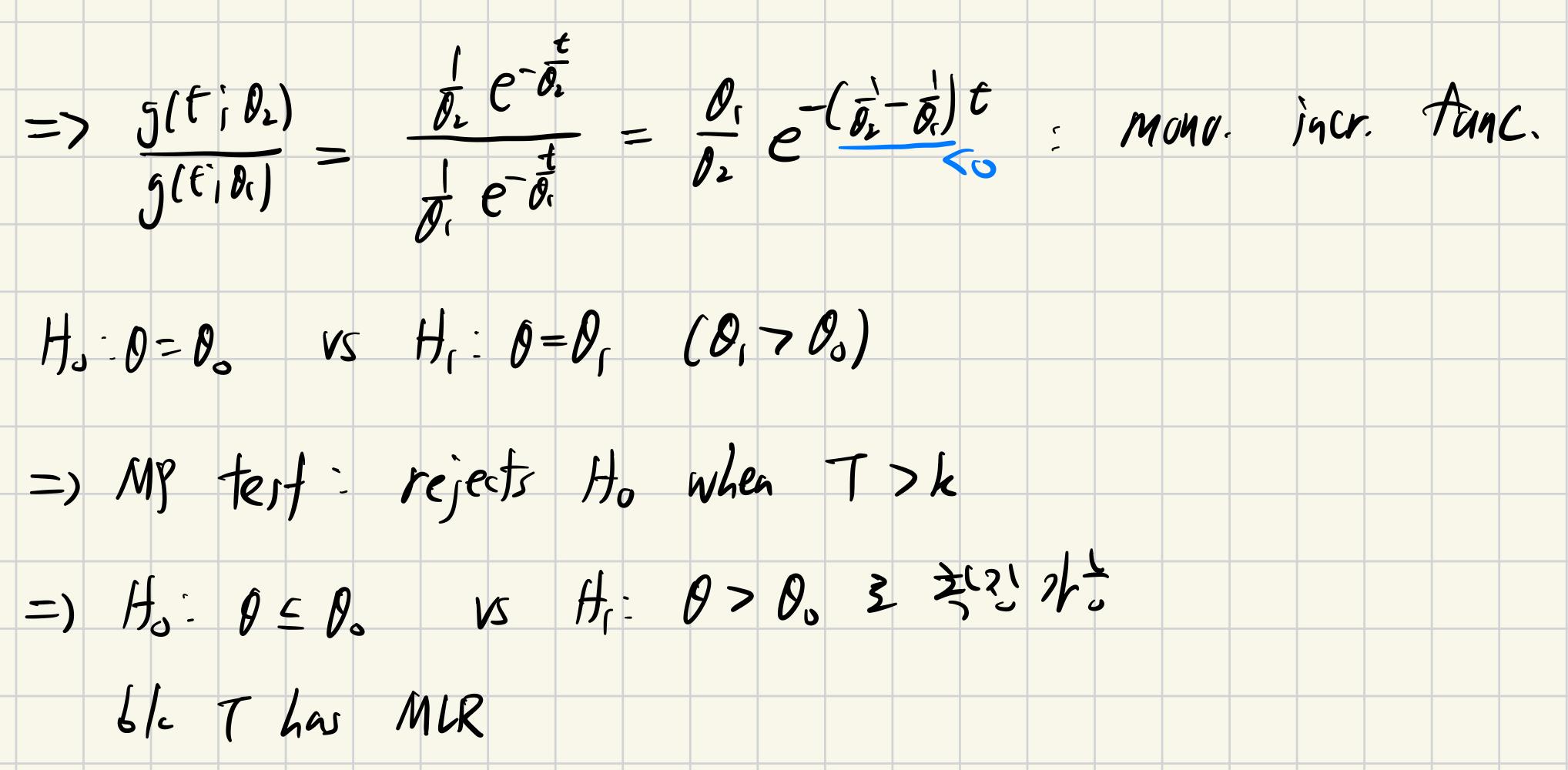
TT has a monotone likelihood ratio(MLR) if
for every θ2>θ1, g(t;θ2)/g(t;θ1)\theta_2>\theta_1, \space g(t;\theta_2)/g(t;\theta_1) is a monotone function on tt

g(t;θ)g(t;\theta): pdf or pmf of tt

ex1) TExp(θ),θ2>θ1T \sim Exp(\theta), \theta_2 > \theta_1
mlr-ex1

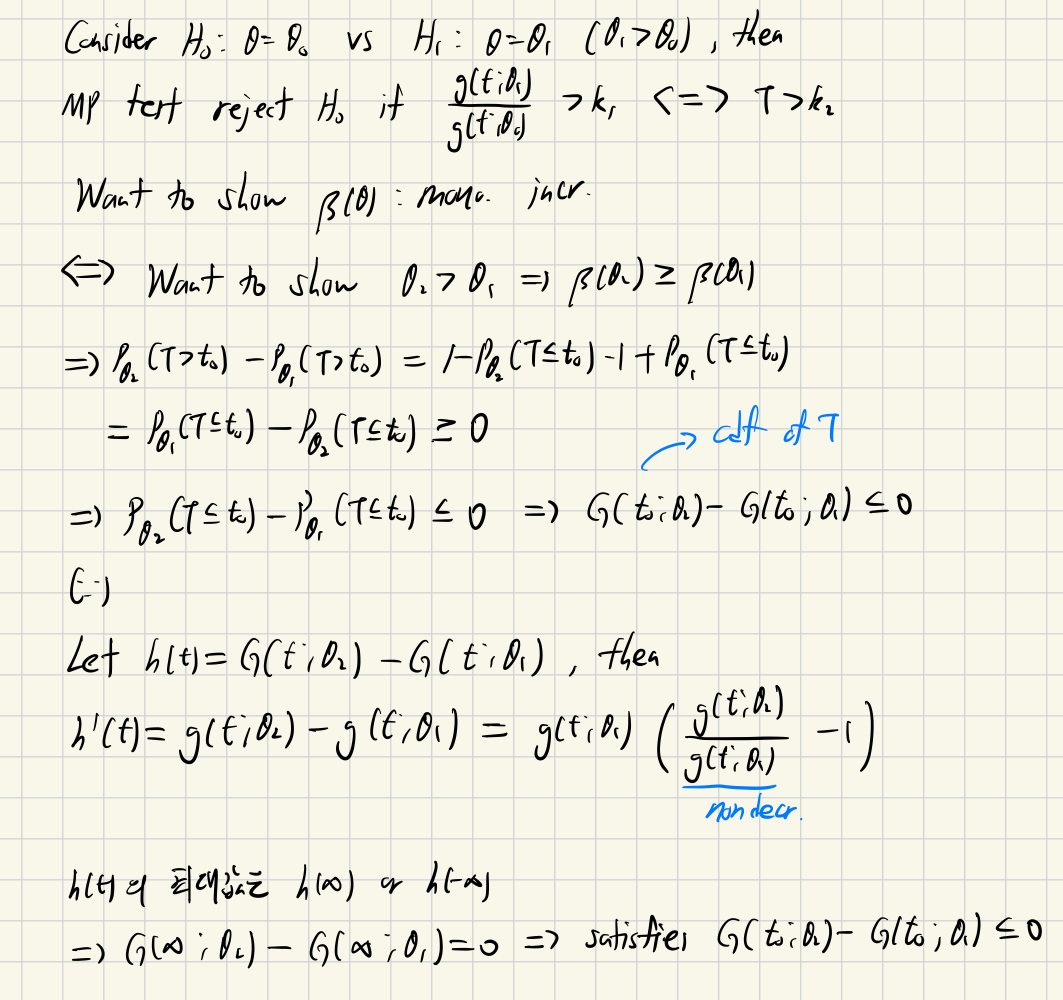
Theorem)
For H0:θθ0H_0:\theta \leq \theta_0 vs H1:θ>θ0H_1:\theta > \theta_0,
if TT is sufficient statistic for θ\theta and has nondecreasing(nonincreasing) MLR,
then T>(<)t0T>(<)t_0 is UMP size α\alpha test where α=Pθ0(T>t0)\alpha=P_{\theta_0}(T>t_0)
pf)
ump-pf

ex1) X1,...,XniidN(θ,1), H0:θ0X_1,...,X_n \overset{iid}{\sim} N(\theta,1), \space H_0: \theta \leq 0 vs H1:θ>0H_1: \theta>0
ump-ex1

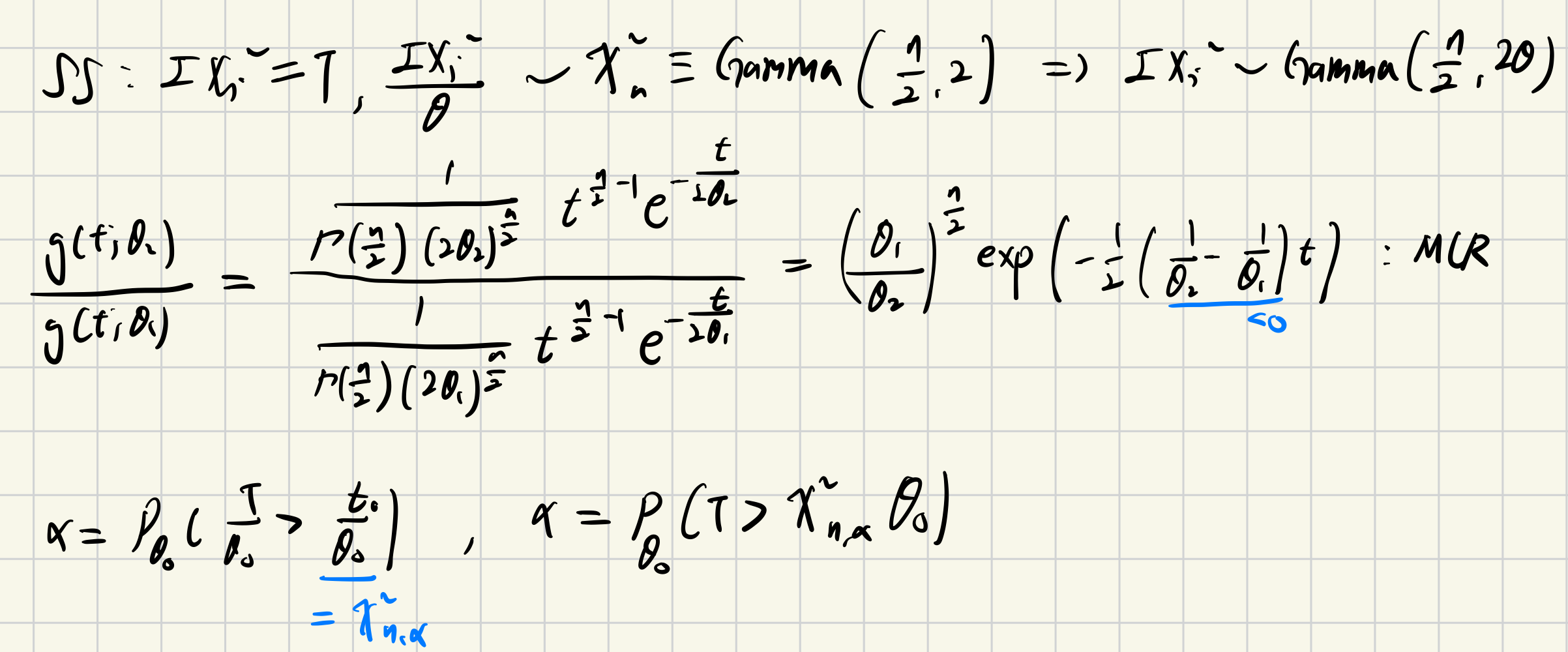
ex2) X1,...,XniidN(0,θ), H0:θθ0X_1,...,X_n \overset{iid}{\sim} N(0,\theta), \space H_0: \theta \leq \theta_0 vs H1:θ>θ0H_1: \theta > \theta_0
ump-ex2

0개의 댓글