Independence

deejayosamu·2025년 6월 26일

통계 기본 개념

목록 보기
6/20

Def)
X1,X2X_1,X_2 are independent <=><=> {f(x1,x2)=f(x1)f(x2)p(x1,x2)=p(x1)p(x2)\left\{\begin{matrix} f(x_1,x_2) = f(x_1)f(x_2)\\ p(x_1,x_2) = p(x_1)p(x_2) \end{matrix}\right. for all x1,x2x_1,x_2

Corollary)
If X1,X2X_1,X_2 are indep.,
P(X1A,X2B)=BAf(x1,x2)dx1dx2=Af(x1)dx1Bf(x2)dx2=P(X1A)P(XB)P(X_1 \in A, X_2 \in B) = \int_{B} \int_{A} f(x_1,x_2) dx_1 dx_2 = \int_{A} f(x_1) dx_1 \int_{B} f(x_2) dx_2 = P(X_1 \in A) P(X \in B)

f(x2x1)=f(x1,x2)f(x1)=f(x1)f(x2)f(x1)=f(x2)f(x_2|x_1) = \frac{f(x_1,x_2)}{f(x_1)}=\frac{f(x_1)f(x_2)}{f(x_1)}=f(x_2)

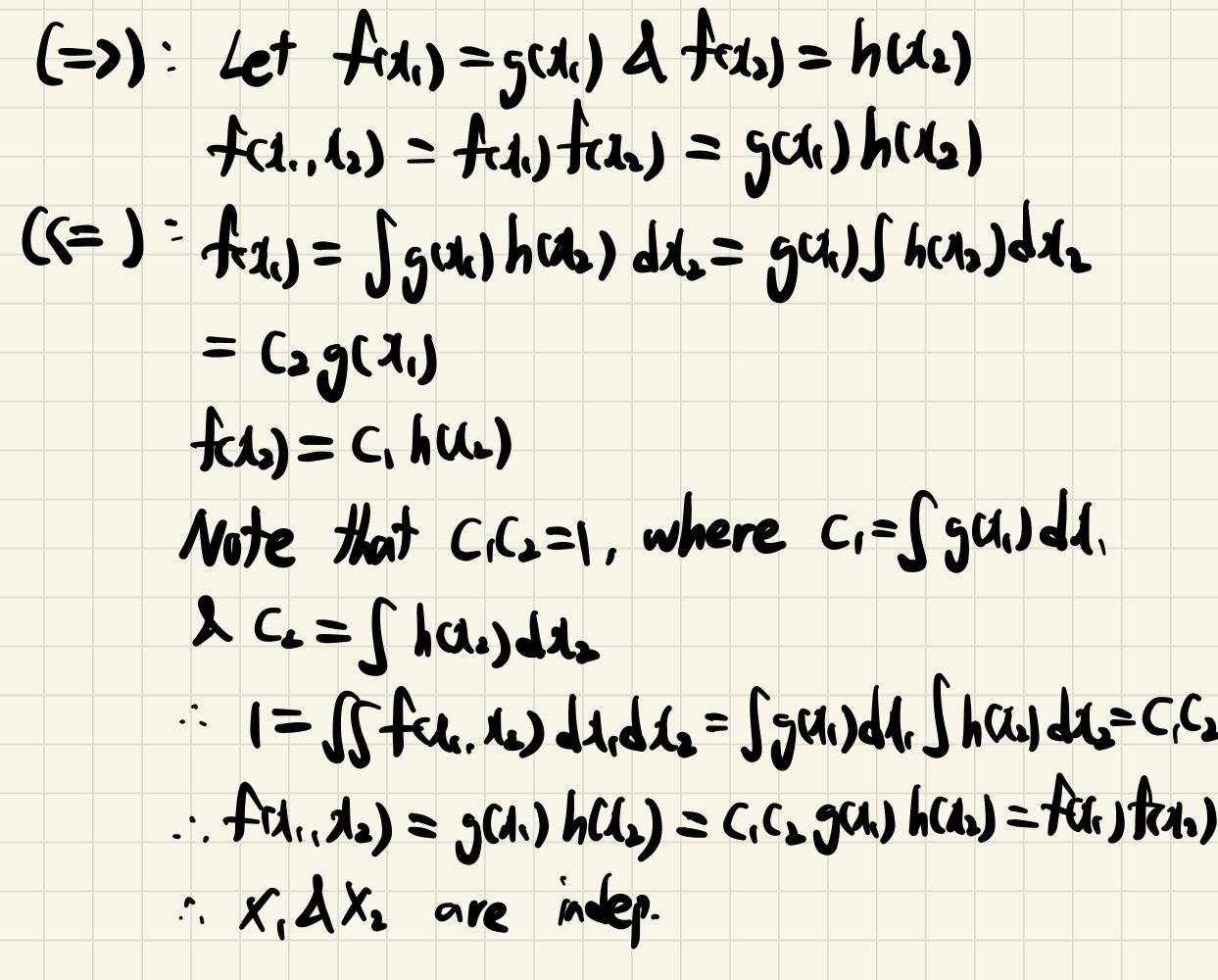
Theorem) factorization theorem
Let X1,X2X_1,X_2 have supports A,BA,B respectively,
X1,X2X_1,X_2 are independent <=><=> {f(x1,x2)=g(x1)h(x2)p(x1,x2)=g(x1)h(x2)\left\{\begin{matrix} f(x_1,x_2) = g(x_1)h(x_2)\\ p(x_1,x_2) = g(x_1)h(x_2) \end{matrix}\right.

where g(x1)>0,x1Ag(x_1)>0,x_1 \in A and h(x2)>0,x2Bh(x_2)>0,x_2 \in B
pf)
fctr_pf

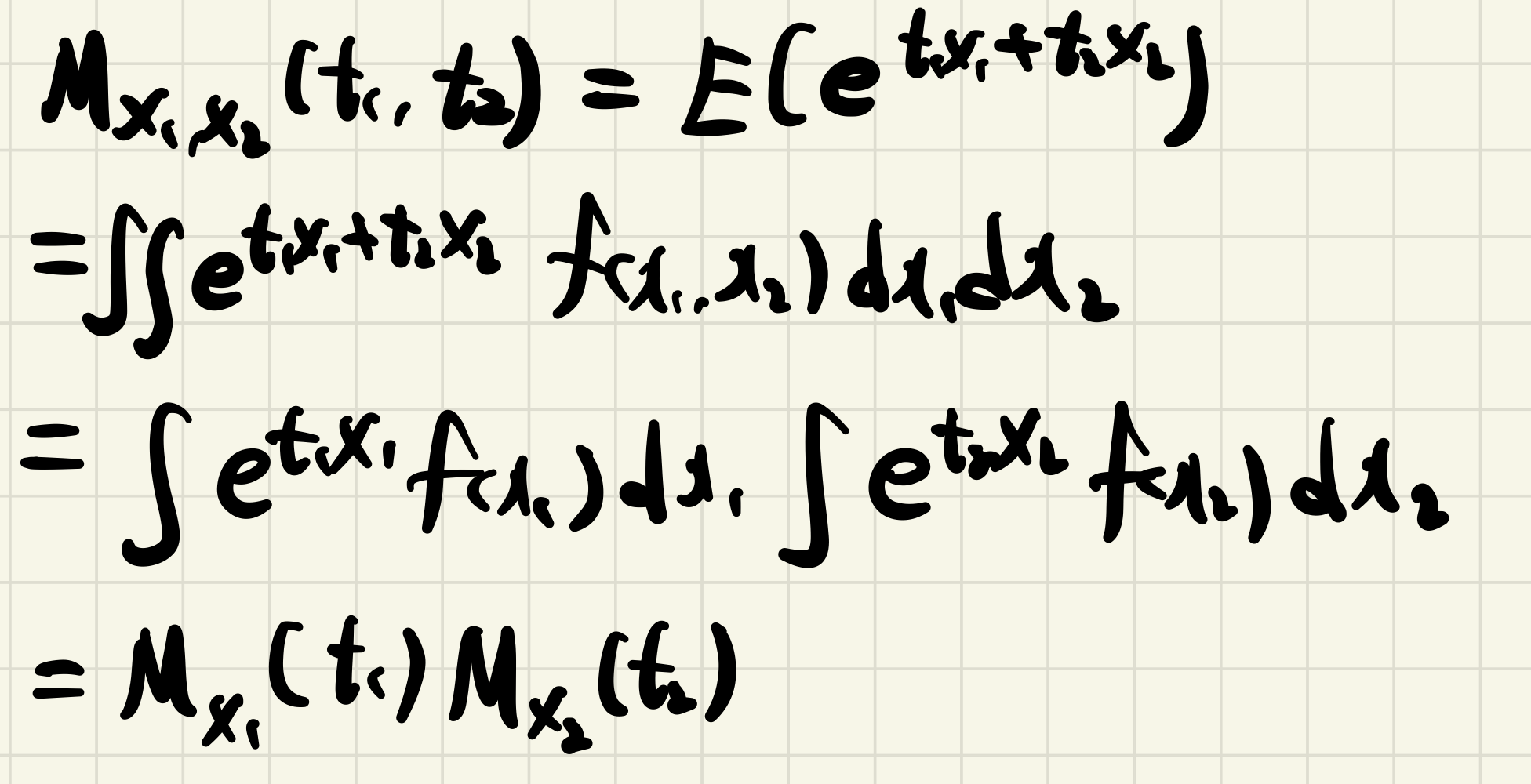
Theorem)
The followings are equivalent
X1,X2X_1,X_2 are independent
F(x1,x2)=FX1(x1)FX2(x2)F(x_1,x_2)=F_{X_1}(x_1) F_{X_2}(x_2)
P(a<X1<b,c<X2<d)=P(a<X1<b)P(c<X2<d)P(a < X_1 < b, c < X_2 <d) = P(a < X_1 < b) P(c < X_2 < d)
MX1,X2(t1,t2)=MX1(t1)MX2(t2)M_{X_1,X_2} (t_1,t_2) = M_{X_1}(t_1) M_{X_2}(t_2)
pf)
mgf_pf

Theorem)
If X1,X2X_1,X_2 are independent,
E[u(x1)v(x2)]=E(u(x1))E(v(x2))E[u(x_1)v(x_2)] = E(u(x_1))E(v(x_2))

✔︎ 역은 성립하지 않음!

0개의 댓글