(Final) Explanation : RISC-V RV32I single cycle processr
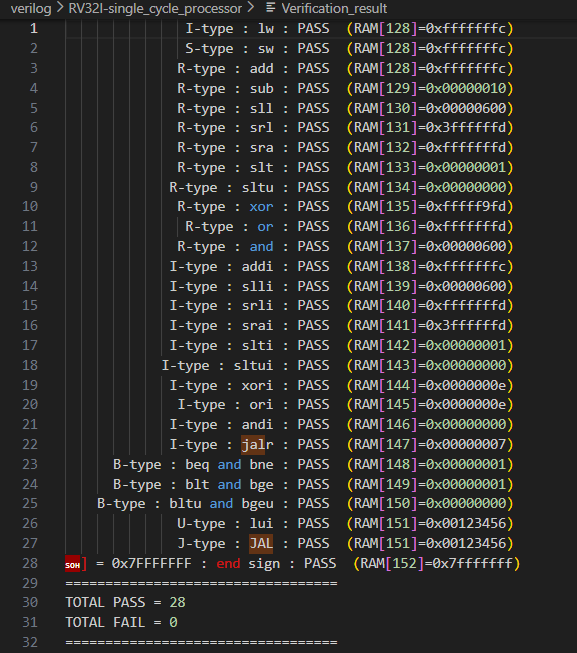
지금까지 시간이 없어 포스팅은 제대로 하지 못했지만, 어느 정도 마음에 들게 구현했다. 구현 결과는 다음 링크에 있다.
https://github.com/liquetxnx/RV32I_single_cycle_processor
RV32I-single_cycle_processor
This project is clear.
2025/10 ~ 2026/1/15
Table of Contents
- 0. TL/DR
- 1. Project Overview
- 2. Architecture
- 3. Memory Design
- 4. Supported Instructions
- 5. Verification
- 6. How to Run?
- 7. Limitation and Next Goal
- 8. License
0. TL/DR
- Core : RV32I single cycle processor (Verilog)
- Support : R, I, S, B, J, U type (only word load and store are supported in loading and store instrution)
- Memory architecture : Harvard Architecture(seperate Instruction memory, and Data memory)
- Addressing : PC and IM(8KB) is byte-addressed otherwise, Memory(16KB) are word-addressed.
- Endians : Little - endians (RISC-V default)
- Verification : self-checking C-code excuted by tb_cpu.v
- Run : make, (and "gtkwave waves_cpu.vcd")
- Limitation and Next goal : Explain below.
Environment :
Linux- Icarus Verilog
- GTKWave for wave form viewing
Run (manual)
- make
- gtkwave waves_cpu.vcd
Expected output(file)
- Verifiaction_result (pass/fail file)
- trace.log (log data when reg_write, mem_write happen)
- waves_cpu.vcd (simulation data)
1. Project Overview
Goals
- Make single core which can excute c code
- Clean and readable datapath/control
- Deterministric simulation
- Verification-first work flow
None Goals
- No CSR/privilege/interrupt
- No MUL and DIV for (RV32M)
- Misaligned access handling
2. Architecture
-
Harvard Architecture
-
Block Diagaram
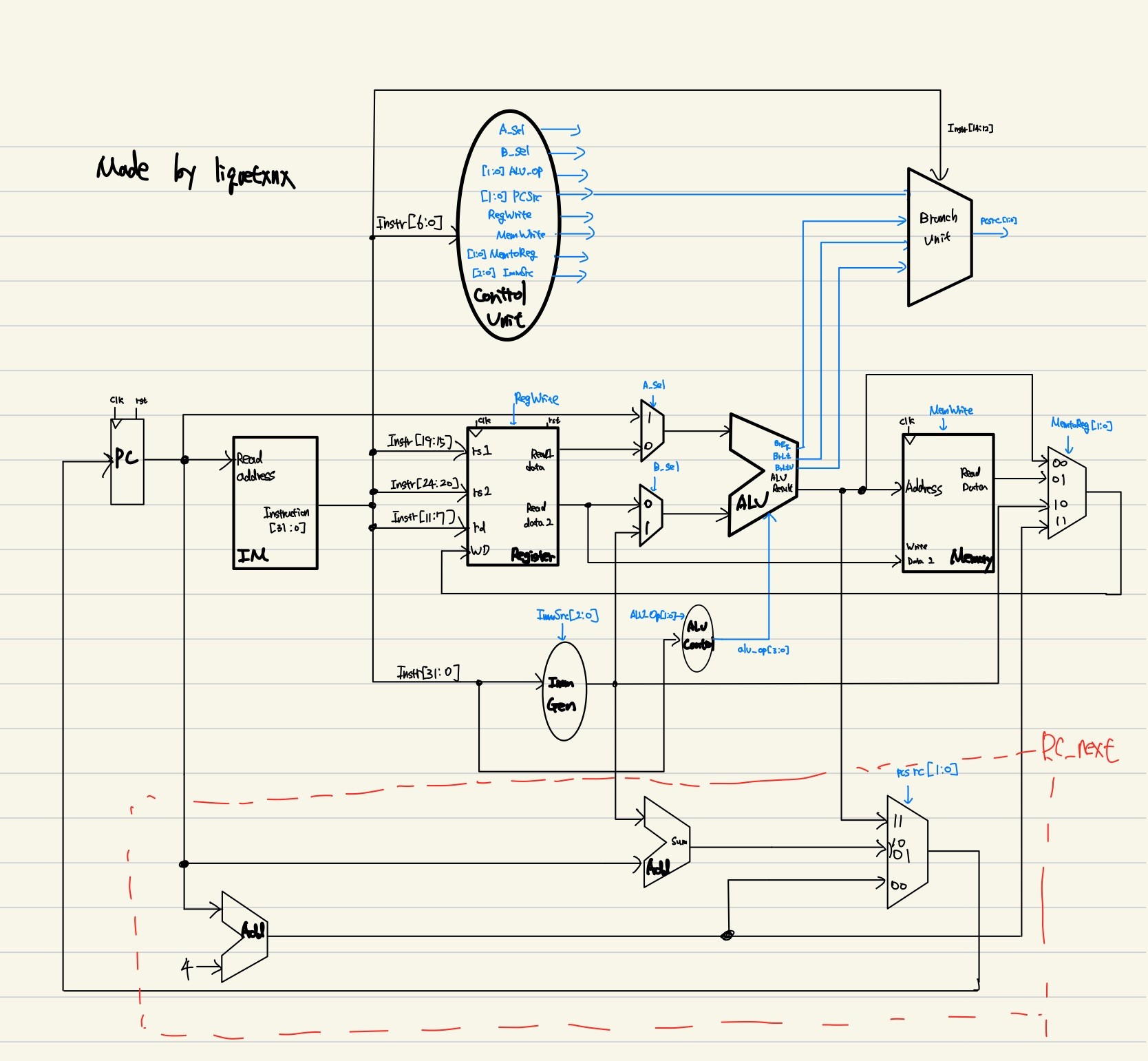
-
Top module
	- Control unit

	- Data path

		- PC(register)

		- PC_next

		- Instruction Memory(IM)

		- Register File

		- ALU

		- ALU_Control

		- Immediate Generation(ImmGen)

		- Memory

		- Branch_Unit

		- Mux 2 to 1

		- Mux 4 to 1
3. Memory Design
Endians
-
Instrution is stored by 1-byte little endians in IM.
- For example, Instruction0x01020304is stored by04 03 02 01in IM -
Data Memory is stored by 1-word, so do not considered endians.
Addressing
Insturtion Memory(IM)
- PC is byte address (increments by 4 byte) :
- pc_next = pc + 4 (unless branch/jump)
- IM is stored as 8-bit (1-bytes) (
mem[8192][8]) - Size is
8KB - Instruction fetch uses in bytes and by little - endians :
- pc = current pc address (1bytes)
- Instr = [8bytes, 8bytes, 8bytes, 8bytes] = [IM[pc+3], IM[pc+2], IM[pc+1], IM[pc]]
Data Memory
- Data memory is also stored as 32-bit words like IM (array of
mem[word_index]) - Size is
16KB - Effective address is word addresses;
-mem[4096][32]
- DMEM_index = alu_result >> 2
- It is implemented by DMEM_index = alu_result[13:2]
4. Supported Instructions
Note: Only word load/store are implemented:
lw,sw
Byte/halfword memory ops are not supported:lb/lh/lbu/lhu/sb/sh
| Type | Instructions | Status | Notes |
|---|---|---|---|
| R | add, sub, sll, slt, sltu, xor, srl, sra, or, and | ✅ | Full RV32I R-type ALU ops |
| I (ALU) | addi, slti, sltiu, xori, ori, andi, slli, srli, srai | ✅ | Shift-immediate included |
| I (Load) | lw | ✅ | Word only |
| S (Store) | sw | ✅ | Word only |
| B | beq, bne, blt, bge, bltu, bgeu | ✅ | Branch compare + PC redirect |
| U | lui, auipc | ✅⚠️ | Large constant / PC-relative AUIPC verification is not contained on verification |
| J | jal | ✅ | Link register writeback |
| I (Jump) | jalr | ✅ | Target = (rs1 + imm) & ~1 |
| RV32M | mul/div/rem* | ❌ | Not implemented |
5. Verification
What this verifies
-
Operate cpu by simple c code(prog.c) to verification.
-
All command except AUIPC is verified on tb_cpu.vcd
It is difficult to indicate AUIPC on C code in small memory(16KB)
-
Load and Store and JAL command are verified if verification are all passed.
Why I used signature (sig[]) array for verification?
To verify the CPU behavior without relying on waveform inspection, I used a memory-mapped signature array (sig[]) as a verification output buffer.
The program writes the results of key operations (ALU instructions, branches, loads/stores, jumps, etc.) into sig[], which is fixed at address 0x200 in data memory.
The stack pointer is initialized to 0x4000, so the stack grows downward while keeping the signature region safe from being overwritten.
With this setup, the testbench can simply monitor this small memory region and perform a direct comparison:
Deterministic and scalable testing: Instead of manually tracing internal signals, I can validate many instructions by checking a compact, fixed memory window.
Fast debugging: If a mismatch occurs, the failing signature index immediately shows which step or instruction sequence is incorrect, avoiding long waveform debugging sessions.
Overall, the signature array turns CPU verification into a simple PASS/FAIL memory comparison, making regression testing much more efficient and reproducible.
Simulation outputs
-
Verification_results
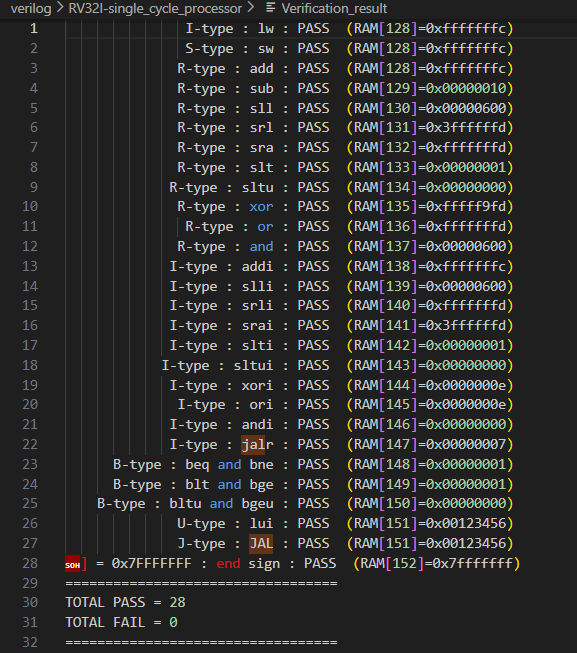
- **Target files** indicated verification is corrected. It store simple PASS/FAIL memory comparison.
-
trace.log
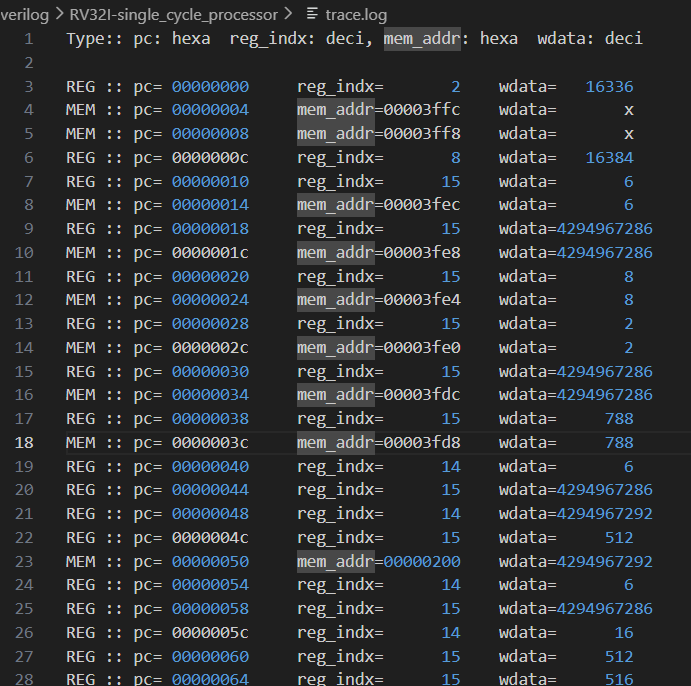
- prints register writeback events: pc(hex), reg_indx(deci), wdata(deci) - prints store events: pc(hex), mem_addr(hex), wdata(deci) - (cycle count is not printed) -
waves_cpu.vcd

- waveform dump for debugging in GTKWave
6. How to Run?
First of all, you have to install gtkwave, iverilog, gcc compiler.
OS is Ubuntu.
Command
make
- make all verification files. such as Verification_results, trace.log, waves_cpu.vcd.make dump
- make rv32i assembly files onprog.ccode.make clean
- clean all files from 'make' commandgtkwave waves_cpu_vcd
- Aftermakecommand, open simulation wave form.
7. Limitation and Next Goal
-
Can't be runned on modern computer
- not implemented anyCSRScommand
- Limited memory (16KB)
- Not Piped-line and single core (too slow) -
Next Goal
- To implement pipe-line, forwarding and hazard control cpu
8. License
This project is licensed under the MIT License - see the LICENSE file for details.
Copyright (c) 2026 Eunsang(liquetxnx)