
Components
Economy of Mechanism ( 경제성 있는 메커니즘 )
Keep the design as simple and small as possible.
Fail-safe defaults
Base access decisions on permission rather than exclusion.
Complete mediation ( 완전한 중재 )
Every access to every object must be checked for authority (there and then).
Open design
The design (and the code) should not be considered secret. The secret is always data, like a password or a cryptographic key.
Separation of privilege
It’s always safer if it takes two parties to agree on a decision than if one can do it alone.
Least privilege
Operate with the minimal set of powers needed to get the job done.
Least common mechanism
Minimize subsystems shared between or relied upon by mutually distrusting users ( 상호 신뢰하지 않는 사용자들 사이에서 ).
Psychological acceptability
Design security systems for ease of use for humans.
Isolation
Individual processes or tasks running in their own space.
Encapsulation
The ability to only use a resource as it was designed to be used.
Modularity
The breaking down of larger tasks into smaller, more manageable tasks.
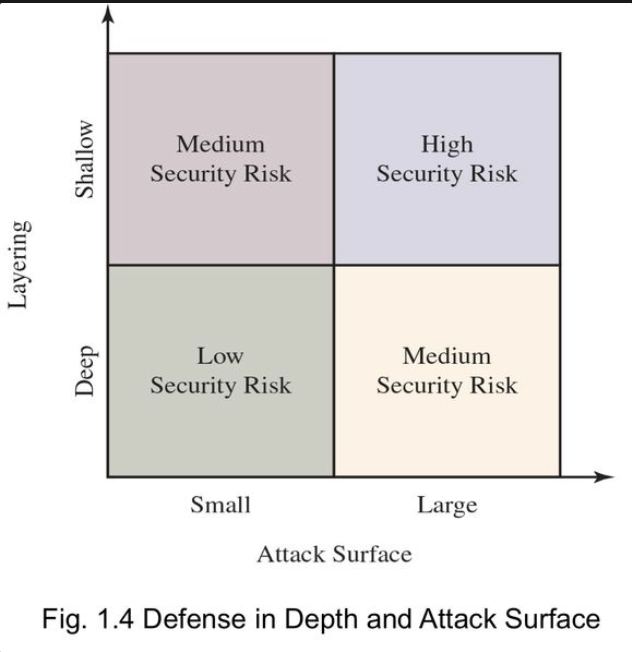
Layering
Having multiple forms of security. This can be from hardware or software, but it involves a series of checks and balances to make sure the entire system is secured from multiple perspectives
Least astonishment ( Psychological acceptability과 유사 )
Security mechanisms should not make the resource more difficult to access than when security mechanisms were not present
Categories
Network Attack Surface
사내 네트워크, WAN 혹은 인터넷 전반에 걸친 취약점에 대한 것.
네트워크 프로토콜 취약점, 서비스 접근 방해 공격, 통신 링크 방해 등이 이루어질 수 있다.
Software Attack Surface
어플리케이션, 기자재 혹은 운영체제 코드의 취약점에 대한 것.
특히 웹 서버 소프트웨어에 집중된다.
Human Attack Surface
개인, 외부인, 휴먼 에러, 관계자 등 사람으로 부터 생기는 취약점에 대한 것.
Surface and Layer
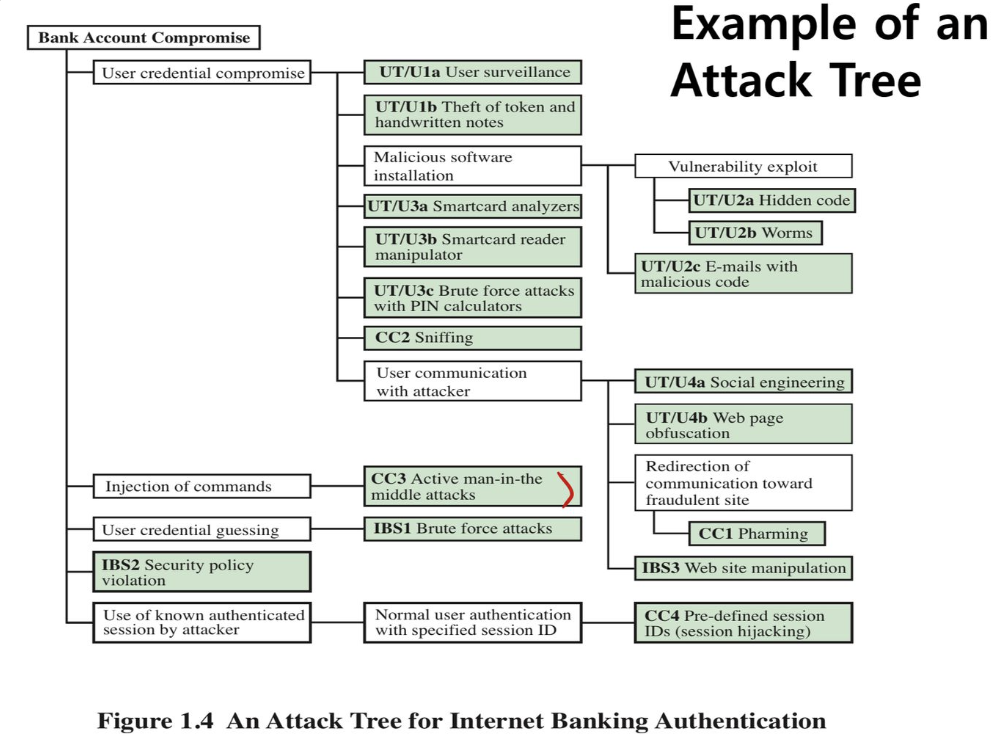
Attack Tree
보안 취약점을 악용하는 잠재적 기술 집합을 표현하는 데이터 구조체
- Root - Attack Goal
- Sub nodes - sub goals
- Leaf nodes - Ways to initiate the attack
Computer Security Strategy
Security Policy
Formal statement of rules and practices that specify or regulate how a system or organization provides security services to protect sensitive and critical system resources
어떻게 시스템이나 조직이 민감하고 중요한 시스템 자원을 보호하기 위해 보안 서비스를 제공하는가에 대한 구체적이고 보편적으로 쓰여진 규칙에 대한 공적인 문서
Security Implementation
- Prevention
- Detection
- Response
- Recovery
Assurance
The degree of confidence one has that the security measures, both technical and operational, work as intended to protect the system and the information it processes
기술적, 운영적 보안 조치가 시스템과 시스템이 처리하는 정보를 보호하기 위해 의도한 대로 작동한다는 확신의 정도
Evaluation
각각의 특정 기준으로 제품이나 시스템에 대한 평가를 진행하는 것.