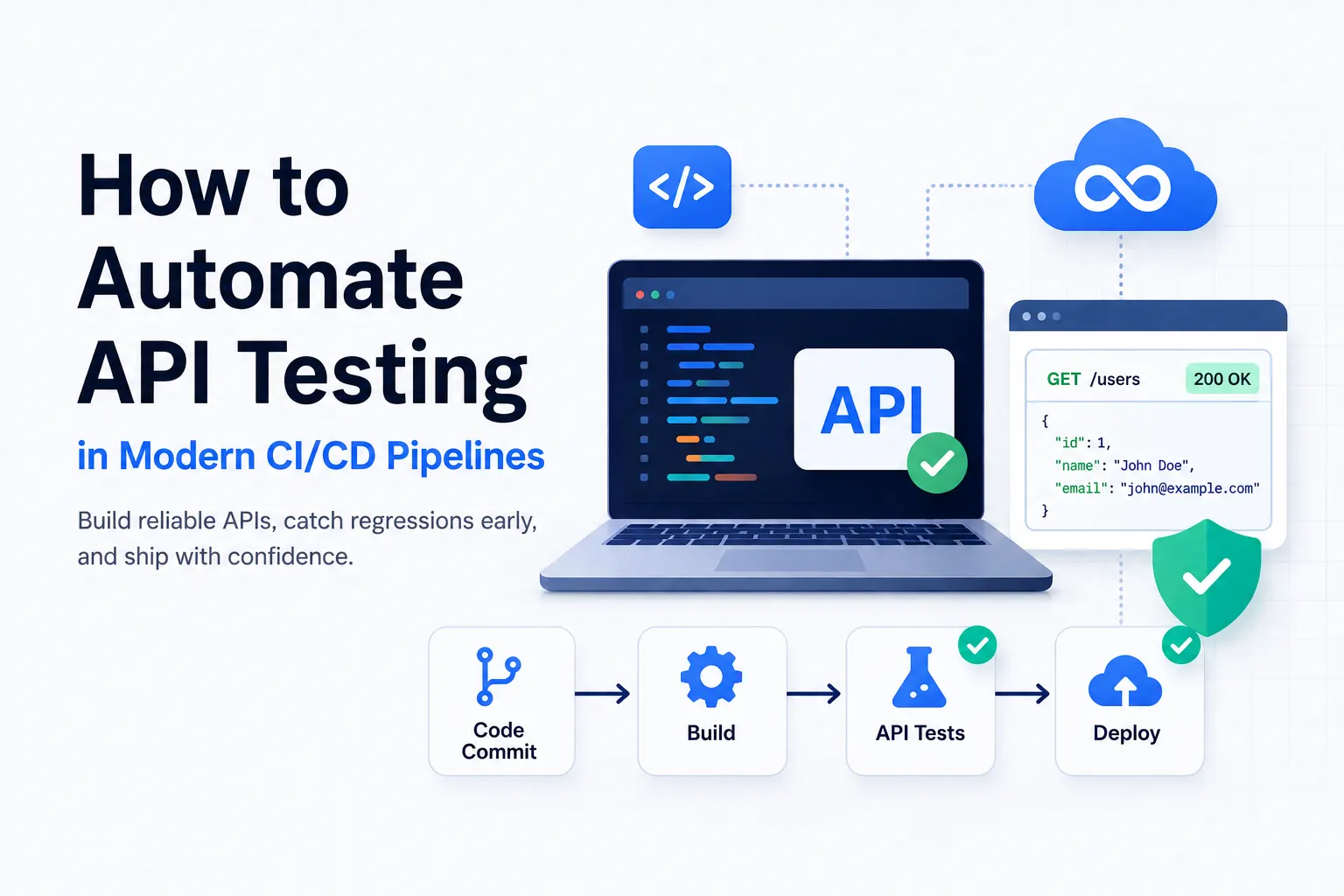
As applications become more API-driven, manual testing quickly turns into a bottleneck. Learning how to automate API testing helps development teams reduce repetitive work, catch regressions earlier, and confidently ship updates through CI/CD pipelines. Instead of spending hours rerunning the same API checks after every code change, automation enables faster, more reliable software delivery
Why API Test Automation Matters
Every deployment introduces the possibility of breaking existing functionality. Even a small change to an API response can impact multiple services.
Automated API testing helps teams:
- Detect regressions before production
- Validate API behavior consistently
- Reduce manual verification
- Speed up release cycles
- Increase confidence in deployments
Without automation, testing quickly becomes the bottleneck in continuous delivery.
The Biggest Challenge Isn't Writing Tests—It's Maintaining Them
Many teams successfully automate their APIs, but over time they face problems such as:
- Duplicate test cases
- Hardcoded test data
- Fragile assertions
- Environment-specific failures
- Time-consuming maintenance
The larger the application, the harder these issues become to manage.
A Practical Workflow for API Automation
Rather than trying to automate everything at once, build your testing strategy around your development lifecycle.
Start with Business-Critical APIs
Focus on endpoints that users depend on every day, such as:
- Authentication
- Payments
- User management
- Orders
- Notifications
These APIs provide the highest return on testing effort.
Build Reusable Tests
Avoid creating unique logic for every endpoint.
Reusable request builders, shared validation methods, and centralized test data reduce maintenance as your API grows.
Test Real-World Scenarios
Good API tests go beyond checking status codes.
Validate:
- Response structure
- Business rules
- Authorization
- Invalid requests
- Edge cases
- Error messages
These scenarios provide much stronger regression protection.
Run Tests Automatically
Integrate API testing into your CI/CD pipeline so every pull request and deployment is validated automatically.
Fast feedback allows developers to catch issues before they reach production.
Choosing the Right Tool
Different teams have different needs.
Some prioritize scripting flexibility, while others prefer low-maintenance workflows or seamless CI/CD integration.
The important part isn't choosing the "perfect" tool—it's choosing one that fits naturally into your engineering process.
Best Practices That Make Automation Sustainable
Over the years, several practices have consistently proven effective:
- Keep tests independent.
- Avoid unnecessary duplication.
- Use realistic test data.
- Mock unstable external services.
- Review failed tests immediately.
- Refactor test suites regularly.
Small improvements in test quality often save hundreds of hours later.
Final Thoughts
API automation isn't just about increasing test coverage—it's about making software delivery more predictable.
When tests are reliable, maintainable, and integrated into your development workflow, your team spends less time fixing broken test suites and more time building features that matter.
The goal isn't to write more tests. The goal is to create a testing process that grows with your application.
