Smoke Testing Microservices: What to Test When Everything Depends on Everything
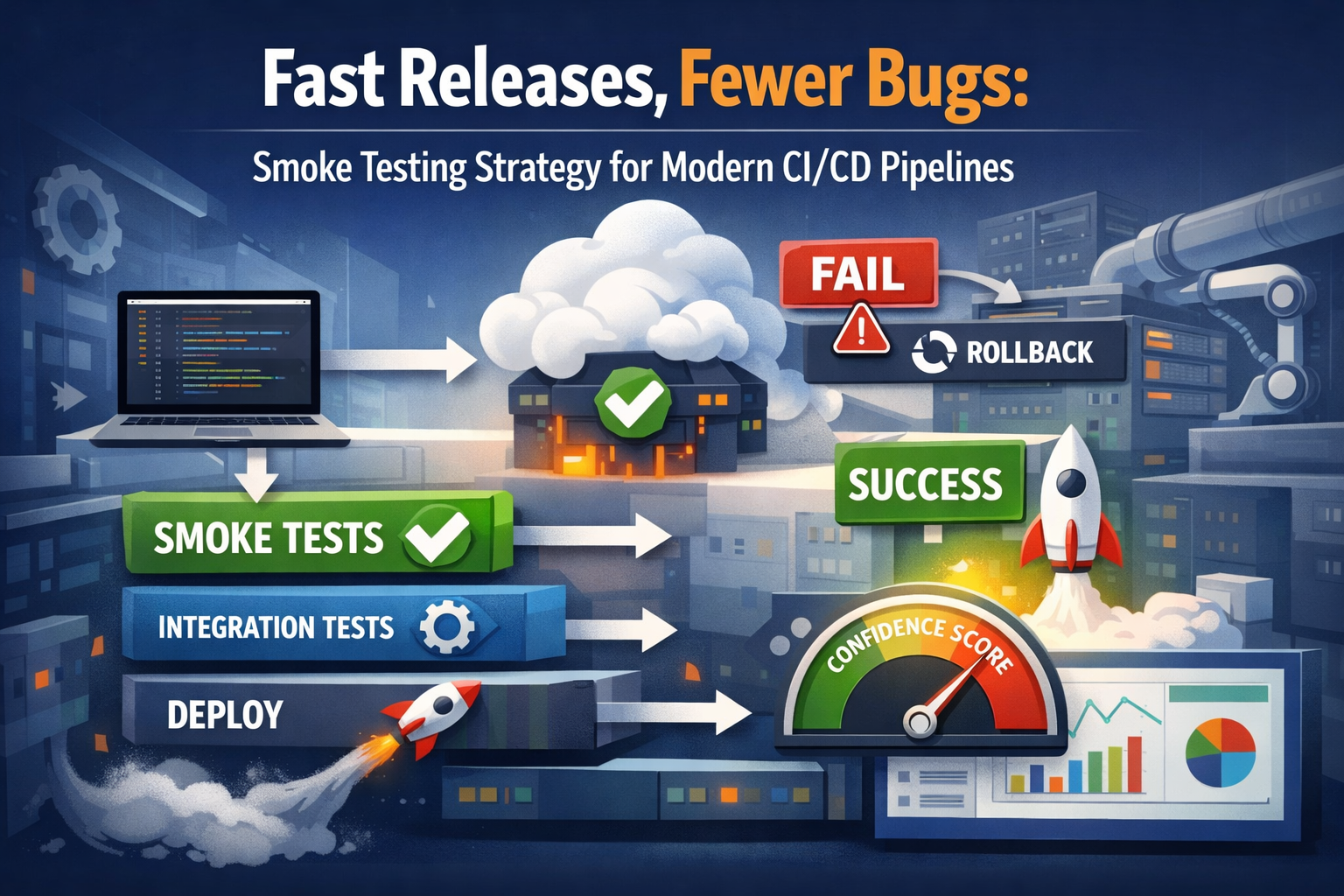
Microservices architectures promise scalability and flexibility, but they introduce a new problem: uncertainty. A single user request may travel through authentication, billing, inventory, messaging, and notification services before completing. When a deployment happens, the biggest question is not whether a single service works, but whether the system still functions as a whole. Traditional smoke testing assumed one application and one database. Modern distributed systems require a different strategy.
In microservices, smoke testing is not about validating features. It is about validating connectivity, contracts, and operational readiness across services. If any core dependency fails, the entire system becomes unreliable even if individual services appear healthy. Effective smoke testing focuses on proving that communication pathways and essential workflows are alive before deeper testing begins.
Contract-Level Smoke Tests
The most important validation in a distributed system is not UI functionality but service communication. Each service exposes an API contract that other services rely on. If a response structure changes or a required field disappears, downstream services fail even though the originating service technically runs.
Contract-level smoke tests verify that each service still produces responses matching expected schemas. Instead of testing dozens of endpoints, the test suite checks only critical operations such as authentication token generation, order creation request acceptance, and payment authorization response structure. The goal is to confirm that dependent services can still interpret responses.
These tests should focus on structure rather than business correctness. For example, confirming that an order total equals the expected value is unnecessary at this stage. Confirming that the order service returns a valid JSON structure with required identifiers is sufficient. This keeps the suite fast while still protecting system stability.
Dependency Isolation
One of the biggest challenges in microservices testing is failure ambiguity. If a checkout request fails, the cause could be payment service downtime, database latency, authentication failure, or network routing issues. Smoke tests must isolate failures quickly so engineers know where to investigate.
To achieve this, each service should first be tested independently with minimal dependencies. The authentication service should prove it can issue tokens using its own database. The order service should prove it can create records using a controlled dependency environment. Only after independent checks pass should cross-service tests run.
This layered isolation prevents cascading failures from hiding the real problem. Without isolation, a database outage could appear as multiple service failures, increasing debugging time dramatically.
Service Health Matrix
A useful pattern in distributed smoke testing is the service health matrix. Instead of a single pass or fail result, the system records the readiness of every service and dependency combination.
| Service | Startup | Database | External Dependency | API Response |
|---|---|---|---|---|
| Auth | Pass | Pass | Pass | Pass |
| Orders | Pass | Pass | Pass | Pass |
| Payments | Pass | Pass | Fail | Fail |
| Notifications | Pass | Pass | Pass | Pass |
This matrix gives immediate clarity. Engineers can see not only that the system failed but exactly which component prevented readiness. The matrix also becomes valuable historical data, helping teams identify unstable services over time.
Mock vs Real Service Decisions
A common question in microservices smoke testing is whether to call real dependencies or mocked ones. The answer depends on what the smoke test is proving.
If the goal is verifying a service can start and process requests, mocks are appropriate. They remove environmental instability and confirm internal readiness. If the goal is verifying inter-service communication, real dependencies must be used because communication failure is precisely what needs detection.
A balanced approach works best. Start with isolated smoke tests using mocks to confirm the service runs. Then execute a second layer of cross-service smoke tests using real network calls. This ensures both internal stability and integration readiness without increasing execution time excessively.
Handling Asynchronous Services
Modern architectures rely heavily on message queues and event streaming systems. These introduce a new challenge: responses may not be immediate. Traditional smoke tests expecting synchronous responses will falsely report failures.
For asynchronous flows, smoke tests should validate event production and consumption rather than immediate output. For example, placing an order should produce an event in a queue, and the billing service should consume it within a short time window. The test does not need to validate full billing correctness, only that the event moves through the pipeline.
Timeout-based validation works well here. The test publishes an event and waits for confirmation of processing. If confirmation appears within the expected window, the system is considered operational.
Example Architecture Flow
A typical distributed smoke testing flow might look like this:
Step 1
Each service starts in a controlled environment and passes its independent readiness check.
Step 2
Authentication service generates a token.
Step 3
Order service accepts a request using that token.
Step 4
Payment service receives a payment authorization request.
Step 5
Event is published to a message queue.
Step 6
Notification service consumes the event and acknowledges processing.
If every step completes within a short time frame, the platform is considered alive. No business edge cases are validated yet, only the operational path from entry to completion.
Why This Approach Works
Microservices failures are rarely complex logic errors at deployment time. They are configuration mismatches, missing environment variables, network routing problems, expired credentials, and incompatible contracts. Smoke testing designed around communication paths detects exactly these issues.
By focusing on operational readiness rather than feature validation, teams gain immediate confidence that deployments will not break core workflows. Deeper testing can then safely verify correctness without risking wasted execution time.
Conclusion
Smoke testing in microservices is fundamentally about verifying relationships between services rather than validating individual features. Contract checks ensure compatibility, isolation identifies root causes, health matrices provide visibility, and asynchronous validation confirms event flow. When these elements combine, deployments become predictable even in highly distributed systems.
In distributed architectures, stability depends less on whether code compiles and more on whether services cooperate. Effective smoke testing ensures that cooperation exists before any complex testing begins.
reference article: https://keploy.io/blog/community/developers-guide-to-smoke-testing-ensuring-basic-functionality
