How Public Utilities Struggle Without Blockchain and How It Solves Billing Fraud
Every year, public utility companies lose significant revenue to billing errors, meter tampering, and outright fraud, and most of the time, nobody notices until the damage is already done. Traditional billing systems rely on centralized databases that a single person, whether an employee or an outside attacker, can quietly alter. That single point of failure is exactly what keeps utility executives up at night. This is where blockchain development is changing the conversation. By replacing centralized, editable records with a shared, tamper-resistant ledger, utilities finally have a way to catch fraud before it spreads. Here's what the problem actually looks like, and how blockchain fixes it.
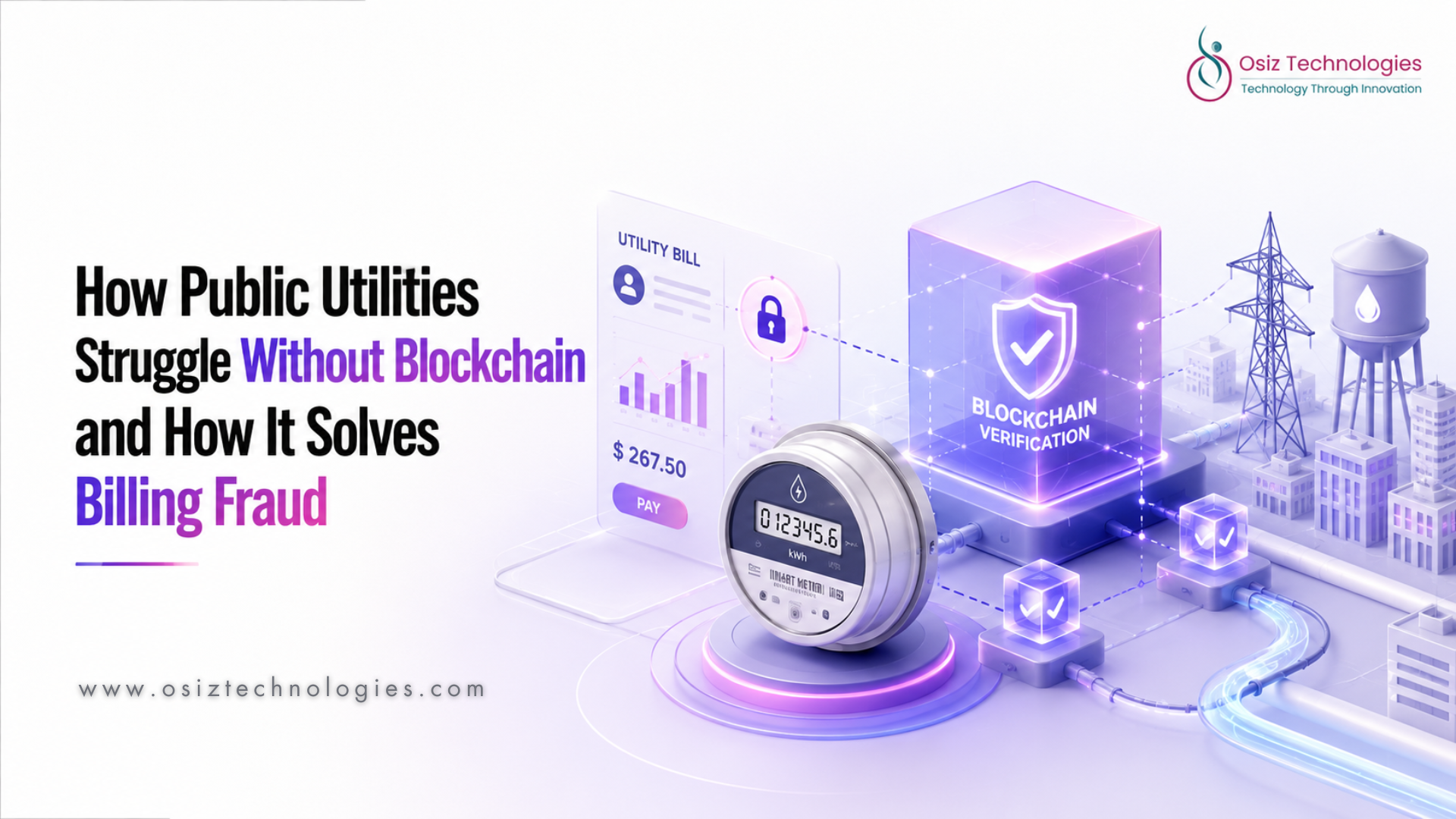
The Billing Fraud Problem in Public Utilities
Public utilities electricity, water, and gas providers operate some of the oldest billing infrastructure still in daily use. Most of it was never built with fraud prevention in mind. A few common issues keep showing up across the industry:
Meter tampering: customers or field agents manipulate smart meters or reporting to lower recorded usage.
Manual billing errors: human data entry mistakes that go undetected for months.
Duplicate or falsified invoices: records altered after the fact, with no reliable audit trail.
Internal fraud: employees with database access adjusting figures without oversight.
Delayed fraud detection: most utilities only discover discrepancies during periodic audits, long after revenue is lost.
The core issue isn't a lack of effort from utility companies; it's the structure of the system itself. When billing data lives in one central database, there's no independent way to verify whether a record has been changed. Auditors have to trust the system rather than verify it, and that gap is exactly where fraud hides.
How Blockchain Solves Billing Fraud
Blockchain doesn't just add another layer of software on top of existing billing systems; it changes how billing data is recorded and verified in the first place. Once a transaction (a meter reading, an invoice, a payment) is written to the ledger, it can't be quietly edited or deleted. Every change is visible, time-stamped, and traceable to its source.
Here's how this plays out in practice:
Immutable meter records: once usage data is recorded on-chain, it cannot be altered without leaving a visible trail.
Smart contract development automates billing based on verified usage data, removing manual entry points where fraud typically occurs.
Private blockchain development allows utilities to keep data permissioned and secure, while still giving regulators and auditors real-time visibility.
Automated auditing replaces slow, periodic manual audits with continuous, real-time verification.
Enterprise blockchain development frameworks let large utility providers integrate this system without rebuilding their entire infrastructure from scratch.
The result is a billing process where trust doesn't depend on any single person or department. The ledger itself becomes the proof something regulators, customers, and internal teams can all verify independently, without relying on one another's word.
Real-World Application
Several energy and water utilities have already piloted private blockchain networks to track billing and usage data with smart contracts handling settlement automatically. In these pilot programs, discrepancies that once took auditors weeks to uncover were flagged within hours, simply because the data couldn't be altered without detection. This isn't a theoretical use case it's an operational shift already happening in select markets, often built in partnership with a Blockchain Development Company experienced in enterprise-scale deployments, sometimes alongside broader Web3 development initiatives connecting billing systems to identity verification and consumer platforms.
Conclusion
Billing fraud in public utilities isn't a new problem, but the tools to solve it finally exist. Blockchain development offers utilities something their legacy systems never could: a billing record that proves its own accuracy. As more providers move toward smart contract development and private, enterprise-grade blockchain infrastructure, the utilities that adapt early will be the ones customers and regulators trust the most. For utilities ready to take that step, working with an experienced blockchain development company is often the fastest way to move from pilot to full deployment.
