Designing algorithms
The divide-and-conquer approach
1. Divide-and-Conquer
- Many recursive algorithms follow a divide-and-conquer approach
- Three steps at each level of the recursion
- Divide
Divide the problem into a number of subproblems that are smaller instances of the same problem
- Conquer
Conquer the subproblems by solving them recursively. If the subproblem sizes are small enough, however, just solve the subproblems in a straightforward manner.
- Combine
Combine the solutions to the subproblems into the solution for the original problem
- Divide
- The merge sort algorithm colsely follows the divide-and-conquer paradigm
- Divide
Divide the -element sequence to be sorted into two subsequences of /2 elements each
- Conquer
Sort the two subsequences recursively using merge sort
- Combine
Merge the two sorted subsequences to produce the sorted answer
- Divide
2. Merge procedure
-
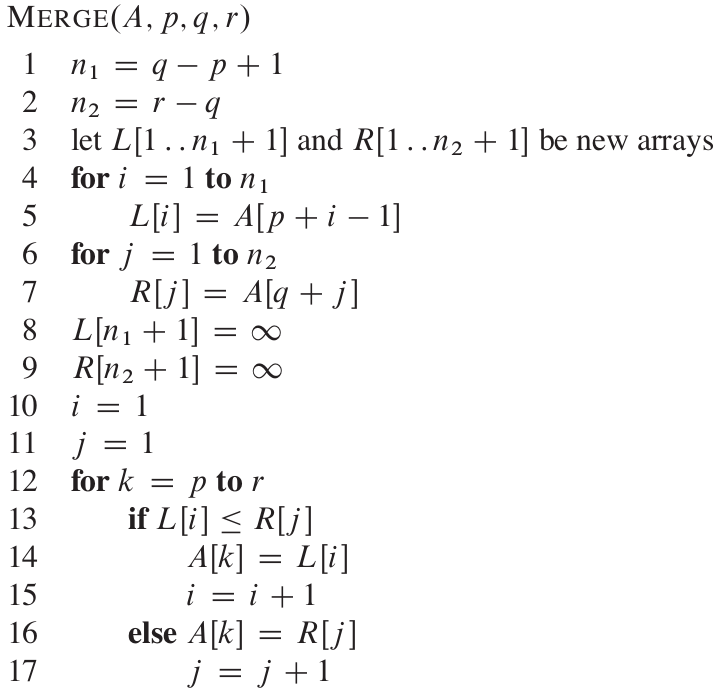
is an array and and are indices into the array such that
-
The subarrays and are in sorted order
-
It merges the two subarrays to form a single sorted subarray that replaces the current subarray
-
This procedure takes time , where is the total number of elements being merged
-
is sentinel value, so that whenever a value with is exposed, it cannot be the smaller value unless both subarrays have their sentinel value exposed
-
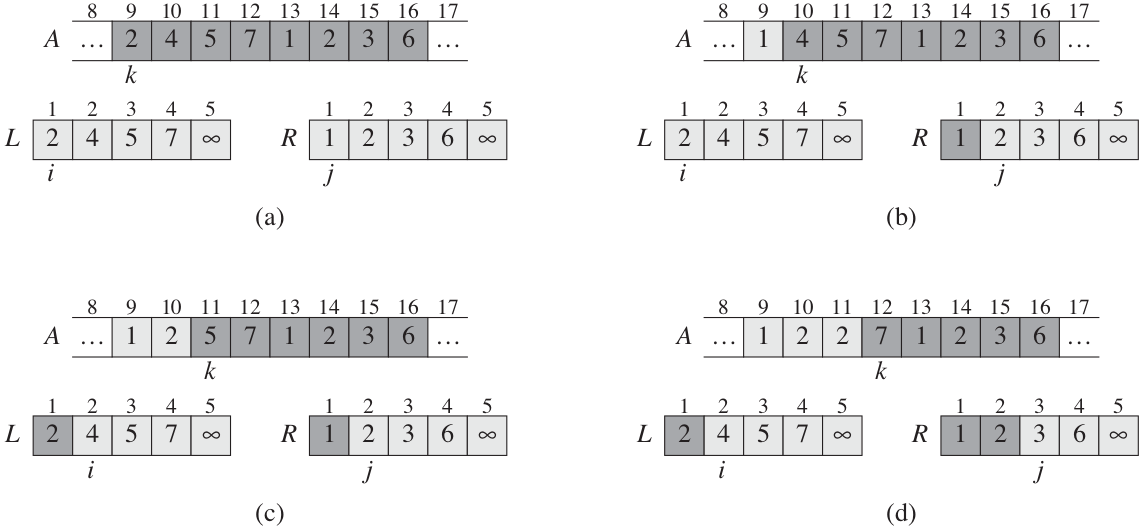
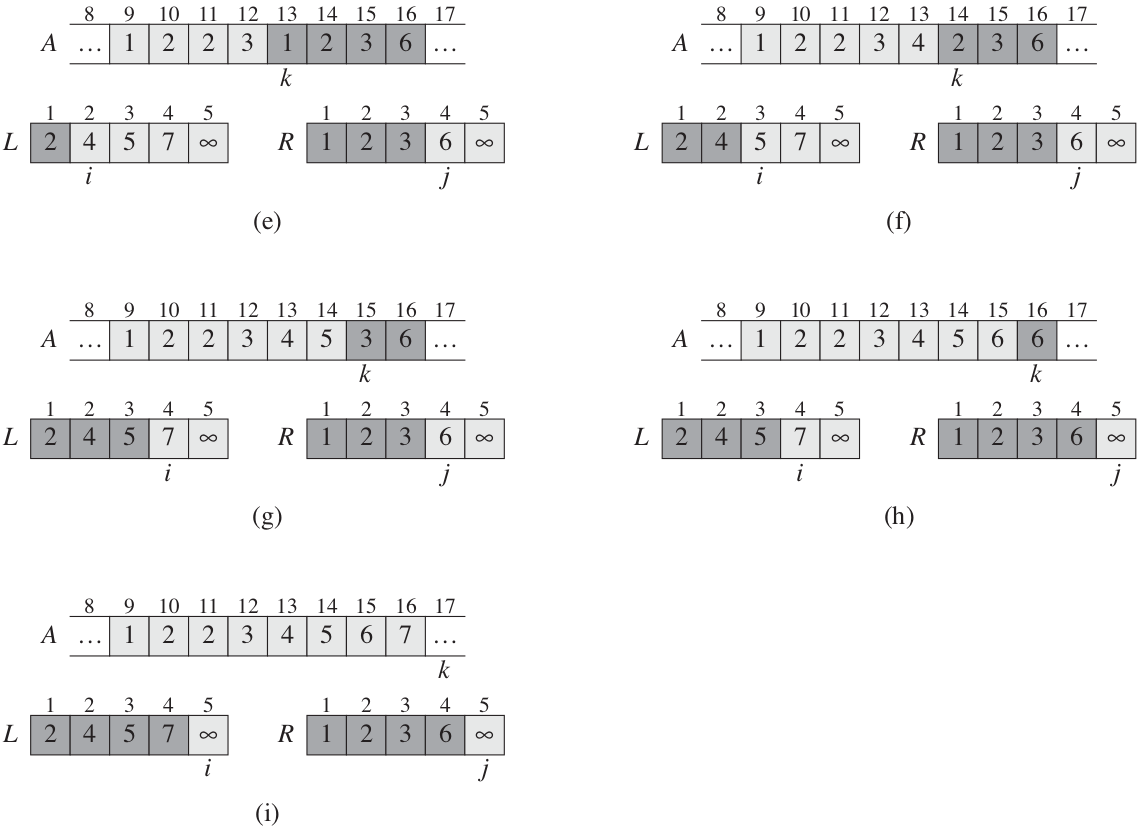
The operation of lines 10-7 in the call MERGE
-
Loop invariant
At the start of each iteration of the for loop of lines 12-17, the subarray contatins the smallest elements of and , in sorted order. Moreover, and are the smallest elements of their arrays that have not been copied back into .
- Initialization
Prior to the first iteration of the loop, we have , so that the subarray is empty. This empty subarray contains the smallest elements of and , and since , both and are the smallest elements of their arrays that have not been copied back into A.
- Maintenance
Let it first suppose that . Then is the smallest element not yet copied back into . Because contains the smallest elements, after line 14 copies into , the subarray will contain the smallest elements. Incrementing and reestablishes the loop invariant for the next iteration. If instead , then lines 16-17 perform the appropriate action to maintain the loop invariant.
- Termination
At termination, . By the loop invariant, the subarray , which is , contains the smallest elements of and , in sorted order. The arrays and together contain elements. All but the two largest have been copied back into A, and these two largest elements are the sentinels.
- Initialization
3. Merge sort algorithm
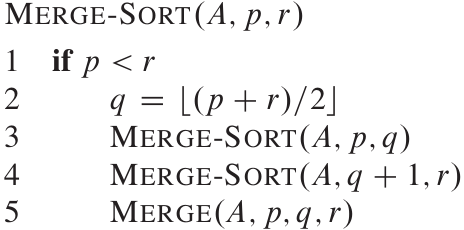
- The MERGE-SORT sorts the elements in the subarray
- If , the subarray has at most one element and is therefore already sorted
- An index partitions into two subarrays: , containing elements, and , containing elements
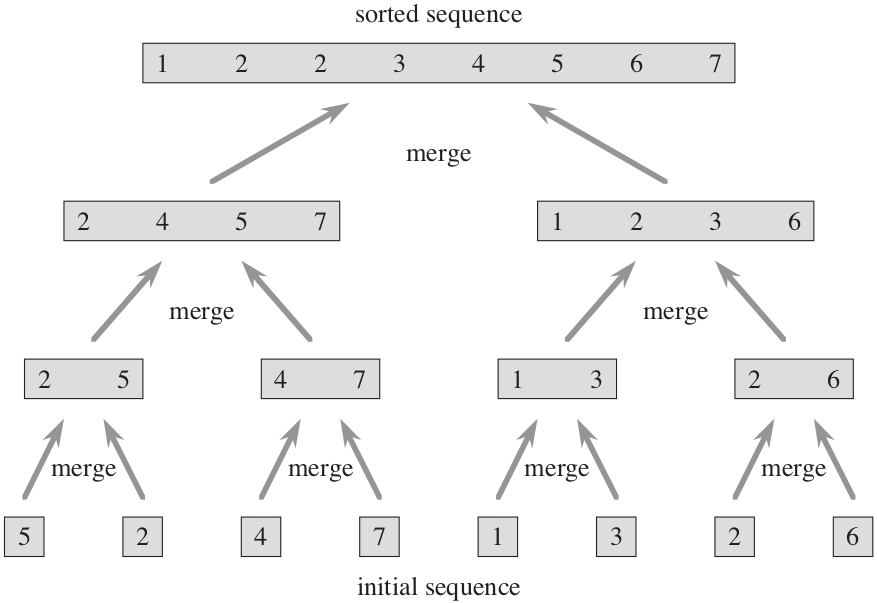
- The operation of merge sort on the array