Analyzing algorithms
1. random-access machine (RAM)
- algorithm analyzing의 배경이 되는 implementation technology와 resources등의 model 중 하나
- instructions는 하나씩만 실행 가능하고 concurrent operations는 불가능
- real computers에 존재하는 대부분의 instructions(arithmetic, data movement, control)를 갖고 있다
- data types는 integer와 floating point가 있다
- memory-hierarchy(caches or virtual memory) effects를 고려하지 않는다
Analysis of insertion sort
1. input size
- 많은 problems에서, 가장 natural measure는 input의 items 갯수
- ordinary binary notation으로 표현하기 위해 필요한 total number of bits인 경우도 존재
2. running time
- the number of primitive operations or "steps" executed
- step의 개념은 machine에 독립적으로 만든다
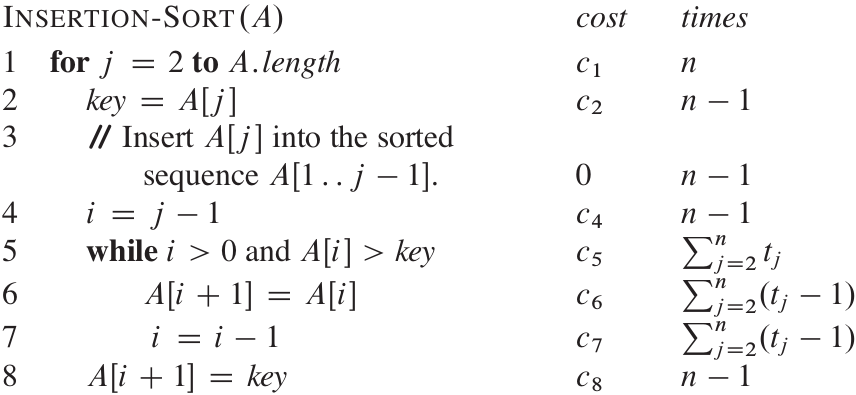
- th line은 만큼의 시간이 걸린다고 가정
3. running time of INSERTION-SORT
-
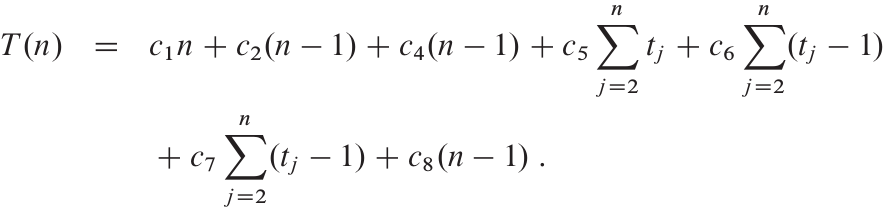
the running time of the algorithm = the sum of running times for each statement executed
-
= the running time of INSERTION-SORT on an input of values
-
the best case
- the best case occurs if the array is already sorted

- we can express this running time as (linear function)
- the best case occurs if the array is already sorted
-
the worst case
- if the array is in reverse sorted order, the worst case results
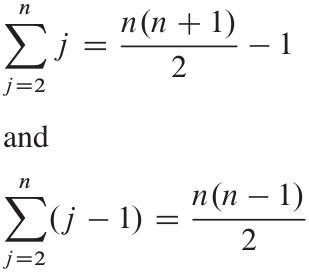
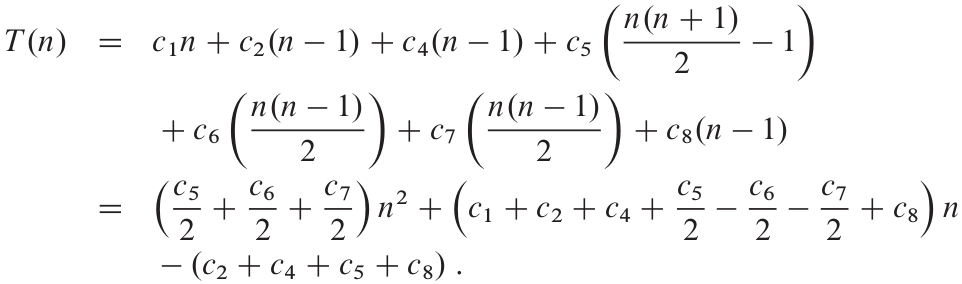
- we can express this worst-case running time as (quadratic function)
- if the array is in reverse sorted order, the worst case results
Worst-case and average-case analysis
1. three reasons for concentrating on finding only the worst-case running time
- The worst-case running time of an algorithm gives us an upper bound on the running time for any input
- For some algorithms, the worst case occurs fairly often
- The "average case" is often roughly as bad as the worst case
Order of growth
1. abstractions
- Using the constants to represent costs
- Expressing the worst-case running time as for some constants , , and that depend on the statement costs
2. more simplifying abstraction
- the rate of growth, or order of growth
- considering only the leading term of a formula ()
- ignoring the leading term's constant coefficient
- insertion sort has a worst-case running time of

return NanSu;