ITPM - 06. Project Schedule Management
1. Plan Schedule Management
Output
Schedule management plan
- Project schedule model development
- Units of measure
- Level of accuracy
- Control thresholds
- Rules of performance measurement
- Reporting formats
2. Defining Activities
: Involves identifying the specific actions that will produce the project deliverables in detail enough to determine resource and schedule estimates
- The WBS is devided further
Input
- Scope baseline
Output
- Activity list : a tabulation of activities / activity name, id, brief description
- Activity attributes : more information about activities / predecessors, successors, logical relationships, leads and lags, resource requirements, constraints, imposed dates, assumptions
- Milestone list : list of important events or achievements / useful tool for setting schedule goals and monitoring progress
3. Sequencing Activities
: invloves evaluating the reasons for dependencies and the different types of dependencies
Input
Project document
- Activity Attributes
- Activity list
- Assumption log
- Milestone list
Output
- Project schedule network diagrams
Dependency
1) Mandatory dependencies : 필수
2) Discretionary dependencies : 추천 but not 필수
3) External dependencies : relationships between project and non-project activities
4) Internal dependencies
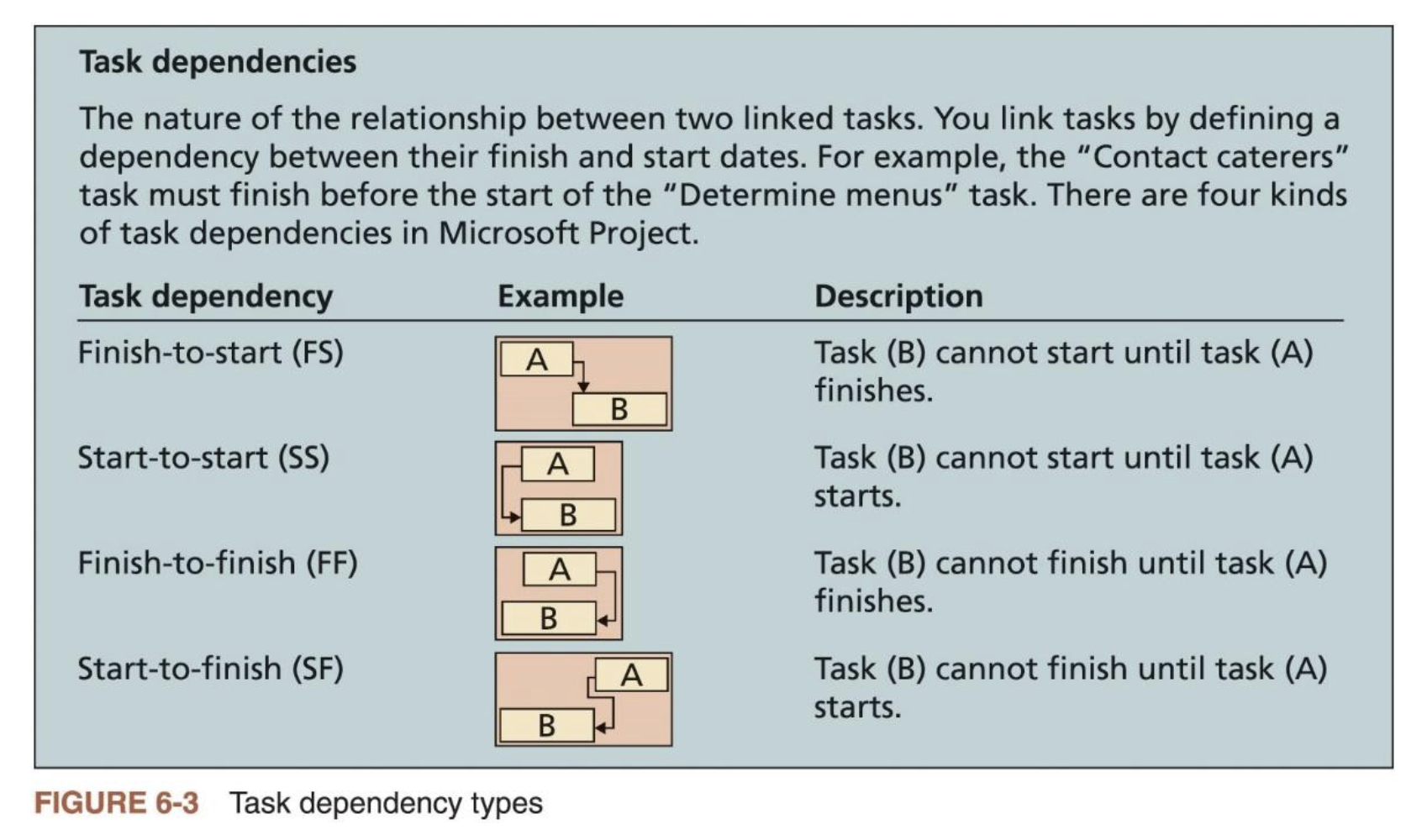
Four Type of Dependency
1) Finish to Start : 끝나면 시작한다.
2) Start to Start : 시작하면 시작한다.
3) Finish to Finish : 끝나면 끝난다.
4) Start to Finish : 시작해야 끝난다.
Lead & Lag
Lead
- 후속 활동이 선행 활동보다 먼저 시작할 수 있는 시간(즉, 앞 작업이 끝나기 전에 뒷 작업을 미리 시작할 수 있는 시간)
- 예시) 빵 반죽을 하는 동안 미리 오븐 예열
Lag
-
후속 활동이 선행 활동보다 늦게 시작해야하는 시간 지연(즉, 앞의 활동이 끝난 뒤엥도 바로 시작하지 않고 일정 시간 기다려야하는 경우)
-
예시) 페인트를 바르고 마르는 시간 지연
Network Diagrams
1) Arrow Diagramming Method (ADM) or Activity on Arrow(AOA)
2) Precedence Diagramming Method (PDM) or Activity on Node(AON)
4. Estimating Activity Durations
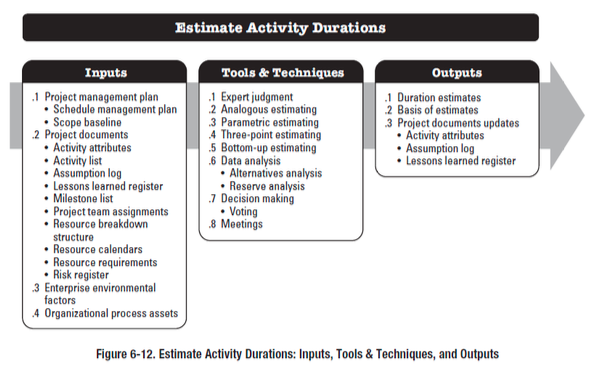
Input
Project Documents
- Activity attributes
- Activity list
- Resource calendars
- Resource requirements
Tools & Techniques
- Expert judgment
- Analogous estimating
- Parametric estimating
- Three-point estimating : includes an optimistic(최단), most likely(가능성 높음), pessimistic(최악) estimate -> Duration estimate = (Best+4*Likely(+Pessimistic)/6
- Bottom-up estimating
- Data Analysis
-> Alternatives analysis
-> Reserve analysis - Decision making
-> Voting - Meetings
Output
- Duration estimates
- Basis of estimates
Duration & Effort
Duration : the actual amount of time worked on an activity plus + elapsed time -> 기간
Effort : the number of workdays or work hours required to complete a task -> 작업량
5. Developing the Schedule
: Determine the start dates and end dates of the project and its activities
Tools and techniques
- Gantt chart
- Critical path analysis
- Critical chain cheduling
- PERT analysis
Gantt chart
- compares planned and actual project schedule information
Critical Path Method (CPM)
Critical path : series of activities that determine the earliest time by which the project can be completed
- The Longest path through the network diagram and has the zero amount of slack or float time
- Longest path is the cirical path