4부 : GAT
-
GAT는 GCN의 개선 모델
-
기존 GCN은 고정된 Normalization 값을 사용
-
GAT는 대신 self-attention으로 가중치 계산 -> 이게 핵심 차이
-
GCN : 이웃 다 비슷하게 봄
-
GAT : 중요한 이웃 더 크게 봄
GCN의 한계
GCN에서는 이웃 노드의 중요도를 degree 기반으로만 계산한다.
- 노드의 Feature 정보는 고려하지 않음
- 단순히 연결 수(Degree)만으로 중요도 결정
GAT의 핵심 아이디어
이웃 노드의 중요도를 직접 학습하자
그래서 등장한 것이 attention score :
노드 i와 j사이의 중요도
Graph Attention 연산
GAT의 핵심 수식:
- h : 노드 i의 새로운 표현
- N : 노드 i의 이웃 집합
- Wx : 이웃 노드 feature 변환
- a : attention(중요도)
해석 :
- 이웃 노드 정보를 가져오되 중요도 만큼 가중합
Self-Attention의 의미
GAT에서 attention은:
노드들끼리 서로 비교해서 계산됨
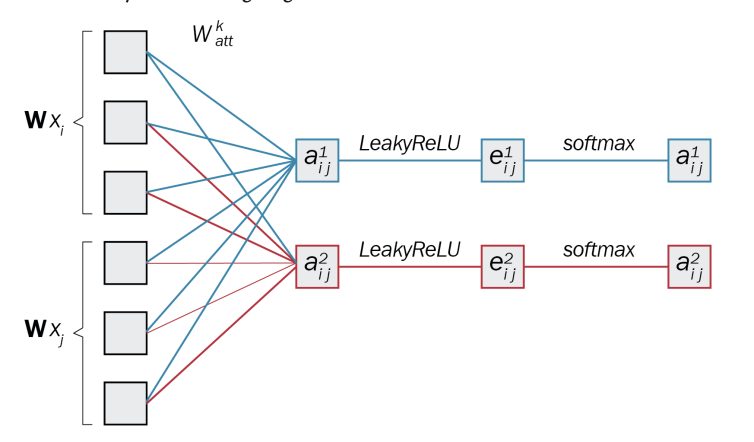
Attention 계산 과정
GAT에서 attention은 다음 단계로 계산된다.
1. Linear Transformation
2. Activation Function
3. Softmax Normalization
4. Multi-head Attention
5. Improved GAT
1. Linear Transformation
attention을 계산하려면 두 노드 i, j의 정보를 같이 봐야 한다.
그래서 :
- 두 벡터를 concat
그리고 추가 weight 적용:
이 과정을 통해 attention score 생성:
결과 :
- 두 노드 i, j 정보를 합쳐서 attention score의 "원재료"를 만든 것
2. Activation Function (LeakyReLU)
-
단순 선형 연산만 하면 -> 표현력이 부족함
-
그래서 비선형성(nonlinearity) 추가 필요
-
사용함수 : Leaky ReLU
기존 ReLU 문제 : -
음수 입력 : 전부 0
-
뉴런이 죽는 문제
-> 해결 : LeakyReLU
- 음수도 조금은 살려둠
3. Softmax Normalization
문제 : Activation Function 이후에 e_ij 값들이 정규화가 안되어 서로 비교가 불가능하다. 그래서 Softmax로 확률처럼 변환해야 한다.
- 최종 attention score
4. Multi-head Attention
기존 attention 문제:
- attention은 불안정함 (unstable)
- 하나의 attention만 쓰면 결과가 편향될 수 있음
여러 개의 attention을 동시에 사용하자
핵심 아이디어 :
- attention을 한 번이 아니라 여러 번 계산
- 각 head마다:
- 다른 weight
- 다른 attention score
- 각 head의 출력
각 head k는 다음과 같은 embedding 생성:
- k : attention head index
- 각각 독립적으로 계산됨
결과 합치는 방법
-
Averaging(평균)
-
Concatenation (붙이기)
-
규칙:
- Hidden Layer : Concatenation
- 마지막 Layer : Averaging
Improved Graph Attention Layer (GATv2)
기존 GAT의 문제
Static Attention으로, attention이 입력에 따라 충분히 유연하게 변하지 않았다. 그래서 표현력이 제한되었다.
기존 GAT 수식 구조
W가 먼저 적용된다.
GATv2 수식 구조
- W 적용 위치를 뒤로 이동
- attention 계산 순서를 바꿈
결과
attention이 입력에 따라 더 유연하게 변함
dynamic attention (더 표현력 있음)
NumPy로 GAT 한 레이어를 손으로 구현하기
1. 그래프의 연결관계 A 만들기 (랜덤으로 adjacency matrix 생성)
import numpy as np
np.random.seed(0)

A = np.array([
    [1, 1, 1, 1],
    [1, 1, 0, 0],
    [1, 0, 1, 1],
    [1, 0, 1, 1]
])
array([[1, 1, 1, 1],
[1, 1, 0, 0],
[1, 0, 1, 1],
[1, 0, 1, 1]])
2. 각 노드의 특징 행렬 X 준비하기(각 노드가 4차원 특징을 가짐), 각 노드마다 4개의 Feature를 가짐
X = np.random.uniform(-1, 1, (4, 4))
X
array([[ 0.09762701, 0.43037873, 0.20552675, 0.08976637],
[-0.1526904 , 0.29178823, -0.12482558, 0.783546 ],
[ 0.92732552, -0.23311696, 0.58345008, 0.05778984],
[ 0.13608912, 0.85119328, -0.85792788, -0.8257414 ]])
3. 선형변환 W로 노드 특징을 hidden space로 보낸다 가중치 W를 만드는것인데, shape가 (2, 4) 라는건 입력 feature 차원 4, 출력 hidden 차원 2 라는 뜻이다.
W = np.random.uniform(-1, 1, (2, 4))
W
array([[-0.95956321, 0.66523969, 0.5563135 , 0.7400243 ],
[ 0.95723668, 0.59831713, -0.07704128, 0.56105835]])
3-1. Attention 가중치 W_att를 만든다. 왜 (1, 4) 냐면, hidden dimension이 2이고, source 노드 hidden vector가 2차원, destination 노드 hidden vector가 2차원이라, 둘을 이어붙여 4차원이다.
W_att = np.random.uniform(-1, 1, (1, 4))
W_att
array([[-0.76345115, 0.27984204, -0.71329343, 0.88933783]])
connections는 A > 0 인 위치를 찾는다. 즉, Adjacency matrix가 1인 좌표, 연결된 좌표 (i, j)를 전부 찾는것이다. 예를들어, (0, 0), (0, 1), (0, 2) 이런식으로 나오게 된다. 연결된 노드 쌍 (i, j) 찾기
connections = np.where(A > 0)
connections
(array([0, 0, 0, 0, 1, 1, 2, 2, 2, 3, 3, 3]),
array([0, 1, 2, 3, 0, 1, 0, 2, 3, 0, 2, 3]))
connections[0] = source 노드 인덱스들
connections[1] = destination 노드 인덱스들
4. 계산하기
W 전치행렬
W.Tarray([[-0.95956321, 0.95723668],
[ 0.66523969, 0.59831713],
[ 0.5563135 , -0.07704128],
[ 0.7400243 , 0.56105835]])
X와 W 전치행렬의 행렬 곱
X @ W.Tarray([[ 0.37339233, 0.38548525],
[ 0.85102612, 0.47765279],
[-0.67755906, 0.73566587],
[-0.65268413, 0.24235977]])
source만 뽑기
(X @ W.T)[connections[0]]array([[ 0.37339233, 0.38548525],
[ 0.37339233, 0.38548525],
[ 0.37339233, 0.38548525],
[ 0.37339233, 0.38548525],
[ 0.85102612, 0.47765279],
[ 0.85102612, 0.47765279],
[-0.67755906, 0.73566587],
[-0.67755906, 0.73566587],
[-0.67755906, 0.73566587],
[-0.65268413, 0.24235977],
[-0.65268413, 0.24235977],
[-0.65268413, 0.24235977]])
conncections[0]과 connections[1] 두개 연결, 두 벡터 이어붙이기
np.concatenate([(X @ W.T)[connections[0]], (X @ W.T)[connections[1]]], axis=1)array([[ 0.37339233, 0.38548525, 0.37339233, 0.38548525],
[ 0.37339233, 0.38548525, 0.85102612, 0.47765279],
[ 0.37339233, 0.38548525, -0.67755906, 0.73566587],
[ 0.37339233, 0.38548525, -0.65268413, 0.24235977],
[ 0.85102612, 0.47765279, 0.37339233, 0.38548525],
[ 0.85102612, 0.47765279, 0.85102612, 0.47765279],
[-0.67755906, 0.73566587, 0.37339233, 0.38548525],
[-0.67755906, 0.73566587, -0.67755906, 0.73566587],
[-0.67755906, 0.73566587, -0.65268413, 0.24235977],
[-0.65268413, 0.24235977, 0.37339233, 0.38548525],
[-0.65268413, 0.24235977, -0.67755906, 0.73566587],
[-0.65268413, 0.24235977, -0.65268413, 0.24235977]])
Attentions Score 계산
a = W_att @ np.concatenate([(X @ W.T)[connections[0]], (X @ W.T)[connections[1]]], axis=1).T
a
array([[-0.1007035 , -0.35942847, 0.96036209, 0.50390318, -0.43956122,
-0.69828618, 0.79964181, 1.8607074 , 1.40424849, 0.64260322,
1.70366881, 1.2472099 ]])
8. LeakyReLU 적용
def leaky_relu(x, alpha=0.2):
    return np.maximum(alpha*x, x)

e = leaky_relu(a)
e
array([[-0.0201407 , -0.07188569, 0.96036209, 0.50390318, -0.08791224,
-0.13965724, 0.79964181, 1.8607074 , 1.40424849, 0.64260322,
1.70366881, 1.2472099 ]])
일반 ReLU는 음수면 0으로 만들지만, LeakyReLU는 음수여도 완전히 0으로 죽이지 않고, alphax 만큼 살려둔다.
예 : 3 -> 3
-2 -> -2 0.2 = -0.4 (alpha가 0.2라면)
9. score를 행렬 E에 배치
E = np.zeros(A.shape)
E[connections[0], connections[1]] = e[0]
E
A랑 같은 크기의 행렬을 0으로 구성된 행렬을 생성하고, connections[0], connections[1] 에 해당하는 위치에 e값을 넣는다. 즉, 존재하는 edge (i, j) 위치에만 attention score를 채운다.
10. Softmax 함수 정의
def softmax2D(x, axis):
    e = np.exp(x - np.expand_dims(np.max(x, axis=axis), axis))
    sum = np.expand_dims(np.sum(e, axis=axis), axis)
    return e / sum

W_alpha = softmax2D(E, 1)
W_alpha
array([[0.15862414, 0.15062488, 0.42285965, 0.26789133],
[0.24193418, 0.22973368, 0.26416607, 0.26416607],
[0.16208847, 0.07285714, 0.46834625, 0.29670814],
[0.16010498, 0.08420266, 0.46261506, 0.2930773 ]])
e = np.exp(x - np.expand_dims(np.max(x, axis=axis), axis)) 이 코드는 softmax 계산 전, overflow 방지를 위해 각 행의 최대 값을 뺀다. 그래서 수치적으로 더 안정적이다. np.expand_dims(..., axis)는 차원을 맞춰서 브로드캐스팅 가능하게 만드는 역할이다. 이후 합을 계산하고 정규화를 해서 확률처럼 만든다.
11. 최종 노드 임베딩 계산
H = A.T @ W_alpha @ X @ W.T
H
array([[-1.10126376, 1.99749693],
[-0.33950544, 0.97045933],
[-1.03570438, 1.53614075],
[-1.03570438, 1.53614075]])
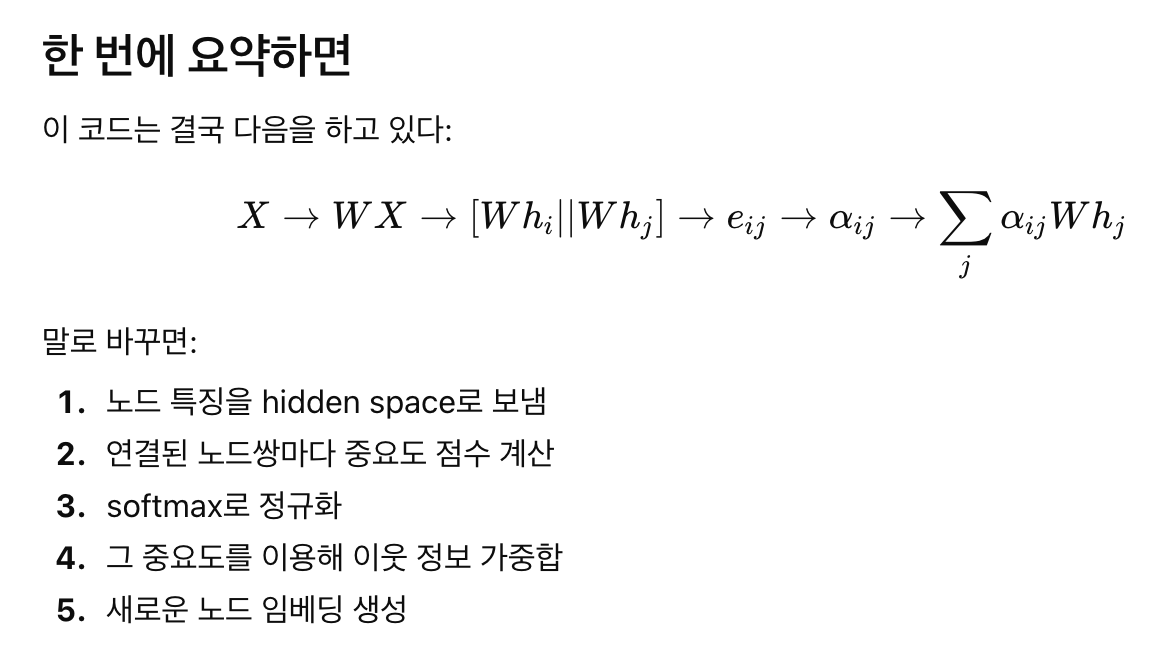
요약
GAT 코드
from torch_geometric.datasets import Planetoid

# Import dataset from PyTorch Geometric
dataset = Planetoid(root=".", name="Cora")
data = dataset[0]

import torch
torch.manual_seed(1)
import torch.nn.functional as F
from torch_geometric.nn import GATv2Conv, GCNConv
from torch.nn import Linear, Dropout


def accuracy(y_pred, y_true):
    """Calculate accuracy."""
    return torch.sum(y_pred == y_true) / len(y_true)


class GAT(torch.nn.Module):
    def __init__(self, dim_in, dim_h, dim_out, heads=8):
        super().__init__()
        self.gat1 = GATv2Conv(dim_in, dim_h, heads=heads)
        self.gat2 = GATv2Conv(dim_h*heads, dim_out, heads=1)

    def forward(self, x, edge_index):
        h = F.dropout(x, p=0.6, training=self.training)
        h = self.gat1(h, edge_index)
        h = F.elu(h)
        h = F.dropout(h, p=0.6, training=self.training)
        h = self.gat2(h, edge_index)
        return F.log_softmax(h, dim=1)

    def fit(self, data, epochs):
        criterion = torch.nn.CrossEntropyLoss()
        optimizer = torch.optim.Adam(self.parameters(), lr=0.01, weight_decay=0.01)

        self.train()
        for epoch in range(epochs+1):
            optimizer.zero_grad()
            out = self(data.x, data.edge_index)
            loss = criterion(out[data.train_mask], data.y[data.train_mask])
            acc = accuracy(out[data.train_mask].argmax(dim=1), data.y[data.train_mask])
            loss.backward()
            optimizer.step()

            if(epoch % 20 == 0):
                val_loss = criterion(out[data.val_mask], data.y[data.val_mask])
                val_acc = accuracy(out[data.val_mask].argmax(dim=1), data.y[data.val_mask])
                print(f'Epoch {epoch:>3} | Train Loss: {loss:.3f} | Train Acc: {acc*100:>5.2f}% | Val Loss: {val_loss:.2f} | Val Acc: {val_acc*100:.2f}%')

    @torch.no_grad()
    def test(self, data):
        self.eval()
        out = self(data.x, data.edge_index)
        acc = accuracy(out.argmax(dim=1)[data.test_mask], data.y[data.test_mask])
        return acc

# Create the Vanilla GNN model
gat = GAT(dataset.num_features, 32, dataset.num_classes)
print(gat)

# Train
gat.fit(data, epochs=100)

# Test
acc = gat.test(data)
print(f'GAT test accuracy: {acc*100:.2f}%')
GAT(
(gat1): GATv2Conv(1433, 32, heads=8)
(gat2): GATv2Conv(256, 7, heads=1)
)
Epoch 0 | Train Loss: 1.978 | Train Acc: 12.86% | Val Loss: 1.94 | Val Acc: 13.80%
Epoch 20 | Train Loss: 0.238 | Train Acc: 96.43% | Val Loss: 1.04 | Val Acc: 67.20%
Epoch 40 | Train Loss: 0.165 | Train Acc: 98.57% | Val Loss: 0.95 | Val Acc: 71.00%
Epoch 60 | Train Loss: 0.209 | Train Acc: 96.43% | Val Loss: 0.91 | Val Acc: 71.80%
Epoch 80 | Train Loss: 0.173 | Train Acc: 100.00% | Val Loss: 0.93 | Val Acc: 70.80%
Epoch 100 | Train Loss: 0.189 | Train Acc: 97.86% | Val Loss: 0.96 | Val Acc: 70.80%
GAT test accuracy: 81.00%