안테나 배열 2

Daisy Kim·2023년 8월 11일

안테나

목록 보기
5/9
post-thumbnail

1D Array

two-element array

한 열에 나열된 안테나 (1D) element 2개가 있다고 해보자
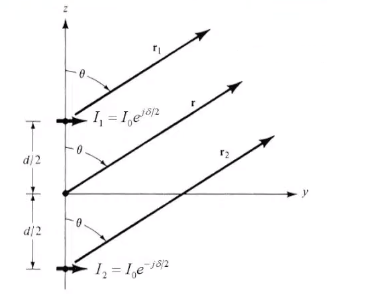
far field에서의 전기장을 계산해보면 다음과 같다.

E2=θ^jηβI0lejβrcosθ4πrAF2\mathbf{E}_2=\hat{\boldsymbol{\theta}} j \eta \frac{\beta I_0 l e^{-j \beta r} \cos \theta}{4 \pi r} \mathrm{AF}_2

여기에서 AF2AF_2는 어레이에 의해 발생되는 array factor이고 다음과 같이 exponential의 조합으로 나타내진다.

AF2=e+j(βdcosθ+δ)/2+ej(βdcosθ+δ)/2=2cos[12(βdcosθ+δ)]\begin{aligned} \mathrm{AF}_2 & =e^{+j(\beta d \cos \theta+\delta) / 2}+e^{-j(\beta d \cos \theta+\delta) / 2} \\ & =2 \cos \left[\frac{1}{2}(\beta d \cos \theta+\delta)\right] \end{aligned}

δ\delta가 안테나 간의 phase 차이, dd는 안테나 사이의 물리적 간격, β\beta는 phase constant이다.
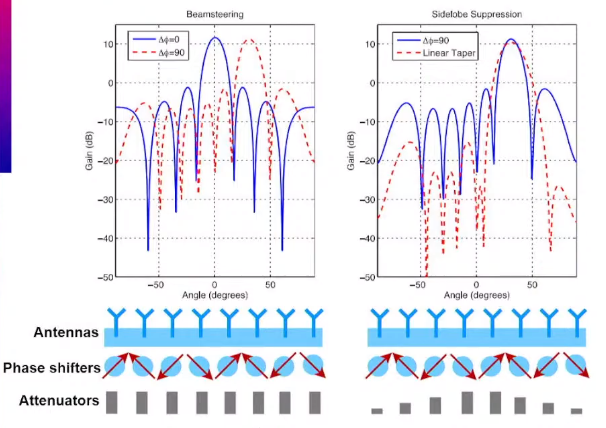
주파수를 얼마로 하느냐, 안테나의 간격dd을 얼마로 하느냐, 급전을 어떤 phase로 하느냐에 따라서 원하는 방향으로 steering 할 수 있다.

N-element array

이번에는 n개의 element로 확장해보자. 이때에는 array factor가 AFNAF_N으로 바뀐다.

AFNAF_N이 N개의 수열로 표현이 되는데 잘 정리하면 sin분의 sin 형식으로 나타나게 되는것을 확인 할 수 있다.

AFN=1+ej(βdcosθ+δ)+ej2(βdcosθ+δ)++ej(N1)(βdcosθ+δ)=exp[j(N12)ψ]sin(Nψ/2)sin(ψ/2),ψ=βdcosθ+δ\begin{aligned} \mathrm{AF}_N & =1+e^{j(\beta d \cos \theta+\delta)}+e^{j 2(\beta d \cos \theta+\delta)}+\cdots+e^{j(N-1)(\beta d \cos \theta+\delta)} \\ & =\exp \left[j\left(\frac{N-1}{2}\right) \psi\right] \frac{\sin (N \psi / 2)}{\sin (\psi / 2)}, \quad \psi=\beta d \cos \theta+\delta \end{aligned}

1D Array pattern

GTotal =GElement ×GArray Factor G_{\text {Total }}=G_{\text {Element }} \times G_{\text {Array Factor }}
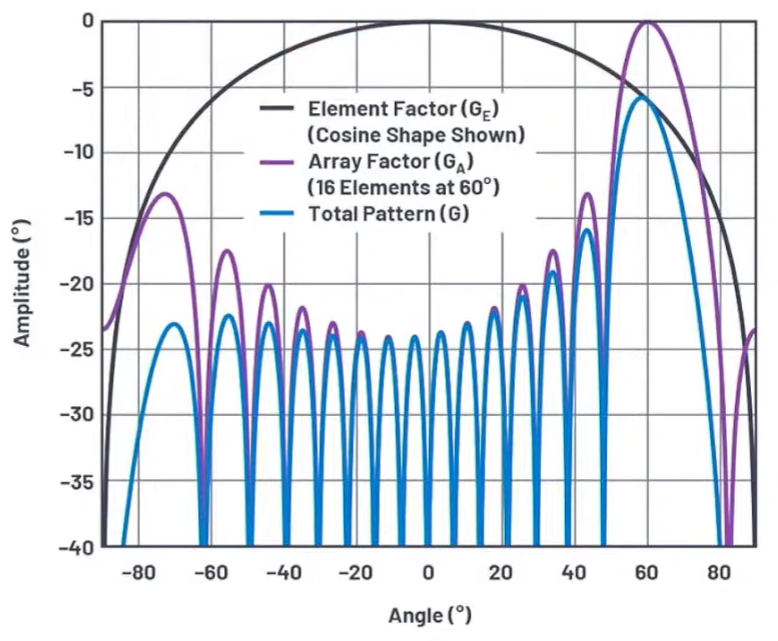

어레이 패턴을 나타내보면 한개의 element에 대한 pattern에 array factor에 의한 term을 곱해준것으로 나타내진다.


2D Array

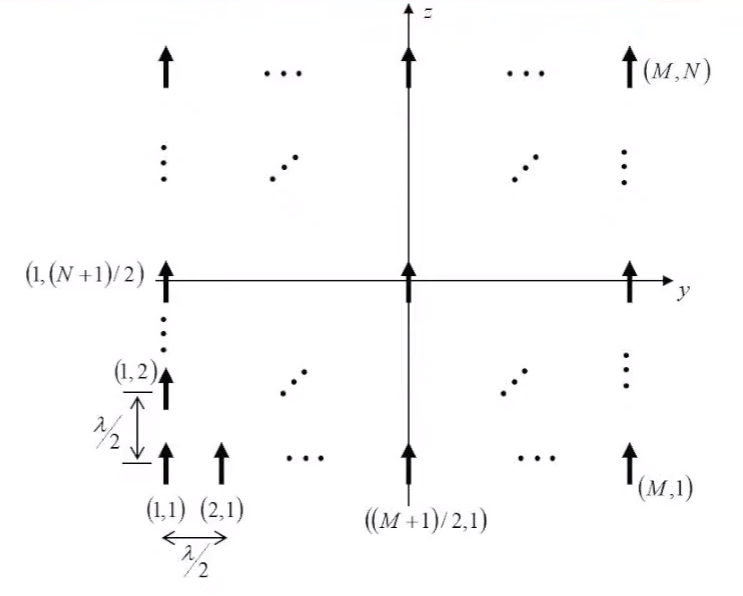
이번에는 2D array로 확장해보자.
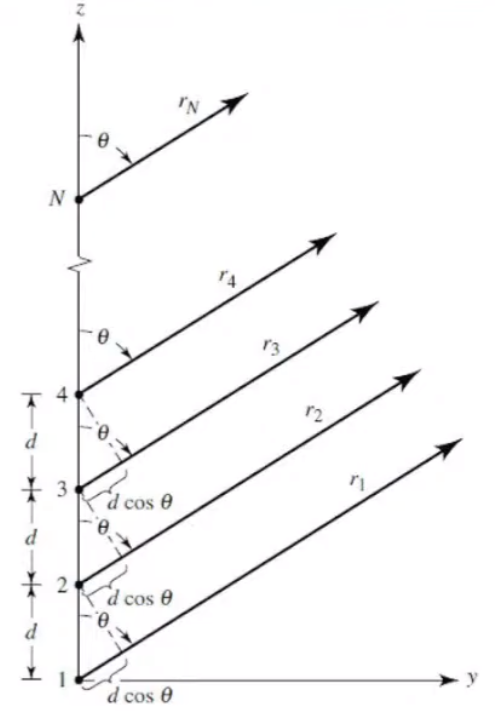
M by N 개의 2D array로 안테나를 배치한다고 하면
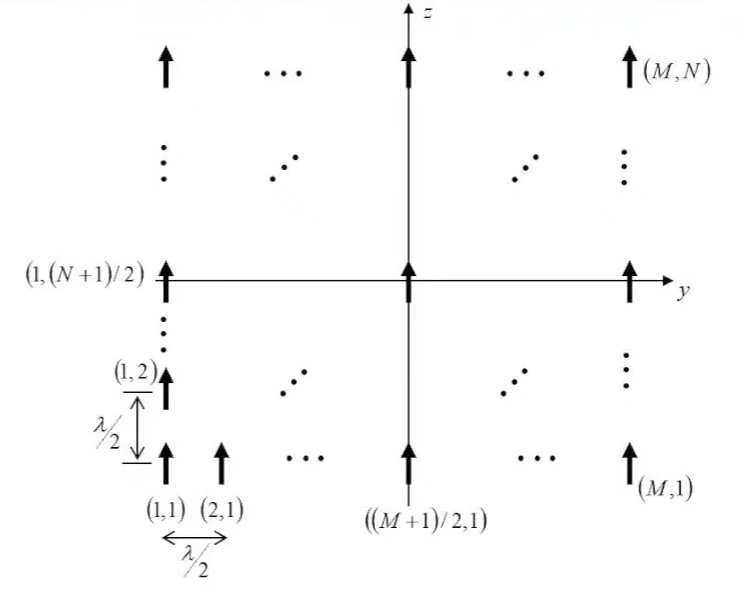
앞의 Array Factor AFN\mathrm{AF}_NAFM×N\mathrm{AF}_{M \times N}로 확장하면 된다.

  • N element
    AFN=exp[j(N12)ψ]sin(Nψ/2)sin(ψ/2)ψ=βdcosθ+δ\begin{gathered} \mathrm{AF}_N=\exp \left[j\left(\frac{N-1}{2}\right) \psi\right] \frac{\sin (N \psi / 2)}{\sin (\psi / 2)} \\ \psi=\beta d \cos \theta+\delta \end{gathered}

>->

  • MXN elements
    AFM×N=exp[j(M12)ψy+j(N12)ψz]sin(Mψy/2)sin(ψy/2)sin(Nψz/2)sin(ψz/2)ψy=βdsinθsinϕ+δyψz=βdcosθ+δz\begin{gathered} \mathrm{AF}_{M \times N}=\exp \left[j\left(\frac{M-1}{2}\right) \psi_y+j\left(\frac{N-1}{2}\right) \psi_z\right] \frac{\sin \left(M \psi_y / 2\right)}{\sin \left(\psi_y / 2\right)} \frac{\sin \left(N \psi_z / 2\right)}{\sin \left(\psi_z / 2\right)} \\ \psi_y=\beta d \sin \theta \sin \phi+\delta_y \quad \psi_z=\beta d \cos \theta+\delta_z \end{gathered}

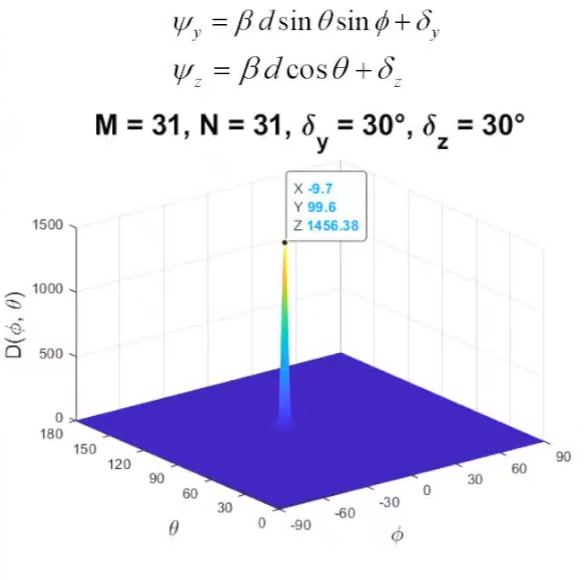
2D Array pattern

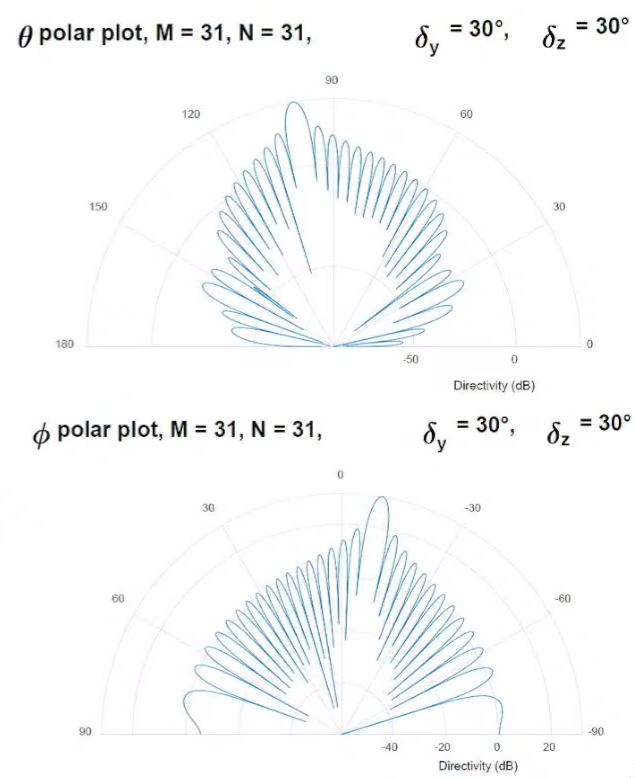
δ\delta를 얼마로 하느냐에 따라 steering이 다르게 나타나고 θ\theta 방향으로 빔 집속이 가능하다.

Main lobe가 특정방향으로 있고 그 주변으로 side lobe가 발생한다.

Side Lobe Suppression

레이더에서 사이드 로브를 줄이는 것이 중요한데
사이드 로브를 줄이는 방법으로 각 element에 급전되는 전류의 크기를 tapering 하는 방법이 있다.

각 element마다 uniform한 파워 급전 하면 사이드 로브 레벨 커진다.
반면에 amplitude tapering을 하니까 side lobe level이 10dB정도 낮아졌다.
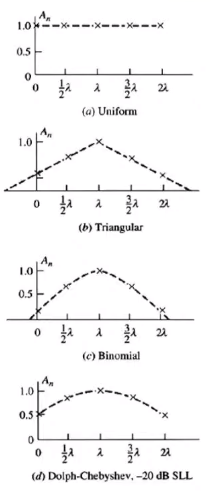
또한 어떤 Polinominal을 가지고 tapering을 하느냐에 따라서도 특성이 달라진다.
profile
내가 보려고 만든 벨로그 (●'◡'●)

0개의 댓글