Inline Function
- Function call → stack management → consumption of CPU and memory resources
- To reduce this overhead, a compiler inserts a callee function into caller function
Source code
#include <stdio.h>
#include <string.h>
#include <stdlib.h>

int add(int a, int b)
{
	return a + b;
}
int main()
{
	int input;
	scanf_s("%d", &input);

	int result = add(3, input);
	printf("%d\n", result);

	return 0;
}
Disassemble
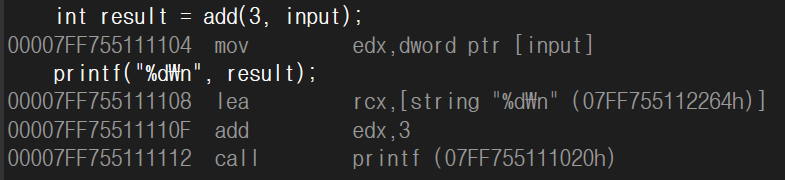
add is removed and implanted inline main after code has been compiled
Function Pointer
Just as an array name is a pointer to its first element,
- a function name is const variable that points to an address of the first instruction of the function [ ( ): Function Call Operator ]
- a function pointer is a variable that contains a function name (i.e, a function pointer is a temporary alias of a function name)
How to use
- same signature
- (*)
- ex)
int add (int, int);

int (*operation) (int, int);

operation= add;

int result = operation(3, 4);
// other code
related code to a function pointer may not be optimized
Callback
-
Caller makes callee run a function that belongs to caller
-
Caller passes the function via a parameter
-
ex) qsort
void qsort ( void* base, size_t nel, size_t width, int (*compare)(const void *, const void *) ); // callback: qsort calls *compare* -
Useful for Multi-threaded or modular programming
Callback is related strongly to ‘asynchronous’
- Another thread
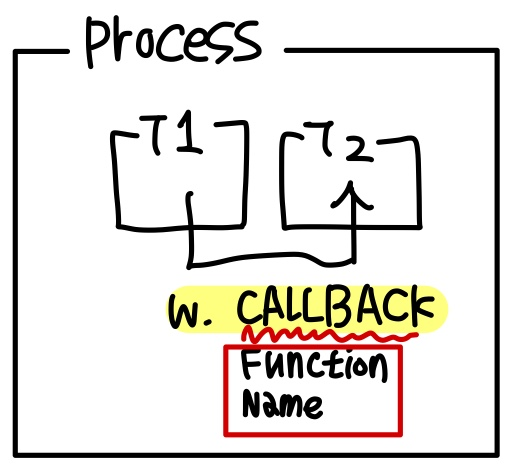
- Operating System
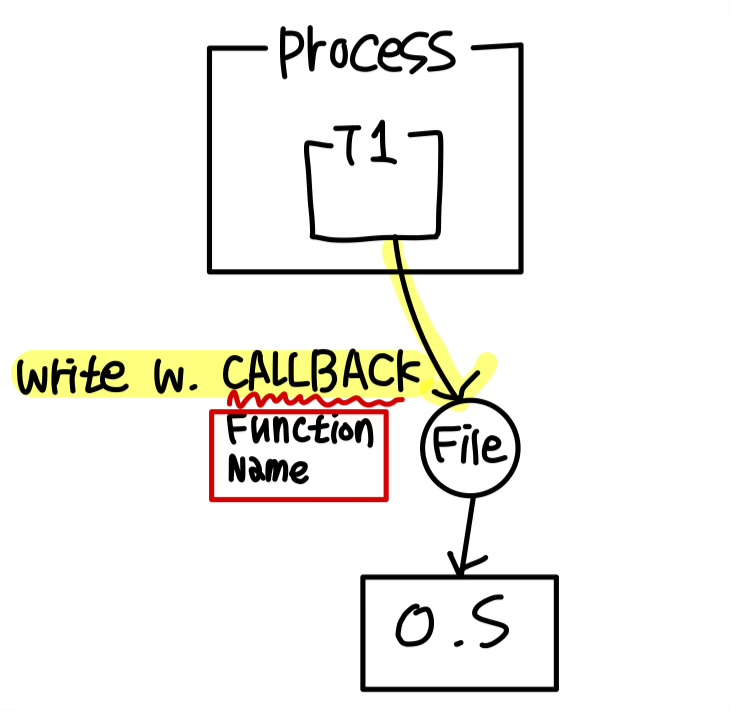
- Another thread
Lookup table
An array of function pointers
Higher performance than switch-case or if-else
- No comparison
- Prevention of branch Hazard on CPU
#include <stdio.h>

int add(int, int);
int sub(int, int);
int multiply(int, int);
int divide(int, int);

int main() {
    int (*operations[5]) (int, int);
    operations[0] = add;
    operations[1] = sub;
    operations[2] = multiply;
    operations[3] = divide;

    int op_num;
    scanf_s("%d", &op_num);

    if (op_num < 0 || op_num > 3) {
        return 1;
    }
    int result = operations[op_num](4, 5);
    printf("%d\n", result);

    return 0;
}
People live above layers of abstraction beneath which engineers reside