Learning Quadrotor Control From Visual Features Using Differentiable Simulation 논문 리뷰
[Learning Quadrotor Control From Visual Features Using Differentiable Simulation] ([2410.15979] Learning Quadrotor Control From Visual Features Using Differentiable Simulation) (Johannes Heeg, Yunlong Song, Davide Scaramuzza / ICRA, 2025)
Summary
- Vision-based UAV control에서 sample inefficiency 문제를 해결하기 위한 방법으로 differentiable simulation을 제안
- surrogate dynamics model을 활용해서 backpropagation 속도 향상
- state representation learning을 활용해서 convergence 속도 향상
- 기존 model-free approach에 비해서 학습 효율성이 크게 향상
My Insights / Takeaways
- Differentiable simulation을 UAV RL control에 활용하는 방법에 대해 공부
→ forward / backward process가 어떻게 되는지 이해
→ backward process는 조금 더 단순화해도 학습에 지장 없고, 훨씬 더 빠르게 학습 가능
⇒ 기존 model-free 기반 방법론과 다르게, sampling 기반이 아니고 직접적으로 gradient를 구해서 업데이트하므로 sample efficiency 훨씬 높음
-
시뮬레이션 구현 난이도가 높을 것 같음 → 한번 살펴보면 좋을 것 같음.
-
이론적으로는 깔끔한거 같은데 Real world deployment는 실제로 의미있는 것인지 의문
- 해당 연구에서는 visual feature point coord를 기반으로 stabilize했는데,
→ 실제로는 이 point를 quadrotor에 facing하고 있다는 보장도 없고
→ pixel coord를 추출하는 model의 정확도에 대한 보장도 없어서 ..
- 해당 연구에서는 visual feature point coord를 기반으로 stabilize했는데,
- State representation pretraining은 추후에도 쓸만한 방법인 것 같음.
- implicit한 state estimation을 먼저 조금 배워두는 느낌으로
Introduction
Problem definition
-
Vision-based RL Control의 가장 큰 문제 →
Sample inefficiency- Input dimension이 높아서 더 많은 sample 필요
- NN이 implicit한 state representation과 control law를 동시에 학습해야함
- 실제로 이전 pure-vision-based 연구들은 한 모델 학습하는데 몇 일이 걸릴 수 있다고 함.
-
Differentiable simulation을 활용하면 sample efficiency를 크게 향상시킬 수 있음- Dynamics의 derivative를 활용하여 policy gradient를 sampling하지않고 직접 계산
→ parameter update의 variance를 크게 줄여서 sample efficiency를 높임
- Dynamics의 derivative를 활용하여 policy gradient를 sampling하지않고 직접 계산
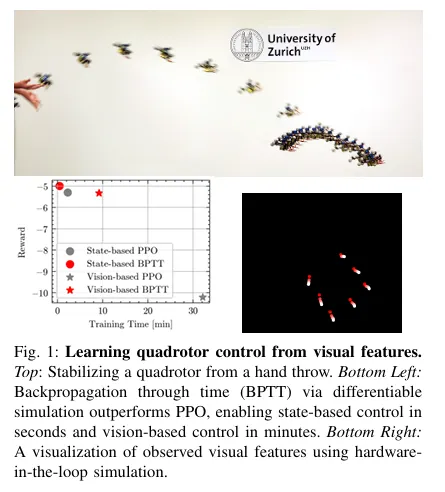
Contribution
Vision based quadrotor control 학습을 위해 differentiable simulation을 활용하는 방법 제안
- 이 논문에서는 quadrotor를 던졌을 때, camera로부터 얻어지는 visual feature만을 활용해서 stabilize하는 문제를 풀어보려고 함.
-
state based control task와 vision based control task 모두 실험
→ model-free RL (PPO)와 비교하여 월등한 성능
-
Backward pass에서 단순화된 surrogate model을 활용하면, gradient 계산을 훨씬 빠르게 수행할 수 있음
→ sample efficiency 향상
- Control policy를 보조적인 representation task로 pretraining하면 전체적인 학습을 가속화 / 안정화 가능
Method
Differentiable simulation의 핵심은 dyanmics를 통해 objective function으로부터 policy parameter까지 직접 gradient를 back-propagation 할 수 있다는 것
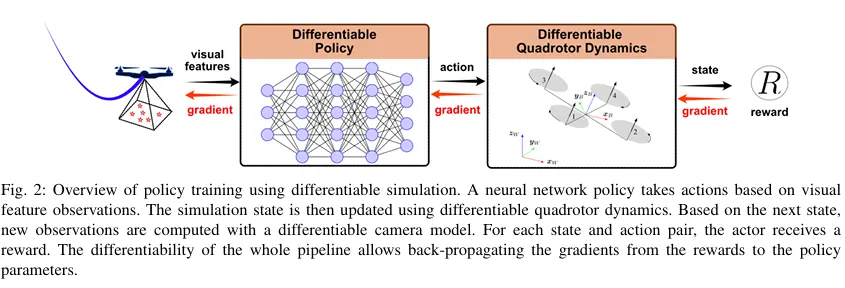
참고) model-free & model-based policy gradient
Model-free policy gradient에서는 사실상 world의 dynamics transition을 모른다고 가정하기 때문에, reward를 미분하는게 아니고, policy objective를 잘 정의해서, reward로 weighted된 log-probability gradient로 policy update
= policy gradient theorem
→ reward를 sampling해서 log-probability를 좋은 행동을 하는 방향으로 조금씩 조작해주는 것
-
Model-based policy gradient에서는 실제로 reward를 policy 파라미터로 미분해서 직접적으로 파라미터 업데이트→ dynamics가 파라미터로부터 reward까지를 연결해주기 때문에 가능한 일 (아래와 같이)
⚠️ 그리고 여기서 model-based는 DreamerV3와 같은 실제 model-based RL의 개념은 아님.
- 이 논문에서 model-based라 하는 것은 world physics를 알고 있어서, 물리적 state를 가지고 기술된 dynamics를 미분해서 학습 또는 최적화를 수행한다는 것
- 보통 RL에서 model-based라 하는 것은 실제 world physics를 모르기 때문에, 이를 근사하는 미분 가능한 world 모델을 데이터로부터 학습하겠다는 것
이제 differentiable simulation이 policy optimization에 어떻게 활용되는지 살펴보자.
Policy Optimization via Differentiable Simulation
-
먼저 quadrotor는 discrete-time dynamic system으로 정의
-
system state :
-
control input :
→ system dynamics는 아래와 같이
-
observation
→ observation은 각 time step마다 observation model을 통해 state로 만들어진다.
- 또한 각 time step마다 reward를 받는다. → 여기선 reward도 의 함수
- control policy는 deterministic differentiable function (NN)
- Objective function 는 policy parameter가 주어졌을 때 누적 reward값으로, optimal parameter를 찾기 위해 gradient ascent로 maximize✅ model-free RL과 핵심 차이는 이 objective function이 sampling기반이 아니라 (expection이 아님) 실제 결정론적인 함수라는 것
-
Back-propagation Through Time (BPTT)-
그래서 이 의 구조를 통해 chain rule을 적용하여 policy gradient를 구하면
-
여기서 은 dynamic system의 jacobian
→ 과거 state의 변화가 현재 state에 얼마나 영향을 주는지를 의미
✅ BPTT의 policy gradient를 두 항으로 나눠 해석하자면 아래와 같다고 생각
- ⇒ state를 통한 효과
: 파라미터를 바꾸면 action이 바뀌고, 그게 dynamics를 통해 state를 바꾸고, 그 state가 reward에 영향을 준다 - ⇒ action을 통한 효과
: 파라미터를 바꾸면 action이 바뀌고, 그 action이 reward에 직접 반영되는 경우 (e.g., control effort penalty)
-
Quadrotor dynamics
- Simple quadrotor dynamics를 아래와 같이 표현
-
는 world frame position, orientation, velocity
-
는 body frame angular velocity
-
는 collective thrust
-
full dynamics는 motor, drag, delay, 등을 모두 포함한 수식
Jax-based Differentiable Simulator
- Differentiable simulator는 Flightmare 시뮬레이터와 비슷하게 air-drag, low-level control 구조, motor speed, transmission delay를 simulate
→ 최대한 현실적으로 만들어서 real-world zero-shot 가능하도록
-
모든 simulation framework는
JAX를 활용하여 구현→ 시뮬레이션 + BPTT를 포함한 함수 자체를 실행 시점에 컴파일 (JIT)해서 GPU에서 바로 실행되도록 함.
⚠️ 실제 구현이 어떻게 되어있는지는 코드를 봐야 알거같은데, 아마 JAX로 컴파일한 어떤 함수에서 시뮬레이션 rollout → back propagation까지 해서 gradient구해주고, 우리는 외부에서 모델만 계속 업데이트해주는 구조일 것 같음
   # 이런식이려나
   @jax.jit
   def loss_and_grad(theta, x0):
       R = rollout(theta, x0)
       return R, jax.grad(R)(theta)
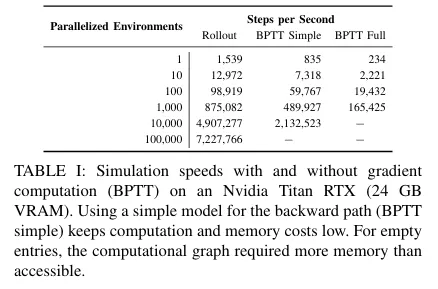
→ 그래서 매우 빠른 실행이 가능함 (1초에 몇백만 steps까지)
→ 또한 위 표에서 gradient 계산을 빠르게 해주는 또 다른 요소가 아래 나오는 fast surrogate gradients
Fast Surrogate Gradients
- Differentiable simulator는 위에서 설명한 것처럼 fully differentiable.
- 하지만, full low-level control stack까지 모두 미분하는것은 바람직하지 않음 → computational graph가 너무 expensive해짐
➡️ 그래서 forward path에서는 full model 를 활용하고, backpropagation에서는 simpler model 를 활용
forward path→ 실제 시뮬레이션에서 활용되는 모델 (flightmare 등)
backward path→ 최소한의 물리 관계만 유지 = 위에 Quadrotor dynamics에 표현된 식
Pretraining on State Representation Learning
- 지금까지는 differentiable simulation과 그 gradient 계산 방법 등에 대해서 알아보았음.
- 근데 실제로 vision-based control을 생각해보면, policy training 전에, visual feature representation을 학습하는 것 자체가 또 어려운 task임.
-
visual feature → command mapping 학습이 훨씬 어려움.
state-based: state -> controlvision-based: image -> (implicit state representation) -> control
⇒ NN은 이미지에서 암묵적으로 state를 추정해야함.
-
Observation model 떄문에 gradient가 우회해서 흐르게 됨
state-based:vision-based:
-
➡️ Neural network를 state representation에 대해 Pretraining하자
-
데이터 수집
- control 자체는 중요하지 않고, random 초기화된 policy로 데이터 수집
-
State representation learning
- NN은 visual observation으로부터 quadrotor state를 예측하도록 학습한다.
-
학습된 weight를 policy network 의 초기값으로 사용한다.
→ policy network 내부적으로 state space를 latent로 가지게 되어서 vision → state mapping이 어느정도 가능
→ 이 상태에서 control만 추가로 잘 가르치면 되는 식.
→ 이러한 방법은 RL의 convergence에 큰 도움을 준다고 함.
“Integrating State Representation Learning Into Deep Reinforcement Learning” (RAL 2018) 참고
Training Details
-
Policy
- two hidden layer MLP
- size → 512 for state-based, 1024 for vision-based
-
Action space
- body rate 와 collective thrust
- on-board controller는 이를 받아서 execute (~50Hz)
→ FC에서 state estimation이 필요 없음
→ RL이 stabilization까지 모두 수행하는 구조
-
Observation space
-
state-based에서는
-
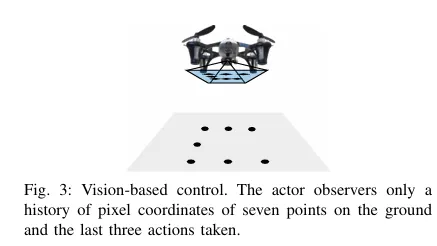
vision-based에서는 아래 그림과 같이 바닥에 놓인 7개의 feature point pixel coord
-
한 frame만 가지고는 vel, acc를 추정할 수 없으므로, 5개의 이전 frame과 3개의 이전 action을 추가로 observation으로 활용
-
Camera model도 differentiable model 사용
-
-
Reward function
- Quadrotor stabilization이라는 것은 원하는 위치 에서 드론을 hovering 시키는 것
- 는 huber loss
- Quadrotor stabilization이라는 것은 원하는 위치 에서 드론을 hovering 시키는 것
Experiments
-
여기서 task는 random condition으로부터 stabilize하는 것
-
state-based RL과 vision-based RL로 각각 실험
-
PPO와 BPTT를 비교
-
모든 학습은 Nvidia Titan RTX (24GB VRAM)에서 진행
Sample efficiency and Training time
Learning State-based Control
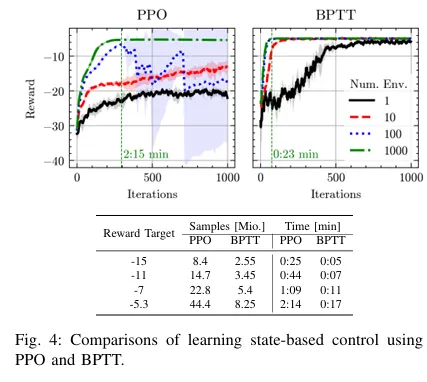
- BPTT는 훨씬 적은 parallel environment로도 PPO와 비슷한 성능 도출
- 같은 reward를 도달하기 위한 sample 수, time에서도 우위
Feature-based Control without state estimation
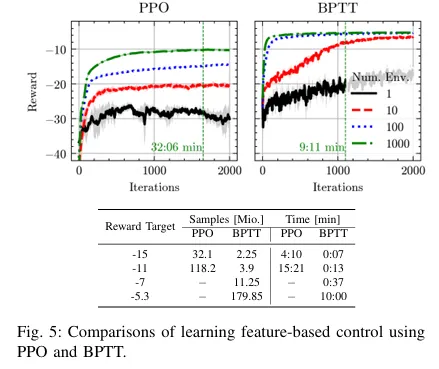
- BPTT는 state-based control에 유사한 성능을 낼 수 있음.
Real world transfer
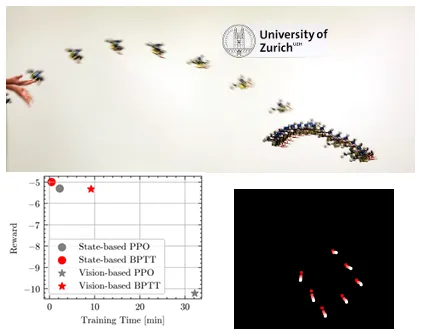
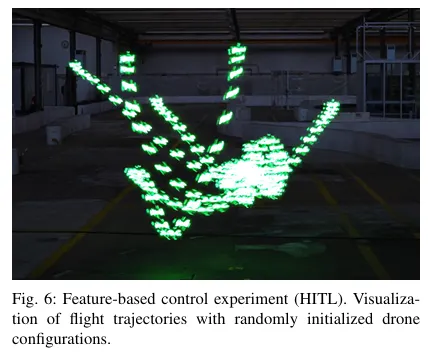
- 실제 드론으로 HITL 실험
- 실제 드론의 pose는 MOCAP으로 측정
- actor는 가상의 observation을 받음 (아래 그림 오른쪽 아래 feature point observation 처럼) → feature detection model 없이도 control 성능 측정 가능
- observation model은 sim2real gap 없지만, MOCAP 측정 오류는 존재 가능한 상황
Simple model gradient computation
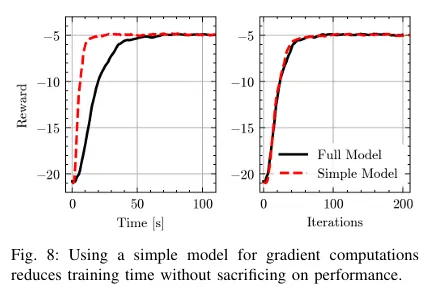
- Surrogate function을 사용했을때, training time을 줄이면서, sample efficiency나 성능에 손해를 보지 않는다
Pretraining on state representation
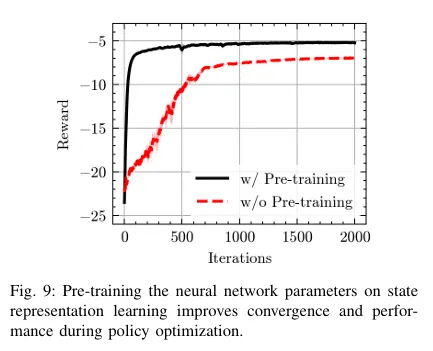
- vision-based control task에서 state representation learning을 해줬을 때 성능이 훨씬 좋다.
→ 네트워크가 vision → state mapping에 대한 이해를 가지게 됨
→ gradient quality를 높임