Learning on the Fly: Rapid Policy Adaptation via Differentiable Simulation 간단 리뷰
Learning agile vision-based drone flight
[Learning on the Fly: Rapid Policy Adaptation via Differentiable Simulation](Learning on the Fly: Rapid Policy Adaptation via Differentiable Simulation) (Jiahe Pan, Jiaxu Xing, Rudolf Reiter, Yifan Zhai, Elie Aljalbout, Davide Scaramuzza / RAL, 2025)
Visual feature based policy + differential simulation + sim2real fast adaptation (residual learning)
Problem
- sim2real gap 문제
- Domain randomization은 ood disturbance에 약함
- real2sim2real : 실세계 데이터 활용해서 시뮬레이터를 현실처럼 맞게 고치고, 그 시뮬레이터에서 정책 다시 학습→ 너무 오래 걸림
Core Idea
미리 모든 환경을 커버하려 하지 말고 상황에 맞게 즉석에서 fitting해서 쓰자
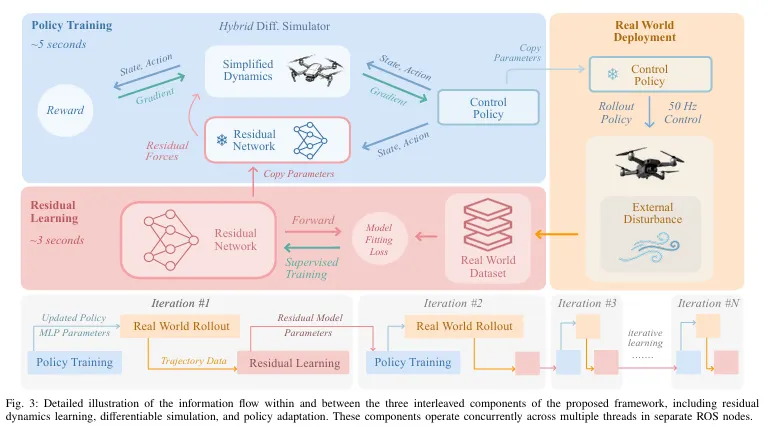
method
-
Policy Pretraining + Online Adaptation
- Policy pretraining에서는 간단한 dynamics 를 통해 base policy 학습
-
Online Adaptation에서는 아래 세 루프를 동시에 돌림
1. Real world rollout
- 실제 드론 비행에서 trajectory 얻음
2. Residual Dynamic Learning
- 간단한 dynamic model이 맞추지 못한 가속도 residual 학습
→ 이건 supervised learning
- state, action 주어졌을 때 실제로 드론의 가속도와 계산되는 가속도를 비교
3. Policy Training
- Residual network가 주는 residual을 통해 dynamics가 정확해지고, 이를 기반으로 하는 differentiable simulator에서 policy 학습
➡️ 5초 정도면 adaptation이 끝난다고 함.
💡Low-fidelity vs. High-fidelity Dynamics model
- 동역학이 정확해질수록 gradient 계산이 복잡해짐
- low-fidelity 모델도 gradient 방향은 대충 맞음 → 성능 차이 거의 없음.
- low-fidelity 모델에 residual 보정 해주면 충분히 쓸만한 forward model 설계 가능
- 즉, 여기서 differentiable simulator에서 활용되는 dynamic model은 policy를 미분하기 위한 surrogate model이지, 실제 물리를 그대로 재현하기 위한 simulator가 아님.