What Engineers Actually Look for in Open Source Automation Tools Before Committing
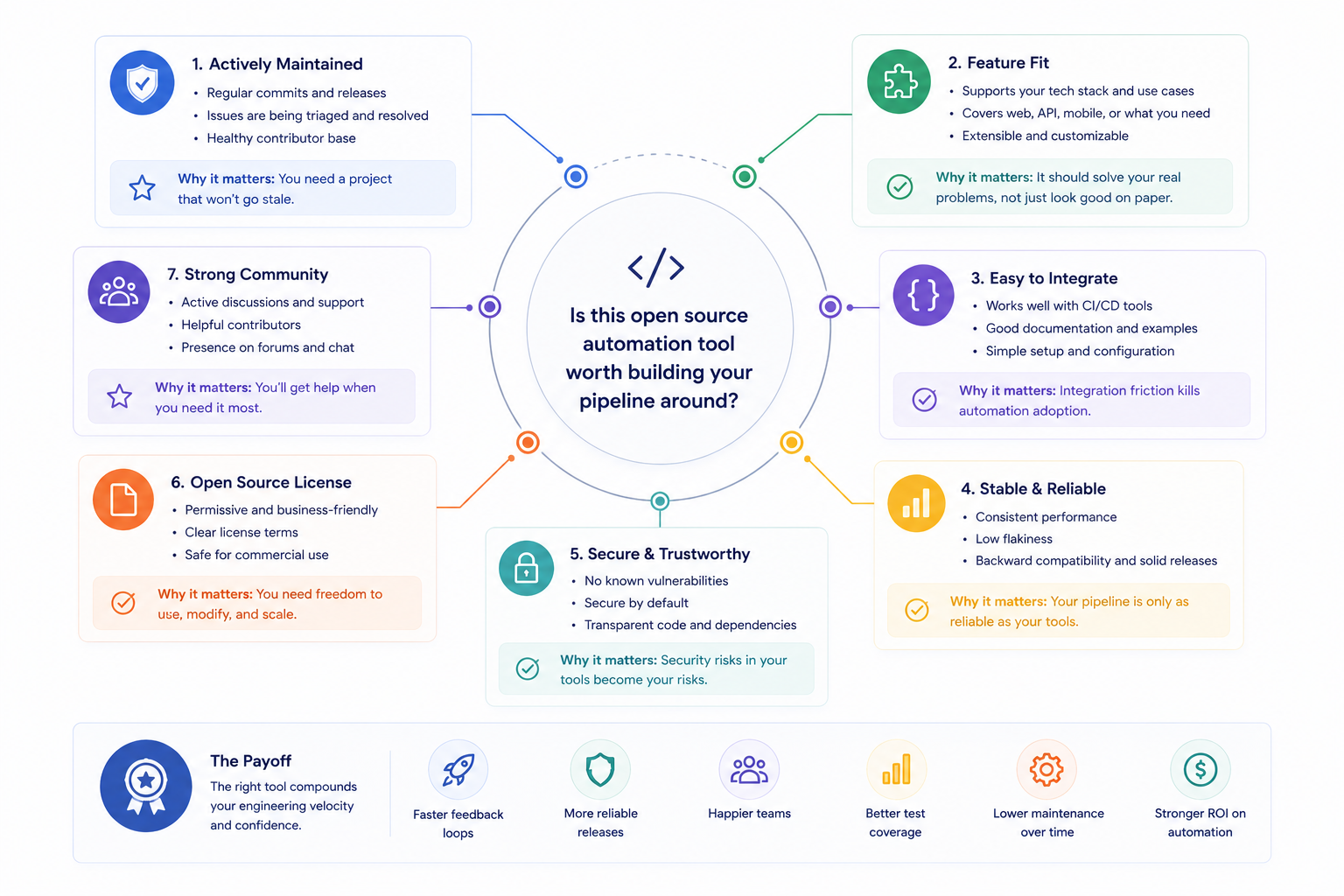
Every engineer who has migrated a test pipeline away from a tool they committed to too quickly knows the specific feeling that comes with it.
It is not regret exactly. It is more like the recognition that the evaluation process that felt thorough at the time did not actually surface the things that ended up mattering. The tool worked fine in the demo. It worked fine for the first few months. And then the system grew, the team changed, and the limitations that were not visible during evaluation became the dominant reality of working with it every day.
The engineers who avoid this pattern tend to evaluate open source automation tools differently from the start. Not more formally, not with longer checklists, but by asking different questions than the ones that appear in comparison articles.
Does It Actually Solve the Problem You Have Right Now
This sounds too basic to include. It is the question that gets skipped most often.
When engineers are evaluating open source automation tools, they tend to research the category and then evaluate candidates against the category's general requirements. The tool supports the right languages. It integrates with CI/CD platforms. It has good community activity. It has documentation.
What does not always happen is a direct comparison between what the tool actually does and the specific failure mode that triggered the evaluation in the first place.
If production incidents keep tracing back to integration failures at service boundaries, the relevant evaluation question is whether this tool addresses integration testing at service boundaries under conditions that resemble your system. Not whether it is a generally well-regarded automation tool. Not whether it has a large community. Whether it solves the actual problem.
Engineers who have made expensive migration decisions tend to start here now rather than at the feature comparison stage. The question is not what does this tool do but does what this tool does match what we actually need.
How the Community Handles Problems That Look Like Yours
Community size matters less than community composition. A tool with fifty thousand GitHub stars and an active community of enterprise Java developers is not particularly useful to a team running polyglot microservices, regardless of how healthy the project looks by conventional metrics.
The evaluation that tells you something real is reading through open issues and discussions looking for problems that resemble your situation. Not feature requests. Not documentation improvements. Problems. Integration failures on specific platforms. Behavior under load. Edge cases in dependency handling. The ways the tool breaks down when systems get more complex than the tutorial examples.
How maintainers respond to those problems is the most informative signal available. A project where complex integration problems get substantive responses from people who clearly understand both the tool and the underlying architecture is a project where you are likely to get help when you need it. A project where complex problems accumulate without responses or get closed with suggestions to consult the documentation is a project where you will be solving hard problems alone.
This evaluation takes an hour. It predicts the next two years of working with the tool more accurately than any benchmark or feature comparison.
Whether the Setup Cost Matches the Value
Open source automation tools have setup costs that do not appear in the documentation.
These costs include:
- Time to get it running in your specific pipeline.
- Time to write the initial test cases or configure the initial coverage.
- Time to train the team on how to use it.
- Time to figure out the integration quirks that only appear when you connect it to your actual infrastructure rather than the example setup.
Engineers who have done this a few times tend to estimate these costs honestly before committing rather than anchoring on the assumption that open source means low friction.
Some tools have genuinely low setup costs and deliver value within days. Others require significant investment before they provide useful signal, and the value only materializes after weeks of configuration and team adjustment.
Neither profile is inherently wrong. A tool with high setup costs might be the right choice if the long-term value justifies the investment. The mistake is not accounting for the setup cost at all and then being surprised when the adoption timeline extends beyond what anyone planned for.
How It Handles the Accuracy of Dependency Representations
This is the evaluation question that separates engineers who have run automation tooling at scale from engineers who have not.
Every open source automation tool that covers service interactions has to represent external dependencies during test execution. Mocks, stubs, recorded responses, contract definitions — the specific mechanism varies but the underlying requirement is the same. The tool needs a way to stand in for the real dependencies your services call.
The question that matters is not whether the tool can do this but what happens to those representations over time.
In a system where services deploy independently on their own schedules, dependency behavior changes continuously. A mock written in January represents how a service behaved in January. By April that service has shipped several times and the mock is a historical artifact rather than a current representation.
Tools that have no systematic approach to this problem produce automation suites that degrade silently. Tests keep passing. The gap between what tests validate and what production actually does keeps growing. The automation looks healthy until a production incident reveals that the coverage was accurate six months ago and has been drifting since.
Engineers who have experienced this failure mode look specifically for tools that address dependency accuracy at the architecture level rather than relying on manual mock maintenance discipline.
Keploy addresses this by capturing real API traffic from running applications and generating test cases and mocks from those actual interactions, which means dependency representations reflect current service behavior rather than historical assumptions. For teams building automation around API-driven systems and microservices, this approach to dependency accuracy is one of the most consequential architectural choices available.
Whether It Will Still Be a Good Fit When the System Is Bigger
The system you are building automation for today is not the system you will have in two years.
The tool that handles your current scale comfortably might struggle significantly when:
- The service count doubles.
- The team grows.
- Deployment frequency increases.
Engineers who have been through a migration tend to evaluate scalability more carefully than engineers who have not.
The relevant questions are not abstract:
- Does the tool support enterprise scale?
- Does it handle distributed systems?
- How does it perform as service complexity increases?
- What happens when execution volume grows significantly?
They are specific to the trajectory the system is actually on.
If the team is growing from five engineers to fifteen over the next year, the evaluation should include:
- How the tool handles multiple people working on test cases simultaneously.
- How it manages conflicts.
- How new team members get up to speed.
If deployment frequency is increasing from weekly to daily, the evaluation should include:
- How the tool performs under higher execution load.
- Whether its CI integration supports the pipeline stages that higher-frequency deployment requires.
The tool that fits well for the next six months and breaks down in year two costs significantly more than the migration eventually required. Spending the extra evaluation time to understand the scalability profile before committing is cheaper than the alternative.
What the Actual Maintenance Burden Is
Open source automation tools are free in the sense that there is no license fee. They are not free in the sense of requiring no ongoing investment.
Maintenance takes several forms:
- Keeping the tool updated as new versions are released.
- Addressing breaking changes when they occur.
- Maintaining the test cases and dependency representations as the system they cover evolves.
- Supporting team members who encounter problems the documentation does not address.
Engineers who evaluate maintenance burden honestly before committing make better long-term tool decisions.
The evaluation questions are practical:
- How frequently does the tool release breaking changes?
- How difficult have historical migrations been?
- How much effort does keeping dependency representations current actually require?
- How long does it take a developer who is not familiar with the tool to diagnose and resolve a test failure?
The answers to these questions determine whether the tool becomes a sustainable part of the workflow or a recurring source of technical debt that eventually generates a migration project of its own.
The Commitment Is the Evaluation
The engineers who make good open source automation tool decisions tend to treat the evaluation itself as a commitment rather than as a precursor to one.
They:
- Run the tool against real workloads.
- Investigate the community's handling of real problems.
- Estimate the actual setup and maintenance costs honestly.
- Think about whether the tool will still be the right choice when the system is significantly more complex than it is today.
That evaluation takes longer than reading a comparison article. It produces significantly better decisions than comparison articles can.
The migration that does not happen because the right tool was chosen upfront is the most valuable outcome available, and it starts with asking different questions than the ones most evaluations ask.