Types of Regression Testing That Matter More Now That AI Is Writing Your Code
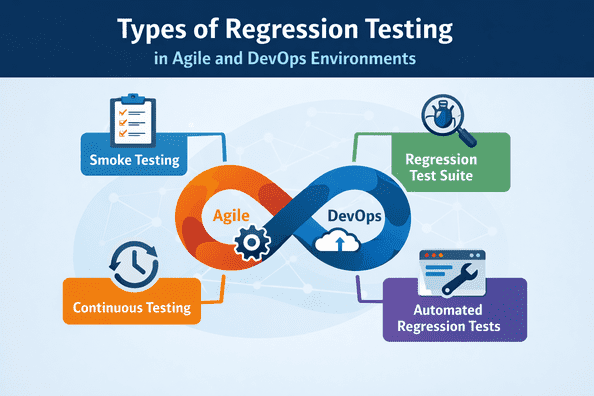
AI coding assistants have changed a lot about how software gets written. The pace is faster. The volume of code arriving for review is higher. Features that took a week now take a day.
What has not changed is what happens when that code breaks something that was already working. The bugs still reach production. The post-mortems still happen. The question of which testing practices would have caught the failure still gets asked.
What has changed is which types of regression testing answer that question reliably. Some types of regression testing were already doing their job well before AI coding tools arrived. Others have become significantly more important because of specific ways AI-generated code fails that human-written code failed less often.
This article focuses on the second category.
Why AI-Generated Code Fails Differently
Before getting into specific types of regression testing, lets understand the specific failure patterns that AI coding assistants introduce.
Human developers who have worked on a system for months carry context that AI tools do not have. They know which downstream services are sensitive. They know which data patterns appear in real production traffic. They know which edge cases caused problems six months ago. That knowledge shapes how they write code and how they write tests for it.
AI coding assistants work from the stated requirement. They generate code that satisfies the specification and tests that validate the described behavior. The unstated requirements, the undocumented edge cases, the production patterns that experienced engineers know to anticipate -- none of these appear in AI-generated code unless someone explicitly put them in the prompt.
The result is a specific category of regression failure. The code is technically correct. The tests pass. The failure only appears when real users or real downstream services interact with the system in ways the AI did not anticipate.
Three types of regression testing are specifically designed to catch this category of failure.
Integration Regression Testing
Integration regression testing has always been the most underinvested layer in most testing strategies. AI-assisted development has made the cost of that underinvestment significantly higher.
Integration regression testing validates what happens at the boundaries between components -- specifically, how services communicate with each other through API calls, how data flows across service boundaries, and whether the contracts between independently deployed services hold up as those services evolve.
This is where AI-generated code is most likely to introduce failures that pass unit tests. An AI coding assistant generating a service integration writes code that handles the response shape it was told to expect. It does not know that the downstream service changed its response schema three weeks ago. It does not know that a new required field was added to an API contract in the last release cycle. It generates code that was accurate against the specification it was given and inaccurate against the service that actually exists in production.
Integration regression testing catches this because it validates behavior at service boundaries under current conditions rather than against static mocks that reflect past assumptions. In a development environment where AI is generating service integrations at higher velocity than before, the surface area of potential integration failures grows proportionally. The teams that have invested in integration regression testing infrastructure find that this investment pays off significantly more in AI-assisted development environments than it did before.
Behavioral Regression Testing
Behavioral regression testing validates what the system does from the perspective of its users and downstream consumers -- not whether the code executes correctly internally, but whether the observable outputs match what users and integrations expect.
The distinction matters for AI-generated code because AI coding assistants optimize for internal correctness. A function generated by an AI tool will do what the code says it should do. Whether what it does matches what users need is a separate question that requires a different kind of test.
Behavioral regression testing answers that question by validating the system against its external specification rather than its internal implementation. When an AI-generated change alters observable behavior in a way that breaks what users depend on, behavioral regression tests catch it regardless of whether the internal implementation looks correct.
This type of regression testing has always been valuable. It becomes more valuable in AI-assisted development environments because the gap between internal correctness and external behavioral accuracy is wider. AI generates code that is internally consistent with its instructions. Whether those instructions captured what users actually needed is something behavioral regression testing is specifically designed to verify.
Traffic-Based Regression Testing
This is the type of regression testing that addresses the AI coding problem most directly and that most teams have not yet adopted.
Traffic-based regression testing uses recorded real interactions from production or staging environments as the basis for regression test cases. Rather than writing test inputs based on developer assumptions about what the system will encounter, traffic-based tests reflect what the system actually encounters under real conditions.
The specific advantage for AI-assisted development is that traffic-based regression tests cover the scenarios that neither developers nor AI tools anticipated. Real users produce inputs and interaction patterns that nobody thought to test for. Real downstream services return responses that differ from documented API specifications in ways that only appear under production load. Traffic-based regression tests capture these scenarios directly.
Keploy operates on this principle -- capturing real API traffic flowing through an application and generating repeatable regression tests and dependency mocks from those actual interactions. When AI-generated code handles a new type of request or integrates with a new service, traffic captures from real usage reflect what the system actually encounters rather than what someone assumed it would encounter. The regression suite stays calibrated to production reality rather than to developer or AI assumptions about production reality.
This matters specifically for AI-assisted development because the gap between what AI generates and what production actually looks like is where failures concentrate. Traffic-based regression testing is the type that closes that gap directly.
Selective Regression Testing
Selective regression testing -- sometimes called risk-based regression testing -- applies the other types strategically rather than uniformly. Instead of running every regression test on every code change, it identifies which tests are relevant to a given change and runs that targeted subset.
This type becomes significantly more important when development velocity increases, which is exactly what AI coding assistants do. A team using AI tools to generate code faster than before is making more code changes per sprint. Running the full regression suite on every change creates pipeline bottlenecks that slow feedback loops and eventually lead developers to skip waiting for test results.
Selective regression testing makes comprehensive coverage practical at higher velocity. The key is maintaining accurate mapping between code areas and the tests that cover them, so that when AI generates a change in a specific part of the system, the relevant integration, behavioral, and traffic-based regression tests run automatically without running everything.
The combination of accurate test selection and comprehensive coverage in the relevant areas gives AI-assisted development teams the feedback speed they need without sacrificing the coverage depth that AI-generated code requires.
What Has Not Changed
Unit regression testing remains what it always was. It catches logic errors in individual functions. It runs fast. It gives developers immediate feedback on whether the code they just wrote behaves the way they intended. AI coding assistants generate unit tests alongside code reasonably well, and those tests provide genuine value at the component level.
The issue is not that unit regression testing is less useful than it was. It is that unit regression testing was never designed to catch the specific category of failure that AI-generated code concentrates at integration boundaries and behavioral interfaces. It remains the right tool for the layer it covers. It is just no longer sufficient as the primary regression investment for teams where AI tools are generating significant portions of the codebase.
The types of regression testing that matter more now are the ones that cover the layers where AI-generated code fails most often:
- Integration boundaries where service contracts drift from assumptions.
- Behavioral interfaces where internal correctness diverges from external expectations.
- Production traffic patterns that neither developers nor AI tools anticipated.
Those failures were always there. AI-assisted development has made them more frequent and more consequential. The types of regression testing that catch them have become the ones most worth investing in.