Hash
데이터를 빠르게 저장하고 검색하기 위한 방법
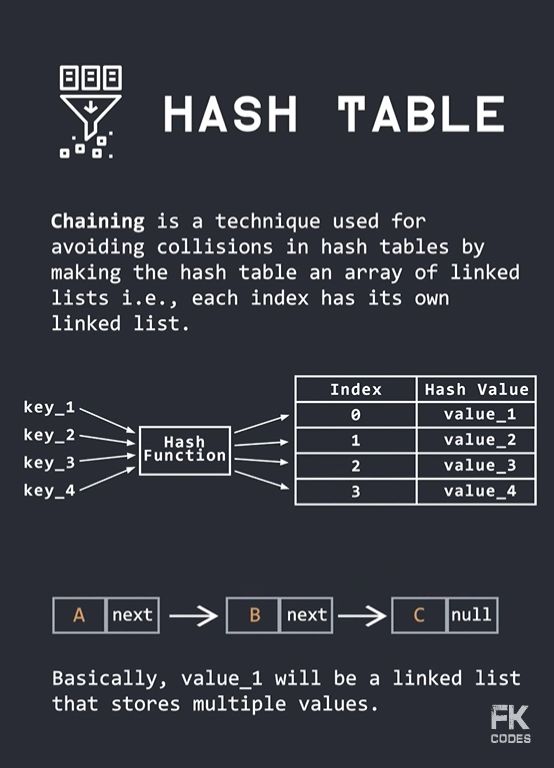
Hash Function을 사용하여 데이터를 특정 위치(해시값)로 매핑
Hash Function
Key값을 받아 고정된 크기의 정수(Hash Code)로 변환하는 함수
Collision: 서로 다른 Key값이 같은 해시값을 갖는 경우
Hash Table
Hash 기반으로 데이터를 저장하는 자료구조
구성: Key-Value 쌍으로 데이터를 저장
Solution Collision
Chaining: 같은 해시값의 데이터를 연결 리스트로 관리
Open Addressing: 충돌이 발생하면 테이블의 다른 빈 공간을 찾아 저장
Implementation
#include<iostream>
#include<vector>
#include<list>
using namespace std;

class HashTable {
private:
    vector<list<pair<string, int>>> table;
    int size;

    int hashFunction(const string& key) {
        int hash = 0;
        for(char ch:key) {
            hash = (hash * 31 + ch) % size;
        }
        return hash;
    }

public:
    HashTable(int s) : size(s) {
        table.resize(size);
    }

    void insert(const string& key, int value) {
        int hash = hashFunction(key);
        for(auto& pair : table[hash]) {
            if(pair.first == key) {
                pair.second = value;
                return;
            }
        }
        table[hash].emplace_back(key, value);
    }

    bool search(const string& key) {
        int hash = hashFunction(key);
        for(const auto& pair : table[hash]) {
            if(pair.first == key) {
                return true;
            }
        }
        return false;
    }

    void remove(const string& key) {
        int hash = hashFunction(key);
        auto& bucket = table[hash];
        for(auto it = bucket.begin(); it != bucket.end(); ++it) {
            if(it->first == key) {
                bucket.erase(it);
                return;
            }
        }
    }

    void display() {
        for(int i=0; i<size; i++) {
            for(const auto& pair : table[i]) {
                cout<<"["<<pair.first<<": "<<pair.second<<"]";
            }
            cout<<endl;
        }
    }
};
Complexity
| average | worst | |
|---|---|---|
| Insert | O(1) | O(n) |
| Search | O(1) | O(n) |
| Deletion | O(1) | O(n) |
Summary
빠른 검색/삽입이 필요할 때 효율적

정렬, 범위 검색이 필요하거나 메모리가 제한된 환경은 비효율적
STL
std::unordered_map
Key-Value 쌍을 저장한는 해시 기반 맵std::unordered_set
중복되지 않는 데이터를 저장하는 해시 기반 집합
Festina Lente, Slow and steady wins the game