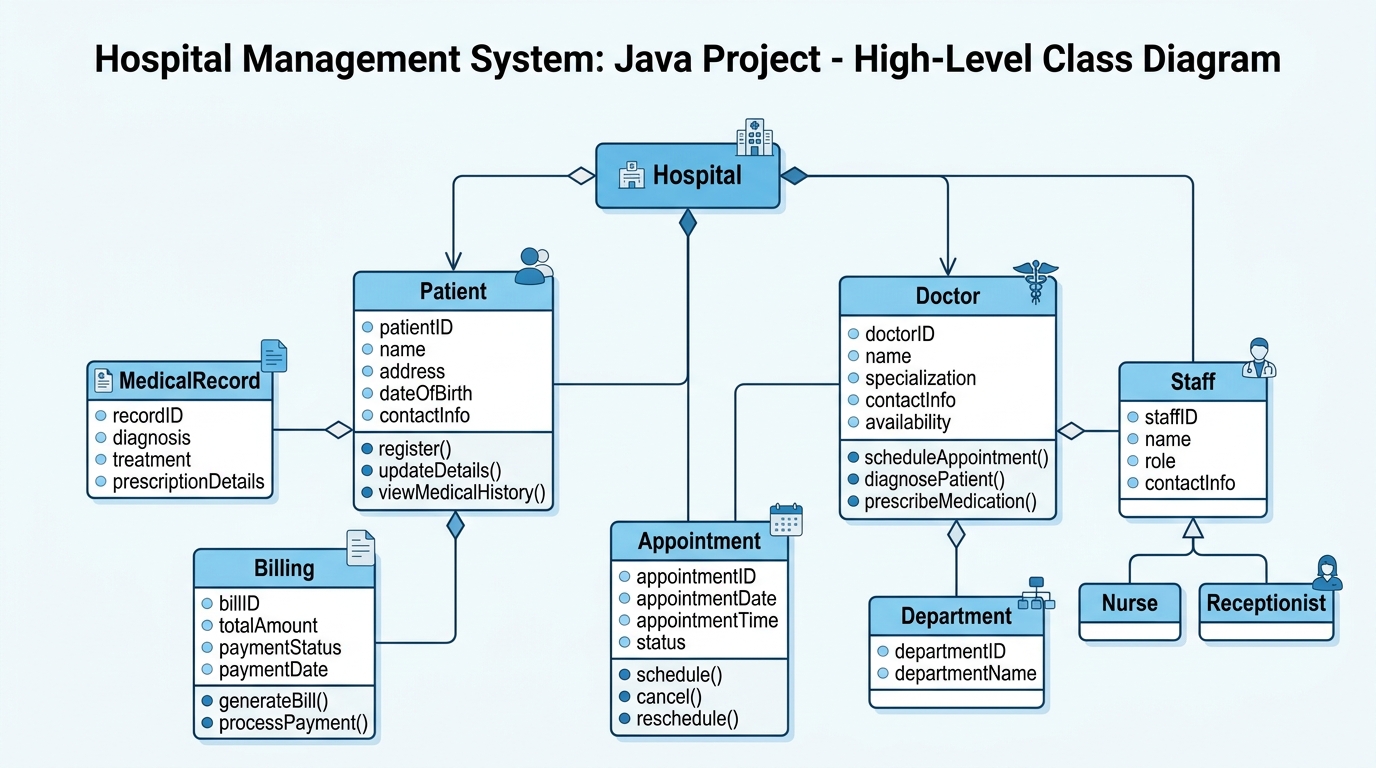
Technology has transformed almost every industry, and healthcare is no exception. Modern hospitals handle thousands of patient records, appointments, prescriptions, billing transactions, and medical reports every day. Managing all this information manually is time-consuming, inefficient, and prone to errors.
A Hospital Management System (HMS) is designed to automate and simplify these operations. It helps hospitals manage patient information, doctor schedules, appointments, billing, and medical records through a centralized software platform.
For Java developers, building a Hospital Management System is one of the best real-time projects because it combines core Java concepts, database management, object-oriented programming, REST APIs, and enterprise application development into a single project.
In this article, we'll explore how a Hospital Management System works, its architecture, key modules, technologies used, and why it is an excellent project for aspiring Java developers.
What is a Hospital Management System?
A Hospital Management System is a software application that helps hospitals and healthcare organizations manage their daily operations digitally.
The system centralizes information related to:
Patients
Doctors
Appointments
Medical Records
Billing
Pharmacy
Laboratory Reports
Instead of maintaining paperwork and manual registers, hospitals can store and retrieve information quickly and securely.
This improves efficiency, reduces administrative workload, and enhances patient care.
Why Build a Hospital Management System in Java?
Java is one of the most widely used programming languages for enterprise software development.
It offers:
Platform Independence
Strong Security Features
Scalability
Reliability
Extensive Library Support
Building a Hospital Management System in Java helps developers gain practical experience with real-world business applications.
It also provides exposure to software architecture, database design, and backend development concepts commonly used in the industry.
Key Features of a Hospital Management System
A complete Hospital Management System typically consists of several modules.
Patient Management
This module stores and manages patient information.
Features
Patient Registration
Profile Management
Medical History Tracking
Contact Information Management
Example:
When a patient visits the hospital for the first time, the system creates a unique patient record that can be accessed during future visits.
Doctor Management
Hospitals employ multiple doctors across different departments.
Features
Doctor Registration
Department Assignment
Schedule Management
Availability Tracking
Departments may include:
Cardiology
Orthopedics
Neurology
Pediatrics
Dermatology
Appointment Management
Appointment scheduling is one of the most important functions of the system.
Features
Book Appointments
Cancel Appointments
Reschedule Appointments
View Appointment History
Workflow:
Patient
↓
Select Doctor
↓
Choose Date & Time
↓
Book Appointment
This helps reduce waiting times and improves patient satisfaction.
Medical Records Management
Doctors need access to a patient's medical history to make informed decisions.
The system stores:
Diagnoses
Prescriptions
Treatment Records
Lab Results
Previous Consultations
Digital records improve accessibility and accuracy.
Billing and Payment Management
Hospitals process numerous financial transactions daily.
Features
Generate Bills
Payment Tracking
Insurance Management
Invoice Generation
Example:
Doctor Consultation Fee
+
Lab Charges
+
Medicine Charges
=
Total Bill
Automated billing reduces manual calculation errors.
Pharmacy Management
Hospital pharmacies must maintain accurate inventory records.
Features
Medicine Inventory Management
Stock Monitoring
Expiry Date Tracking
Purchase Management
This ensures medicines are available when needed.
Technologies Used
A modern Hospital Management System can be developed using the following technologies:
Backend
Java
Spring Boot
Spring MVC
Database
MySQL
Frontend
HTML
CSS
JavaScript
Bootstrap
Security
Spring Security
JWT Authentication
Build Tool
Maven
These technologies are commonly used in enterprise application development.
System Architecture
A layered architecture is generally used for maintainability and scalability.
User Interface
↓
Controller Layer
↓
Service Layer
↓
Repository Layer
↓
MySQL Database
Each layer performs a specific role.
Controller Layer
Handles incoming requests from users.
Service Layer
Contains business logic and processing.
Repository Layer
Interacts with the database.
This separation improves code organization and maintainability.
Database Design
A well-designed database is essential for the success of the application.
Patient Table
Field Description
Patient_ID Unique ID
Name Patient Name
Age Age
Gender Gender
Phone Contact Number
Doctor Table
Field Description
Doctor_ID Unique ID
Name Doctor Name
Department Department
Experience Experience
Appointment Table
Field Description
Appointment_ID Unique Appointment ID
Patient_ID Patient Reference
Doctor_ID Doctor Reference
Appointment_Date Date and Time
Billing Table
Field Description
Bill_ID Unique Bill ID
Patient_ID Patient Reference
Amount Total Amount
Payment_Status Status
Authentication and Security
Healthcare applications deal with highly sensitive information.
Security is therefore critical.
Features
Secure Login
Password Encryption
Role-Based Access Control
Session Management
Different users may have different permissions.
Examples:
Administrator
Manage Doctors
Manage Staff
View Reports
Doctor
View Patients
Update Medical Records
Receptionist
Register Patients
Schedule Appointments
This ensures proper access control.
REST API Development
Modern applications communicate through APIs.
Example Patient APIs:
POST /patients
GET /patients
GET /patients/{id}
PUT /patients/{id}
DELETE /patients/{id}
Example Appointment APIs:
POST /appointments
GET /appointments
These APIs allow web and mobile applications to interact with the backend.
Common Challenges During Development
Building a Hospital Management System introduces developers to real-world software engineering challenges.
Data Consistency
Patient information must remain accurate across all modules.
Appointment Conflicts
The system should prevent multiple bookings for the same doctor and time slot.
Security Concerns
Medical information must be protected from unauthorized access.
Performance
The system should handle thousands of patient records efficiently.
These challenges help developers gain valuable practical experience.
Skills You Learn from This Project
Developing a Hospital Management System strengthens multiple technical skills.
Java Skills
Object-Oriented Programming
Exception Handling
Collections Framework
Spring Boot Skills
REST API Development
Dependency Injection
Spring Data JPA
Database Skills
MySQL
Query Optimization
Relationship Mapping
Software Engineering Skills
Layered Architecture
Security Implementation
Business Logic Design
These skills are highly valuable in enterprise software development.
Why This Project is Important for Your Resume
A Hospital Management System demonstrates the ability to build a real-world business application.
It showcases:
Java Development Skills
Spring Boot Knowledge
Database Design Expertise
REST API Development
Authentication and Security
Software Architecture Understanding
Recruiters often value projects that solve practical business problems, making this an excellent addition to your portfolio.
Future Enhancements
The project can be expanded with advanced features such as:
Online Doctor Consultations
Video Appointments
AI-Based Disease Prediction
SMS Notifications
Email Alerts
Cloud Deployment
Mobile Application Support
These enhancements can transform the system into a modern healthcare platform.
링크텍스트
A Hospital Management System Project in Java is one of the most valuable real-time projects for aspiring developers. It combines core Java programming, Spring Boot development, database management, security, and software architecture concepts into a practical enterprise application.
Beyond technical learning, it provides insight into how real healthcare organizations manage data, automate workflows, and improve patient services.
Whether you're a student, a job seeker, or an experienced developer looking to strengthen your portfolio, building a Hospital Management System is an excellent way to gain hands-on experience and prepare for real-world software development challenges.