Offshore CAD Drafting Services vs In-House Teams: Which is More Cost Effective?

Offshore CAD drafting services are becoming an important operational strategy for architecture, engineering, and construction firms facing rising project demands and tighter delivery schedules. Many companies today struggle with increasing labor costs, shortages of experienced CAD professionals, and pressure to complete projects faster without compromising drawing quality. As a result, businesses are evaluating whether maintaining a large in-house drafting department is still the most cost-effective option.
For firms handling multiple projects across architecture, civil engineering, manufacturing, or MEP disciplines, offshore CAD services offer a scalable alternative that combines technical expertise with operational flexibility.
Understanding Offshore CAD Drafting Services
Offshore CAD drafting services involve outsourcing drafting, detailing, and modeling tasks to a remote team located in another country. These teams work as an extension of the client’s engineering or design department and support a wide range of drafting requirements using industry-standard software such as AutoCAD, Revit, Civil 3D, SolidWorks, Tekla, MicroStation, and Navisworks.
Depending on project requirements, companies can either hire a dedicated offshore CAD team or outsource work on a project-by-project basis. Offshore drafting support is commonly used by architecture firms, EPC contractors, infrastructure companies, manufacturing businesses, and construction consultants.
In-House CAD Teams: Benefits and Challenges
There are clear advantages to maintaining an in-house drafting team. Internal teams usually understand company standards, coordinate directly with engineers, and can participate in onsite meetings when required. Communication is often faster, especially during urgent revisions or project coordination discussions.
However, managing a full-time in-house CAD department also comes with several operational challenges. Recruiting experienced CAD drafters has become increasingly difficult in many regions. Companies also need to invest heavily in salaries, employee benefits, software licenses, workstations, training, and office infrastructure.
Scalability is another major issue. During peak workloads, firms often struggle to hire quickly enough to meet deadlines. During slow periods, maintaining a large drafting workforce increases operational overhead. Overtime expenses and employee burnout can further affect productivity and project timelines.
Why Offshore CAD Drafting Services are More Cost Effective
One of the biggest reasons companies choose offshore drafting services is cost optimization. Offshore CAD teams help reduce expenses associated with recruitment, infrastructure, training, and software management. Instead of building a large internal team, companies can scale resources based on project volume.
Another major advantage is the ability to support 24/7 production cycles. Offshore drafting teams working across different time zones allow firms to continue project work even after local office hours. This often results in overnight drafting delivery, faster revisions, and improved turnaround times for construction and engineering projects.
Offshore CAD drafting services also provide access to specialized expertise that may not always be available internally. Companies can quickly access professionals experienced in structural drafting, fabrication drawings, BIM modeling, MEP drafting, and industrial detailing without long recruitment cycles.
Cost Comparison: Offshore vs In-House CAD Teams
When comparing operational costs, offshore drafting services usually provide greater flexibility and lower overhead.
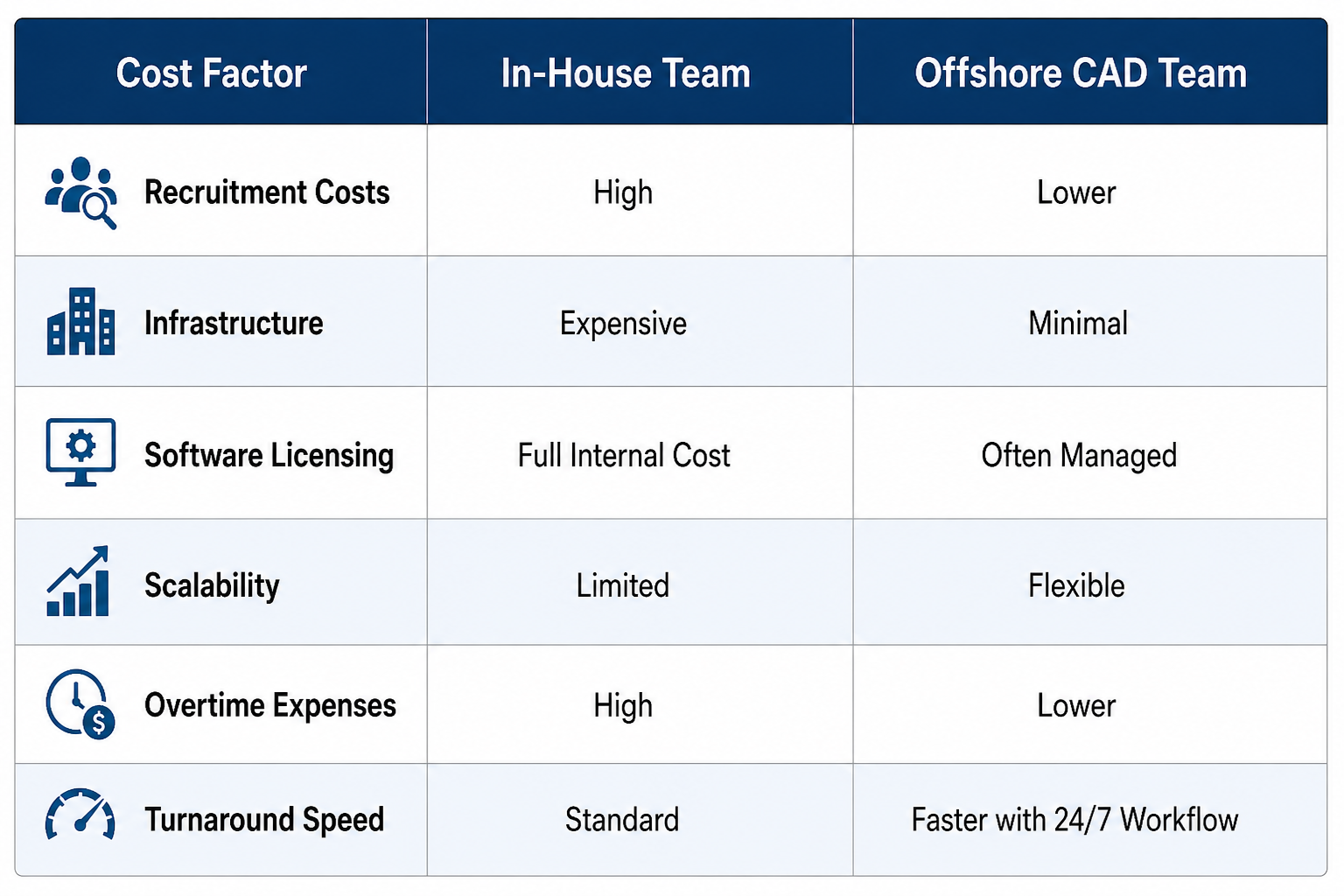
Many engineering and construction firms report significant savings after outsourcing CAD drafting operations, especially during high-volume project phases.
Addressing Common Concerns About Offshore CAD Services
Some companies hesitate to outsource drafting work because of concerns related to communication, quality, or data security. However, experienced offshore CAD providers now operate with structured workflows and collaboration systems that closely align with global engineering standards.
Communication challenges are usually addressed through dedicated project coordinators and collaborative tools like Microsoft Teams, Slack, Zoom, and cloud-based project platforms. Regular overlap meetings help maintain coordination between onsite and offshore teams.
Quality assurance is another critical area. Reliable offshore drafting providers typically follow multi-level quality control processes that include layer standard verification, drawing validation, revision tracking, and checklist-based QC reviews before final delivery.
Data security has also become a priority for engineering firms outsourcing CAD work. Professional offshore CAD drafting companies commonly operate under NDA agreements and use secure FTP systems, VPN access, encrypted file transfers, and controlled access environments to protect project data.
When Offshore CAD Drafting Makes the Most Sense
Offshore CAD services are especially valuable for firms dealing with project overflow, tight delivery schedules, staffing shortages, or sudden increases in drafting requirements. They are also useful for companies looking to reduce fixed operational costs while maintaining drafting productivity.
Industries that benefit most from offshore drafting support include architecture, civil engineering, construction, manufacturing, MEP engineering, and industrial plant design.
Why Many Firms Are Adopting Hybrid CAD Teams
Instead of replacing internal teams completely, many organizations now use a hybrid approach that combines onsite project leadership with offshore production support. This model helps firms balance operational control with cost efficiency while enabling round-the-clock project execution.
As engineering projects become more complex and deadlines continue to tighten, offshore CAD drafting services are no longer viewed simply as a cost-saving option. They are increasingly becoming a strategic solution for companies seeking scalability, faster delivery, and access to specialized CAD expertise.
For architecture, engineering, and construction firms looking to improve drafting capacity without significantly increasing overhead, offshore CAD teams can provide both operational flexibility and long-term business value.