Overcoming Common Challenges in Point Cloud to BIM Implementation
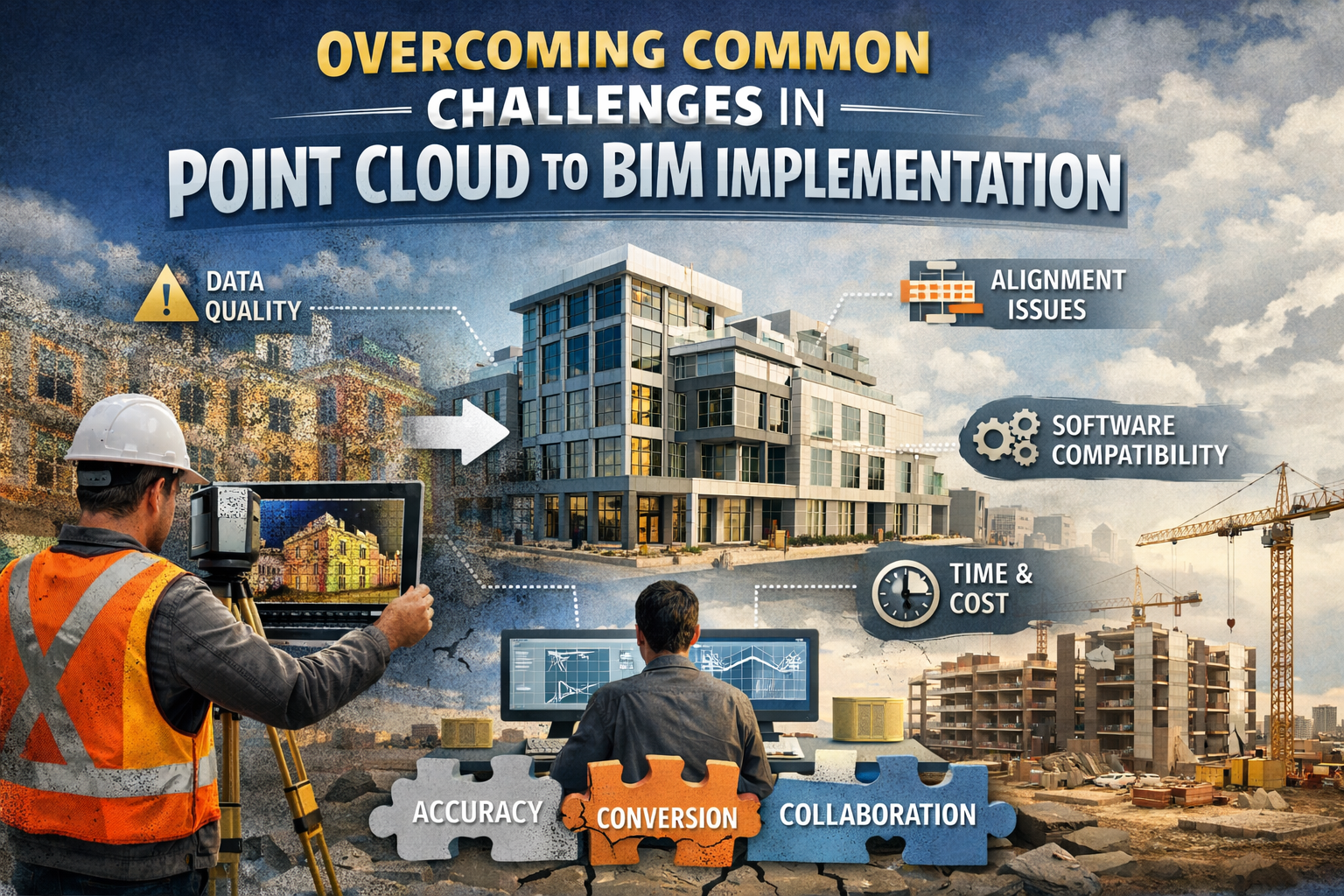
Point Cloud to BIM implementation has become a critical workflow for architecture, engineering, and construction (AEC) professionals seeking accurate as-built documentation and data-driven renovation planning. With the growing adoption of 3D laser scanning, LiDAR scanning, and reality capture technologies, Point Cloud to BIM services enable the creation of intelligent BIM models from high-density point cloud datasets.
However, despite its advantages, the Scan to BIM process presents several technical and operational challenges. Understanding these challenges and implementing the right strategies ensures improved model accuracy, reduced rework, and optimized project delivery.
1. Managing Large Point Cloud Data Sets
One of the most common challenges in Point Cloud to BIM workflows is handling massive point cloud datasets. High-resolution laser scans generate millions or even billions of data points in formats such as .RCP, .RCS, .E57, and .LAS.
Key Issues:
- Slow model performance in BIM authoring tools.
- Data corruption during file transfer.
- Hardware limitations (RAM, GPU, processing power).
Solutions:
- Use point cloud decimation and segmentation techniques.
- Implement cloud-based collaboration platforms for secure data sharing.
- Utilize high-performance workstations optimized for BIM modeling.
- Work with experienced Scan to BIM service providers who follow structured data management protocols.
Proper point cloud registration and alignment also ensure minimal duplication and optimized dataset size.
2. Ensuring Accurate Point Cloud Registration
Point cloud registration involves aligning multiple scans into a unified coordinate system. Poor registration can lead to geometric discrepancies, affecting downstream BIM coordination and clash detection.
Common Causes of Misalignment:
- Inadequate control points.
- Scanner movement or vibration.
- Complex site geometry.
Best Practices:
- Use survey control points and ground control benchmarks.
- Apply automated registration software with error reporting.
- Perform quality assurance (QA/QC) checks before modeling.
Accurate registration directly impacts BIM model accuracy and Level of Development (LOD) compliance.
3. Defining the Right Level of Development (LOD)
Another major challenge is determining the appropriate Level of Development (LOD 100–LOD 500) for BIM modeling. Over-modeling increases cost and time, while under-modeling may fail to meet project requirements.
Challenges Include:
- Lack of clear BIM Execution Plan (BEP).
- Misalignment between stakeholders.
- Unclear modeling tolerances.
Recommended Approach:
- Define LOD specifications at project kickoff.
- Establish modeling tolerances (e.g., ±5mm or ±10mm).
- Align deliverables with renovation, retrofit, or facility management objectives.
A well-defined BIM Execution Plan minimizes scope creep and ensures efficient resource allocation.
4. Handling Noise and Incomplete Data
Point cloud datasets often contain noise, occlusions, and missing geometry due to reflective surfaces, obstructions, or limited scan angles.
Typical Problems:
- Gaps in ceiling plenum areas
- Incomplete MEP system visibility
- Reflective or transparent surfaces (glass, metal)
Mitigation Strategies:
- Conduct multiple scan positions to reduce shadow areas
- Apply point cloud filtering algorithms
- Perform site validation before final BIM model delivery
Combining terrestrial laser scanning with drone-based LiDAR scanning can also improve coverage for large-scale infrastructure projects.
5. Converting Point Clouds into Intelligent BIM Objects
Transforming raw point cloud data into parametric BIM families is labor-intensive. Automated feature extraction tools exist, but they may not always capture complex architectural or MEP components accurately.
Challenges:
- Manual modeling time
- Difficulty in identifying hidden services
- Interpreting irregular or historic structures
Solutions:
- Use semi-automated modeling workflows in BIM software
- Develop standardized BIM families and object libraries
- Leverage AI-powered Scan to BIM tools for faster object recognition
Experienced BIM modelers play a crucial role in interpreting scan data and converting it into structured, information-rich BIM elements.
6. Coordinating Multidisciplinary Models
In renovation and retrofit projects, architectural, structural, and MEP BIM models must be federated into a coordinated BIM environment. Poor coordination can result in clashes and constructability issues.
Common Coordination Issues:
- Inconsistent naming conventions
- Misaligned coordinate systems
- Clash detection errors
Solutions:
- Use a Common Data Environment (CDE)
- Follow standardized BIM workflows and naming conventions
- Conduct regular clash detection using coordination software
Effective model coordination ensures smoother construction sequencing and reduces rework.
7. Managing Cost and Timeline Expectations
Point Cloud to BIM implementation can appear expensive due to scanning equipment, skilled manpower, and processing time. However, the long-term ROI often outweighs initial costs.
Concerns Include:
- Budget constraints
- Tight project schedules
- Unclear deliverables
Strategies for Optimization:
- Outsource Scan to BIM services to specialized providers
- Define project milestones and deliverables clearly
- Use phased modeling approaches
Cost-effective BIM implementation focuses on value engineering and data accuracy rather than excessive modeling detail.
8. Integrating BIM Models with Facility Management Systems
For existing buildings, BIM models are often used for asset management and digital twin applications. Integrating BIM data into facility management (FM) platforms can be technically complex.
Integration Challenges:
- Data interoperability issues
- Inconsistent asset tagging
- Lack of standardized COBie data
Recommended Practices:
- Structure BIM models with asset metadata
- Follow open BIM standards (IFC, COBie)
- Ensure data validation before handover
This approach ensures that the as-built BIM model supports long-term facility lifecycle management.
Conclusion
Point Cloud to BIM implementation offers immense value for renovation, retrofit, and infrastructure modernization projects. However, challenges such as large dataset handling, registration accuracy, LOD management, noise reduction, multidisciplinary coordination, and data interoperability must be addressed systematically.
By adopting structured BIM workflows, defining clear modeling standards, leveraging AI-driven automation, and partnering with experienced Scan to BIM experts, AEC professionals can overcome implementation barriers and unlock the full potential of reality capture technology.
When executed strategically, Point Cloud to BIM not only enhances geometric precision but also supports data-rich decision-making across the entire building lifecycle.