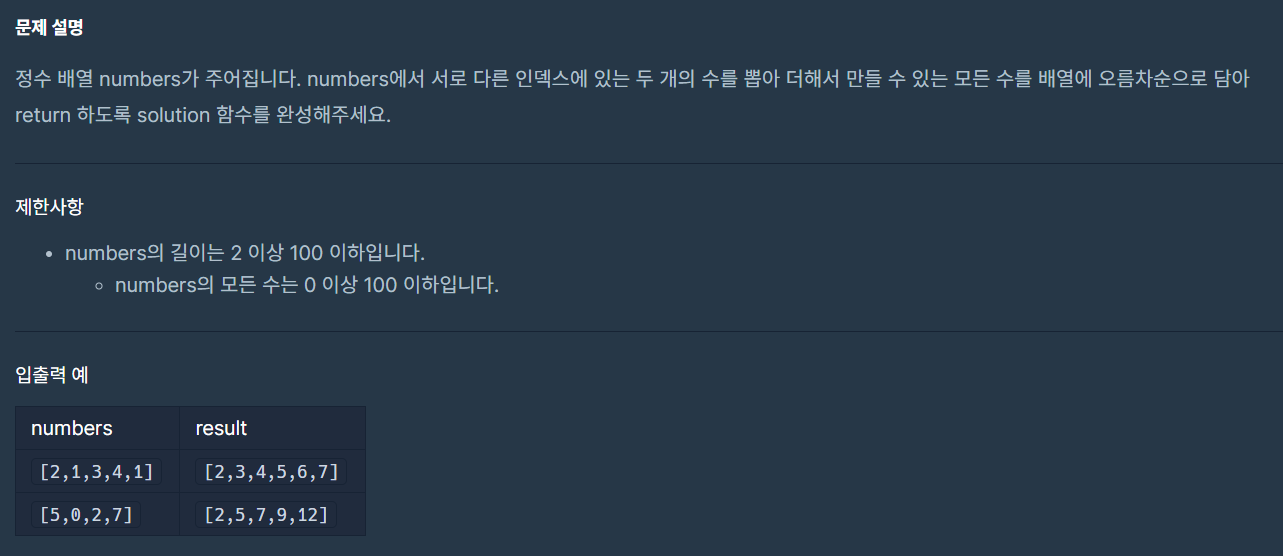
#include <string>
#include <vector>
#include <algorithm>

using namespace std;

vector<int> solution(vector<int> numbers) {
    vector<int> answer;
    vector<int> temp;
    for (int i=0; i<numbers.size(); i++)
    {
        for (int j=i+1; j < numbers.size(); j++)
        {
            temp.push_back(numbers[i] + numbers[j]);
        }
    }
    sort(temp.begin(), temp.end());
    temp.erase(unique(temp.begin(), temp.end()), temp.end());
    answer = temp;
    return answer;
}
원래는 temp.earse(unique(temp.begin(), temp.end()), temp.end()); 대신에
for (int i=0; i<temp.size() - 1; i++)
    {
        if (temp[i]==temp[i+1])
        {
            temp.erase(temp.begin() + i);
        }
    }
이렇게 지우려고 했는데 자꾸 몇 개는 안 지워진다.
그래서 그냥 찾아보니 unique stl을 발견했다.
std::unique
#include <algorithm>
#include <iostream>
#include <vector>

int main()
{
    // a vector containing several duplicate elements
    std::vector<int> v{1, 2, 1, 1, 3, 3, 3, 4, 5, 4};
    auto print = [&](int id)
    {
        std::cout << "@" << id << ": ";
        for (int i : v)
            std::cout << i << ' ';
        std::cout << '\n';
    };
    print(1);

    // remove consecutive (adjacent) duplicates
    auto last = std::unique(v.begin(), v.end());
    // v now holds {1 2 1 3 4 5 4 x x x}, where 'x' is indeterminate
    v.erase(last, v.end());
    print(2);

    // sort followed by unique, to remove all duplicates
    std::sort(v.begin(), v.end()); // {1 1 2 3 4 4 5}
    print(3);

    last = std::unique(v.begin(), v.end());
    // v now holds {1 2 3 4 5 x x}, where 'x' is indeterminate
    v.erase(last, v.end());
    print(4);
}
output
@1: 1 2 1 1 3 3 3 4 5 4   //초기상태
@2: 1 2 1 3 4 5 4         //unique
@3: 1 1 2 3 4 4 5         //sort
@4: 1 2 3 4 5             //unique
그냥 unique를 쓰면 붙어있는 것들에 대해서만 지운다.
목적에 따라 sort()를 적절히 쓰면 좋을 것 같다.
다른 사람들의 풀이를 보니까 set가 중복을 허용하지 않는 특성을 이용했다.
#include <string>
#include <vector>
#include <algorithm>
#include <set>
using namespace std;

vector<int> solution(vector<int> numbers) {
    vector<int> answer;
    set<int> st;
    for(int i = 0;i<numbers.size();++i){
        for(int j = i+1 ; j< numbers.size();++j){
            st.insert(numbers[i] + numbers[j]);
        }
    }
    answer.assign(st.begin(), st.end());
    return answer;
}
std::set
#include <algorithm>
#include <iomanip>
#include <iostream>
#include <iterator>
#include <set>
#include <string_view>

template<typename T>
std::ostream& operator<<(std::ostream& out, const std::set<T>& set)
{
    if (set.empty())
        return out << "{}";
    out << "{ " << *set.begin();
    std::for_each(std::next(set.begin()), set.end(), [&out](const T& element)
    {
        out << ", " << element;
    });
    return out << " }";
}

int main()
{
    std::set<int> set{1, 5, 3};
    std::cout << set << '\n';

    set.insert(2);
    std::cout << set << '\n';

    set.erase(1);
    std::cout << set << "\n\n";

    std::set<int> keys{3, 4};
    for (int key : keys)
    {
        if (set.contains(key))
            std::cout << set << " does contain " << key << '\n';
        else
            std::cout << set << " doesn't contain " << key << '\n';
    }
    std::cout << '\n';

    std::string_view word = "element";
    std::set<char> characters(word.begin(), word.end());
    std::cout << "There are " << characters.size() << " unique characters in "
              << std::quoted(word) << ":\n" << characters << '\n';
}
output
{ 1, 3, 5 }
{ 1, 2, 3, 5 }
{ 2, 3, 5 }

{ 2, 3, 5 } does contain 3
{ 2, 3, 5 } doesn't contain 4

There are 5 unique characters in "element":
{ e, l, m, n, t }
애초부터 중복허용 안 할거면 set를 쓰는 게 나은데, 데이터 쪼물딱 거리고 싶다면 unique를 쓰거나 multiset을 쓰면 될 것 같다.
