
1. 서론
일단, Object equality를 비교하기 전에 Dart의 타입 시스템, 특히
final과const의 차이를 명확히 이해하는 것이 중요하다. Dart 문법 공부 처음할 땐 대충 넘겼지만ㅎㅎ(뭐.. 하다보니 깨달을 수도 있는거죠..그냥 api 받아와서 UI그리면 그만인 줄 알았어요)
1.1 짚고 넘어가야하는 이유
- 외부에서 들어온 데이터를
List나State로 관리할 때, 객체의 값은 같은데==비교가false가 나오면? - 불필요한
setState()발생, 위젯 리빌드, 캐시 미스 등의 문제가 생긴다. - 즉, 객체가 같다고 판단되게 하려면 단순히
값만 같아선 안 되고, 객체 비교 기준을 직접 정의해야 한다.
1.2 final과 const의 차이점 비교
| 구분 | final | const |
|---|---|---|
| 선언 시점 | 런타임에 결정됨 | 컴파일 타임에 결정됨 |
| 인스턴스 생성 | 매번 새 객체 | 같은 값이면 재사용 (싱글턴처럼) |
| 메모리 | 각각 따로 있음 | 공유됨 (정적 메모리로 할당됨) |
동일성 (== 또는 identical) | 값이 같아도 false | 값이 같으면 true |
다음과 같은 예제를 살펴보자
- 먼저
Person객체를 정의한다.Person클래스의 property는id,name,
1.3 person.dart (person 객체 생성)
// ignore_for_file: public_member_api_docs, sort_constructors_first
class Person {
final int id;
final String name;
final String email;
Person({required this.id, required this.name, required this.email});
String toString() => 'Person(id: $id, name: $name, email: $email)';
Person copyWith({int? id, String? name, String? email}) {
return Person(
id: id ?? this.id,
name: name ?? this.name,
email: email ?? this.email,
);
}
}
person_page.dart
import 'package:dart_class/models/person.dart';
import 'package:flutter/material.dart';
class PersonPage extends StatelessWidget {
const PersonPage({super.key});
Widget build(BuildContext context) {
final person1 = Person(id: 1, name: 'John', email: 'john@gmail.com');
final person2 = person1.copyWith(id: 2, email: 'Johndoe@gmail.com');
final person3 = Person(id: 1, name: 'John', email: 'john@gmail.com');
print(person1);
print(person2);
print(person1 == person3);
print(person1.hashCode);
print(person3.hashCode);
return Scaffold(appBar: AppBar(title: Text('Person')));
}
}출력 결과:
false
949309463
581349880
- 현재
person1과person3의property는 같은 상태이다. 하지만 equality 연산자의 값이false임을 확인할 수 있다. - dart의 기본 equality는 referential equality이다. 즉, 두 object가 메모리상 같은 곳을 가르킬 때, equality -> true 라고 반환하게 된다.
person1과person3의 hash값이 다른걸 보아,, 다른 메모리에 할당되었음을 알 수 있다.- 고로 다른 존재.
결론적으로, object의 프로퍼티가 같을 때 논리적 동등성을 가지기 위해서는 hash값을 override하던지, 아니면 처음부터 불변값으로 정해야한다.
2. 본론
2.1. Construct의 type을 const로 지정, const 인스턴스 사용
person.dart (const 생성자)
const Person({required this.id, required this.name, required this.email});person_page.dart
import 'package:dart_class/models/person.dart';
import 'package:flutter/material.dart';
class PersonPage extends StatelessWidget {
const PersonPage({super.key});
Widget build(BuildContext context) {
const person1 = Person(id: 1, name: 'John', email: 'john@gmail.com');
final person2 = person1.copyWith(id: 2, email: 'Johndoe@gmail.com');
const person3 = Person(id: 1, name: 'John', email: 'john@gmail.com');
print(person1);
print(person2);
print(person1 == person3);
print(person1.hashCode);
print(person3.hashCode);
return Scaffold(appBar: AppBar(title: Text('Person')));
}
}출력결과
true 423981177 // person 1 == person3의 논리적 equality
2.2. hash값 override

-
vscode extension -> 객체 생성 도와주는 Tool
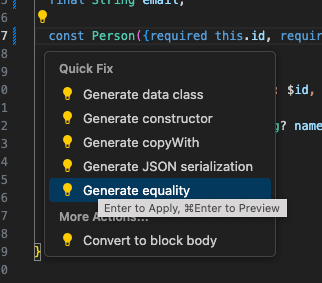
-
Generate equality클릭
// ignore_for_file: public_member_api_docs, sort_constructors_first
class Person {
final int id;
final String name;
final String email;
const Person({required this.id, required this.name, required this.email});
String toString() => 'Person(id: $id, name: $name, email: $email)';
Person copyWith({int? id, String? name, String? email}) {
return Person(
id: id ?? this.id,
name: name ?? this.name,
email: email ?? this.email,
);
}
bool operator ==(covariant Person other) {
if (identical(this, other)) return true;
return other.id == id && other.name == name && other.email == email;
}
int get hashCode => id.hashCode ^ name.hashCode ^ email.hashCode;
}2.3. equatable 패키지 사용
- pub.dev equatable 링크
==연산자와hashCode를 직접 override하는 대신,Equatable을 상속받고props만 정의해주면 된다.- 내부적으로는
props리스트에 들어간 값들을 기준으로==비교와hashCode생성을 자동 처리한다. - 결국 hash값을 override하는 방식은 동일하지만, 훨씬 간결하다
import 'package:equatable/equatable.dart';
// ignore_for_file: public_member_api_docs, sort_constructors_first
class Person extends Equatable {
final int id;
final String name;
final String email;
const Person({required this.id, required this.name, required this.email});
String toString() => 'Person(id: $id, name: $name, email: $email)';
Person copyWith({int? id, String? name, String? email}) {
return Person(
id: id ?? this.id,
name: name ?? this.name,
email: email ?? this.email,
);
}
List<Object> get props => [id, name, email];
}- props 정의할 때
List<Object> get props => [id]; 로 정의하면, id이 같지만 나머지 property가 다른 객체들의 동등성이 부여된다.!

3. 마무리
쉬운게 하나도 없다.

일단 하긴 합니다.