2024.01.12
Call by Reference
- 주소전달 (주소는 유일하다)
- method의 매개변수가 참조형을 가진다면 주소가 그대로 전달된다.
public class Test{
	int i;
    int j;
public void swap(Test t){
	int temp = 0;
	temp=t.i;
	t.i=t.j;
	t.j=temp;
	System.out.println("swap 안 i : "+ t.i + ",j:" + t.j);
}


public static void main(String[] args){

Test t = new Test();
	t.i = 2024;
	t.j = 1;
	System.out.println("swap 전 i : "+ t.i + ",j : "+ t.j);
	t.swap(t);
	System.out.println("swap 후 i : "+ t.i + ",j : "+ t.j);
}
this
- 키워드 형식, method형식으로 사용할 수 있다.
키워드형식
- method를 호출하는 instance(객체)의 주소로 변환하는 일.
- 객체가 생성된 후 호출되는 instance 영역에서만 사용할 수 있다.(static 영역에서는 사용 불가)
- instance변수와 parameter가 같은 이름을 가질 떄, 두 변수를 식별하기 위해 사용.
- 상속 관계에서는 자식의 변수나 method를 식별하기 위해 사용.
사용법)
- 변수 사용)
- this.변수명
- this.변수명 = 값;- method호출(상속관계)
- this.method();
class Test{
 int i ;

  public void setI( int i){

   this.i = i;
   //method를 호출한 객체의 주소로 변환

  }//setI

  public static void main(String[] args){

  	Test t = new Test();
    t.setI(100);

  }//main

}//test
this를 사용하지 않고 인스턴스 변수 i에 할당된 값을 설정하고싶은 경우
public class Test {

	int i ;


	public void setI(int i, Test t2) {
		t2.i = i;


	}


	public static void main(String[] args) {
		Test t = new Test();
		System.out.println(t + "객체의 주소");
		t.setI(2024, t); //t는 heap의 주소이다.
		System.out.println(t.i);


	}//main

}//class
*this의 method형식
-하나의 클래스 안에서 다른 생성자를 호출할 때 사용.
-생성자의 첫 번째 줄에서만 사용가능
-재귀호출 가능성이 있다면 error 발생
사용법
- 클래스명 객체명 = new 생성자();
문법
- this();
- this(값);
public class Test{

  public Test(){

  this(10);

  }

  public Test(int i){

  }
}
객체화
-
클래스에서 정의된 기능을 사용하기 위해 heap메모리에 올려놓는 것.
-
5가지의 문법
-
객체명으로 변수나 method를 사용하지 않는 객체화
클래스명 객체명 = new 생성자();
-
객체명으로 변수나 method를 사용하기 위한 객체화
new 생성자();
-
객체 생성 후 하나의 method만 호출하는 객체화.
new 생성자().method명();
-
is a 관계의 객체화
부모클래스명 객체명 = new 자식클래스의생성자();
-
anonymous inner class의 객체화
호출할method(new 부모클래스명(){
자식클래스에서 정의할 method()들
});
-
String(문자열)
- "묶여진 여러 문자 들.
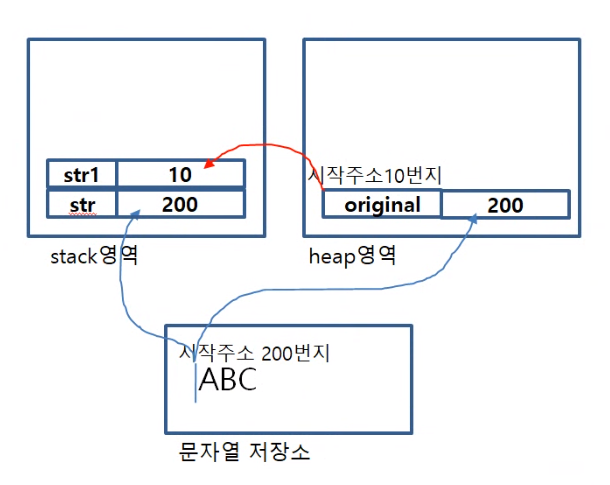
- 문자열은 문자열 저장소 (String literal)에 유일하게 생성된다.
- 문자열 저장소에 저장된 문자열의 시작 주소를 저장하기 위한 데이터 형으로
java.lang.String 클래스를 제공한다. - 참조형 데이터 형.
사용법
- 기본형 형식으로 사용 - new를 사용하지 않음.
String str="문자열";- 참조형 형식으로 사용 - new를 사용
String str=new String("문자열");
public static void main(String[] args){
	String str = "ABC";
    String str1 = new String("ABC");
}
문자열의 비교
- 같은지만 비교 가능.
-
== 연산자
- 기본형 : 값이 같은 지?
str=="ABC" // 200번지 200번지와 같은지? true - 참조형 : 주소가 같은 지?
str1=="ABC" //10번지와 200번지가 같은지? false1. == 연산자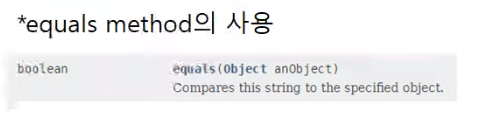
- 기본형 : 값이 같은 지?
-
equals
- 기본형 : 값이 같은 지?
str=="ABC" // 200번지 200번지와 같은지? true - 참조형 : 주소가 같은 지?
str1=="ABC" //10번지와 200번지가 같은지? false
- 기본형 : 값이 같은 지?
java.lang.String 클래스에서 제공하는 기능.
String str = "HeLlo";
-
문자열의 길이:
int leng = str.length(); //반환형과 일치하는 데이터형으로 변수를 선언하고, method에서 return 되는 값을 받아서 사용 System.out.println(leng); // 5 -
대문자 얻기
str.toUpperCase(); //HELLO -
소문자 얻기
str.toLowerCase(); //hello -
특정 인덱스의 문자 얻기
str.charAt(2); //'e' -
특정 문자열의 인덱스
str.indexOf("L"); //2 str.lastIndexOf("L"); // 2 -
문자열 합치기
str.concat("abc"); //"HeLloabc" -
자식문자열 얻기
str.substring(3);//"lo" str.substring(1,3);//"EL" -
문자열이 같은지 비교
str.equals("HeLlo") // true
str = "java는 완벽한 OOP언어";
-
특정 문자열로 시작했는지?
str.startsWith("java"); //true str.startsWith("Java"); //false -
특정 문자열로 끝났는지?
str.endWith("어"); //true str.endWith("언"); //false -
특정 문자열을 포함하는지?
 str.contains("언어"); //true
  str.endWith("우르"); //false