인스턴싱 통합
MeshInstancing,ModelInstancing,AnimInstancing으로 나눠놨던 쉐이더를RenderDemo와 공용으로 쓸 수 있도록Render쉐이더를 만들어서 통합시켜주자
00.Render.fx
#ifndef _RENDER_FX_ // if not define
#define _RENDER_FX_

#include "00.Global.fx"

#define MAX_MODEL_TRANSFORMS 250
#define MAX_MODEL_KEYFRAMES 500
#define MAX_MODEL_INSTANCE 500

// ************** MeshRender ****************

struct VertexMesh
{
    float4 position : POSITION;
    float2 uv : TEXCOORD;
    float3 normal : NORMAL;
    float3 tangent : TANGENT;
	// INSTANCING;
    uint instanceID : SV_INSTANCEID;
    matrix world : INST;
};

MeshOutput VS_Mesh(VertexMesh input)
{
    MeshOutput output;

    output.position = mul(input.position, input.world); // W
    output.worldPosition = output.position;
    output.position = mul(output.position, VP);
    output.uv = input.uv;
    output.normal = input.normal;

    return output;
}

// ************** ModelRender ****************

struct VertexModel
{
    float4 position : POSITION;
    float2 uv : TEXCOORD;
    float3 normal : NORMAL;
    float3 tangent : TANGENT;
    float4 blendIndices : BLEND_INDICES;
    float4 blendWeights : BLEND_WEIGHTS;
	// INSTANCING;
    uint instanceID : SV_INSTANCEID;
    matrix world : INST;
};

cbuffer BoneBuffer
{
    matrix BoneTransforms[MAX_MODEL_TRANSFORMS];
};

uint BoneIndex;

MeshOutput VS_Model(VertexModel input)
{
    MeshOutput output;

    output.position = mul(input.position, BoneTransforms[BoneIndex]); // Model Global
    output.position = mul(output.position, input.world); // W
    output.worldPosition = output.position;
    output.position = mul(output.position, VP);
    output.uv = input.uv;
    output.normal = input.normal;

    return output;
}


// ************** AnimRender ****************

struct KeyframeDesc
{
    int animIndex;
    uint currFrame;
    uint nextFrame;
    float ratio;
    float sumTime;
    float speed;
    float2 padding;
};

struct TweenFrameDesc
{
    float tweenDuration;
    float tweenRatio;
    float tweenSumTime;
    float padding;
    KeyframeDesc curr;
    KeyframeDesc next;
};

cbuffer TweenBuffer
{
    TweenFrameDesc TweenFrames[MAX_MODEL_INSTANCE];
};

Texture2DArray TransformMap;

matrix GetAnimationMatrix(VertexModel input)
{
    float indices[4] = { input.blendIndices.x, input.blendIndices.y, input.blendIndices.z, input.blendIndices.w };
    float weights[4] = { input.blendWeights.x, input.blendWeights.y, input.blendWeights.z, input.blendWeights.w };

    int animIndex[2];
    int currFrame[2];
    int nextFrame[2];
    float ratio[2];

    animIndex[0] = TweenFrames[input.instanceID].curr.animIndex;
    currFrame[0] = TweenFrames[input.instanceID].curr.currFrame;
    nextFrame[0] = TweenFrames[input.instanceID].curr.nextFrame;
    ratio[0] = TweenFrames[input.instanceID].curr.ratio;

    animIndex[1] = TweenFrames[input.instanceID].next.animIndex;
    currFrame[1] = TweenFrames[input.instanceID].next.currFrame;
    nextFrame[1] = TweenFrames[input.instanceID].next.nextFrame;
    ratio[1] = TweenFrames[input.instanceID].next.ratio;

    float4 c0, c1, c2, c3;
    float4 n0, n1, n2, n3;
    matrix curr = 0;
    matrix next = 0;
    matrix transform = 0;

    for (int i = 0; i < 4; i++)
    {
        c0 = TransformMap.Load(int4(indices[i] * 4 + 0, currFrame[0], animIndex[0], 0));
        c1 = TransformMap.Load(int4(indices[i] * 4 + 1, currFrame[0], animIndex[0], 0));
        c2 = TransformMap.Load(int4(indices[i] * 4 + 2, currFrame[0], animIndex[0], 0));
        c3 = TransformMap.Load(int4(indices[i] * 4 + 3, currFrame[0], animIndex[0], 0));
        curr = matrix(c0, c1, c2, c3);

        n0 = TransformMap.Load(int4(indices[i] * 4 + 0, nextFrame[0], animIndex[0], 0));
        n1 = TransformMap.Load(int4(indices[i] * 4 + 1, nextFrame[0], animIndex[0], 0));
        n2 = TransformMap.Load(int4(indices[i] * 4 + 2, nextFrame[0], animIndex[0], 0));
        n3 = TransformMap.Load(int4(indices[i] * 4 + 3, nextFrame[0], animIndex[0], 0));
        next = matrix(n0, n1, n2, n3);

        matrix result = lerp(curr, next, ratio[0]);

		// 다음 애니메이션
        if (animIndex[1] >= 0)
        {
            c0 = TransformMap.Load(int4(indices[i] * 4 + 0, currFrame[1], animIndex[1], 0));
            c1 = TransformMap.Load(int4(indices[i] * 4 + 1, currFrame[1], animIndex[1], 0));
            c2 = TransformMap.Load(int4(indices[i] * 4 + 2, currFrame[1], animIndex[1], 0));
            c3 = TransformMap.Load(int4(indices[i] * 4 + 3, currFrame[1], animIndex[1], 0));
            curr = matrix(c0, c1, c2, c3);

            n0 = TransformMap.Load(int4(indices[i] * 4 + 0, nextFrame[1], animIndex[1], 0));
            n1 = TransformMap.Load(int4(indices[i] * 4 + 1, nextFrame[1], animIndex[1], 0));
            n2 = TransformMap.Load(int4(indices[i] * 4 + 2, nextFrame[1], animIndex[1], 0));
            n3 = TransformMap.Load(int4(indices[i] * 4 + 3, nextFrame[1], animIndex[1], 0));
            next = matrix(n0, n1, n2, n3);

            matrix nextResult = lerp(curr, next, ratio[1]);
            result = lerp(result, nextResult, TweenFrames[input.instanceID].tweenRatio);
        }

        transform += mul(weights[i], result);
    }

    return transform;
}

MeshOutput VS_Animation(VertexModel input)
{
    MeshOutput output;

	//output.position = mul(input.position, BoneTransforms[BoneIndex]); // Model Global

    matrix m = GetAnimationMatrix(input);

    output.position = mul(input.position, m);
    output.position = mul(output.position, input.world); // W
    output.worldPosition = output.position;
    output.position = mul(output.position, VP);
    output.uv = input.uv;
    output.normal = mul(input.normal, (float3x3) input.world);
    output.tangent = mul(input.tangent, (float3x3) input.world);

    return output;
}

#endif
RenderDemo.fx
- pass를 통해서 필요한 것들만 골라서 사용할 수 있도록
#include "00.Global.fx"
#include "00.Light.fx"
#include "00.Render.fx"

float4 PS(MeshOutput input) : SV_TARGET
{
	float4 color = DiffuseMap.Sample(LinearSampler, input.uv);
	return color;
}

technique11 T0
{
    PASS_VP(P0, VS_Mesh, PS)
    PASS_VP(P1, VS_Model, PS)
    PASS_VP(P2, VS_Animation, PS)
};
메인 (RenderDemo)
- 그동안 만들었던
Mesh와Material,Model,Animation을 다 가져오기
void RenderDemo::Init()
{
	RESOURCES->Init();
	_shader = make_shared<Shader>(L"23.RenderDemo.fx");

	// Camera
	_camera = make_shared<GameObject>();
	_camera->GetOrAddTransform()->SetPosition(Vec3{ 0.f, 0.f, -10.f });
	_camera->AddComponent(make_shared<Camera>());
	_camera->AddComponent(make_shared<CameraScript>());

	shared_ptr<class Model> m1 = make_shared<Model>();
	m1->ReadModel(L"Kachujin/Kachujin");
	m1->ReadMaterial(L"Kachujin/Kachujin");
	m1->ReadAnimation(L"Kachujin/Idle");
	m1->ReadAnimation(L"Kachujin/Run");
	m1->ReadAnimation(L"Kachujin/Slash");

	for (int32 i = 0; i < 500; i++)
	{
		auto obj = make_shared<GameObject>();
		obj->GetOrAddTransform()->SetPosition(Vec3(rand() % 100, 0, rand() % 100));
		obj->GetOrAddTransform()->SetScale(Vec3(0.01f));
		obj->AddComponent(make_shared<ModelAnimator>(_shader));
		{
			obj->GetModelAnimator()->SetModel(m1);
			obj->GetModelAnimator()->SetPass(2);
		}
		_objs.push_back(obj);
	}

	// Model
	shared_ptr<class Model> m2 = make_shared<Model>();
	m2->ReadModel(L"Tower/Tower");
	m2->ReadMaterial(L"Tower/Tower");

	for (int32 i = 0; i < 100; i++)
	{
		auto obj = make_shared<GameObject>();
		obj->GetOrAddTransform()->SetPosition(Vec3(rand() % 100, 0, rand() % 100));
		obj->GetOrAddTransform()->SetScale(Vec3(0.01f));

		obj->AddComponent(make_shared<ModelRenderer>(_shader));
		{
			obj->GetModelRenderer()->SetModel(m2);
			obj->GetModelRenderer()->SetPass(1);
		}

		_objs.push_back(obj);
	}


	// Mesh
	// Material
	{
		shared_ptr<Material> material = make_shared<Material>();
		material->SetShader(_shader);
		auto texture = RESOURCES->Load<Texture>(L"Veigar", L"..\\Resources\\Textures\\veigar.jpg");
		material->SetDiffuseMap(texture);
		MaterialDesc& desc = material->GetMaterialDesc();
		desc.ambient = Vec4(1.f);
		desc.diffuse = Vec4(1.f);
		desc.specular = Vec4(1.f);
		RESOURCES->Add(L"Veigar", material);
	}

	for (int32 i = 0; i < 100; i++)
	{
		auto obj = make_shared<GameObject>();
		obj->GetOrAddTransform()->SetLocalPosition(Vec3(rand() % 100, 0, rand() % 100));
		obj->AddComponent(make_shared<MeshRenderer>());
		{
			obj->GetMeshRenderer()->SetMaterial(RESOURCES->Get<Material>(L"Veigar"));
		}
		{
			auto mesh = RESOURCES->Get<Mesh>(L"Sphere");
			obj->GetMeshRenderer()->SetMesh(mesh);
			obj->GetMeshRenderer()->SetPass(0);
		}

		_objs.push_back(obj);
	}

	RENDER->Init(_shader);
}
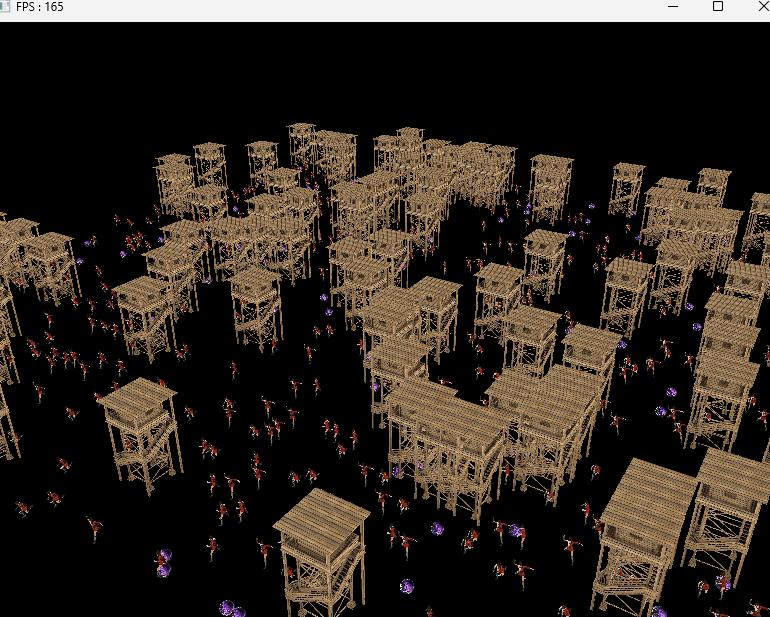
결과
Scene 구조 정리
- 메인클래스의 Update()에서 camera, Render를 Update()해주고 있지만 Scene이라는 클래스로 묶어서 관리
- Light는 따로 컴포넌트로 관리
Light
Light.h
#pragma once
#include "Component.h"

class Light : public Component
{
	using Super = Component;

public:
	Light();
	virtual ~Light();

	virtual void Update();

public:
	LightDesc& GetLightDesc() { return _desc; }

	void SetLightDesc(LightDesc& desc) { _desc = desc; }
	void SetAmbient(const Color& color) { _desc.ambient = color; }
	void SetDiffuse(const Color& color) { _desc.diffuse = color; }
	void SetSpecular(const Color& color) { _desc.specular = color; }
	void SetEmissive(const Color& color) { _desc.emissive = color; }
	void SetLightDirection(Vec3 direction) { _desc.direction = direction; }

private:
	LightDesc _desc;
};
Light.cpp
#include "pch.h"
#include "Light.h"

Light::Light() : Component(ComponentType::Light)
{
}

Light::~Light()
{

}

void Light::Update()
{
	RENDER->PushLightData(_desc);
}
GameObject, Component
- Component에서 ComponentType에 Light추가
- GameObject에서 GetLight() 추가
Component.h
enum class ComponentType : uint8
{
	Transform,
	MeshRenderer,
	ModelRenderer,
	Camera,
	ModelAnimator,
	Light,
	// ...
	Script,

	End,
};
GameObject
// GameObject.h
class Light;

class GameObject : public enable_shared_from_this<GameObject>
{
 ...

public:
	shared_ptr<Light> GetLight();

 ...
}


// GameObject.cpp
shared_ptr<Light> GameObject::GetLight()
{
	shared_ptr<Component> component = GetFixedComponent(ComponentType::Light);

	return static_pointer_cast<Light>(component);
}
SceneManager
- 씬끼리 전환하거나, 현재 실행되고 있는 씬의 정보를 가져오거나 등 씬을 관리하는 클래스
SceneManager.h
#pragma once
#include "Scene.h"

class SceneManager
{
	DECLARE_SINGLE(SceneManager);

public:
	void Update();

	template<typename T>
	void ChangeScene(shared_ptr<T> scene)
	{
		_currentScene = scene;
		scene->Start();
	}

	shared_ptr<Scene> GetCurrentScene() { return _currentScene; }

private:
	shared_ptr<Scene> _currentScene = make_shared<Scene>();
};
SceneManager.cpp
#include "pch.h"
#include "SceneManager.h"

void SceneManager::Update()
{
	if (_currentScene == nullptr)
		return;

	_currentScene->Update();
	_currentScene->LateUpdate();	// 카메라가 들어감
}
Scene
Scene.h
#pragma once
class Scene
{
public:
	virtual void Start();
	virtual void Update();
	virtual void LateUpdate();

	virtual void Add(shared_ptr<GameObject> object);
	virtual void Remove(shared_ptr<GameObject> object);

private:
	unordered_set<shared_ptr<GameObject>> _objects;
	// Cache Camera
	unordered_set<shared_ptr<GameObject>> _cameras;
	// Cache Light
	unordered_set<shared_ptr<GameObject>> _lights;
};
Scene.cpp
#include "pch.h"
#include "Scene.h"

void Scene::Start()
{
	unordered_set<shared_ptr<GameObject>> objects = _objects;

	for (shared_ptr<GameObject> object : objects)
	{
		object->Start();
	}
}

void Scene::Update()
{
	unordered_set<shared_ptr<GameObject>> objects = _objects;

	for (shared_ptr<GameObject> object : objects)
	{
		object->Update();
	}

	// INSTANCING
	vector<shared_ptr<GameObject>> temp;
	temp.insert(temp.end(), objects.begin(), objects.end());
	INSTANCING->Render(temp);
}

void Scene::LateUpdate()
{
	unordered_set<shared_ptr<GameObject>> objects = _objects;

	for (shared_ptr<GameObject> object : objects)
	{
		object->LateUpdate();
	}
}

void Scene::Add(shared_ptr<GameObject> object)
{
	_objects.insert(object);

	if (object->GetCamera() != nullptr)
	{
		_cameras.insert(object);
	}

	if (object->GetLight() != nullptr)
	{
		_lights.insert(object);
	}
}

void Scene::Remove(shared_ptr<GameObject> object)
{
	_objects.erase(object);

	_cameras.erase(object);

	_lights.erase(object);
}
Game, Camera
- 각 매니저의 Update()를 Game의 Update()에서 실행해주는 방향으로 수정
void Game::Update()
{
	TIME->Update();
	INPUT->Update();
	ShowFps();

	GRAPHICS->RenderBegin();
	SCENE->Update();

	GUI->Update();

	_desc.app->Update();
	_desc.app->Render();

	GUI->Render();

	GRAPHICS->RenderEnd();
}- RenderManager의 Update()가 PushGlobalData()로 View와 Projection에 대한 코드이기에 Camera의 Update()에서 해주기
void Camera::Update()
{
	UpdateMatrix();

	RENDER->Update();
}
SceneDemo
SceneDemo.h
- shader를 제외하고 camera와 gameObject를 없애고, Scene에서 관리하는 느낌으로 수정하기
#pragma once
#include "IExecute.h"

class SceneDemo : public IExecute
{

public:
	void Init() override;
	void Update() override;
	void Render() override;


private:
	shared_ptr<Shader> _shader;


private:
};
Scene.cpp
#include "pch.h"
#include "SceneDemo.h"
#include "Camera.h"
#include "CameraScript.h"
#include "Model.h"
#include "ModelRenderer.h"
#include "Material.h"
#include "MeshRenderer.h"
#include "IndexBuffer.h"
#include "ModelAnimator.h"
#include "Light.h"

void SceneDemo::Init()
{
	RESOURCES->Init();
	_shader = make_shared<Shader>(L"23.RenderDemo.fx");

	// Camera
	{
		auto camera = make_shared<GameObject>();
		camera->GetOrAddTransform()->SetPosition(Vec3{ 0.f, 0.f, -5.f });
		camera->AddComponent(make_shared<Camera>());
		camera->AddComponent(make_shared<CameraScript>());
		CUR_SCENE->Add(camera);
	}


	// Light
	{
		auto light = make_shared<GameObject>();
		light->AddComponent(make_shared<Light>());
		LightDesc lightDesc;
		lightDesc.ambient = Vec4(0.4f);
		lightDesc.diffuse = Vec4(1.f);
		lightDesc.specular = Vec4(0.1f);
		lightDesc.direction = Vec3(1.f, 0.f, 1.f);
		light->GetLight()->SetLightDesc(lightDesc);
		CUR_SCENE->Add(light);
	}

	// Animation
	shared_ptr<class Model> m1 = make_shared<Model>();
	m1->ReadModel(L"Kachujin/Kachujin");
	m1->ReadMaterial(L"Kachujin/Kachujin");
	m1->ReadAnimation(L"Kachujin/Idle");
	m1->ReadAnimation(L"Kachujin/Run");
	m1->ReadAnimation(L"Kachujin/Slash");

	for (int32 i = 0; i < 500; i++)
	{
		auto obj = make_shared<GameObject>();
		obj->GetOrAddTransform()->SetPosition(Vec3(rand() % 100, 0, rand() % 100));
		obj->GetOrAddTransform()->SetScale(Vec3(0.01f));
		obj->AddComponent(make_shared<ModelAnimator>(_shader));
		{
			obj->GetModelAnimator()->SetModel(m1);
			obj->GetModelAnimator()->SetPass(2);
		}
		//_objs.push_back(obj);
		CUR_SCENE->Add(obj);
	}

	// Model
	shared_ptr<class Model> m2 = make_shared<Model>();
	m2->ReadModel(L"Tower/Tower");
	m2->ReadMaterial(L"Tower/Tower");

	for (int32 i = 0; i < 100; i++)
	{
		auto obj = make_shared<GameObject>();
		obj->GetOrAddTransform()->SetPosition(Vec3(rand() % 100, 0, rand() % 100));
		obj->GetOrAddTransform()->SetScale(Vec3(0.01f));

		obj->AddComponent(make_shared<ModelRenderer>(_shader));
		{
			obj->GetModelRenderer()->SetModel(m2);
			obj->GetModelRenderer()->SetPass(1);
		}

		//_objs.push_back(obj);
		CUR_SCENE->Add(obj);
	}


	// Mesh
	// Material
	{
		shared_ptr<Material> material = make_shared<Material>();
		material->SetShader(_shader);
		auto texture = RESOURCES->Load<Texture>(L"Veigar", L"..\\Resources\\Textures\\veigar.jpg");
		material->SetDiffuseMap(texture);
		MaterialDesc& desc = material->GetMaterialDesc();
		desc.ambient = Vec4(1.f);
		desc.diffuse = Vec4(1.f);
		desc.specular = Vec4(1.f);
		RESOURCES->Add(L"Veigar", material);
	}

	for (int32 i = 0; i < 100; i++)
	{
		auto obj = make_shared<GameObject>();
		obj->GetOrAddTransform()->SetLocalPosition(Vec3(rand() % 100, 0, rand() % 100));
		obj->AddComponent(make_shared<MeshRenderer>());
		{
			obj->GetMeshRenderer()->SetMaterial(RESOURCES->Get<Material>(L"Veigar"));
		}
		{
			auto mesh = RESOURCES->Get<Mesh>(L"Sphere");
			obj->GetMeshRenderer()->SetMesh(mesh);
			obj->GetMeshRenderer()->SetPass(0);
		}

		//_objs.push_back(obj);
		CUR_SCENE->Add(obj);
	}

	RENDER->Init(_shader);
}

void SceneDemo::Update() { }

void SceneDemo::Render() { }
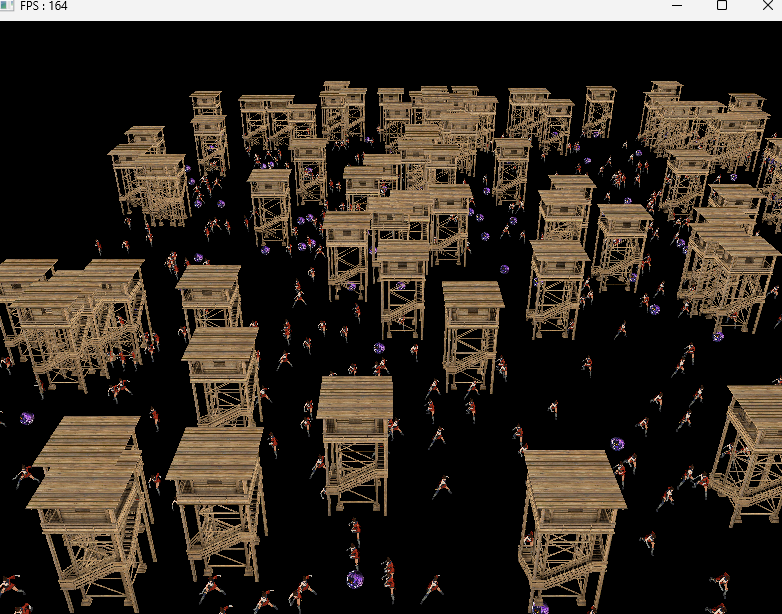
결과
- 기존과 동일하게 작동
참고 강의
https://www.inflearn.com/courses/lecture?courseId=329791&type=LECTURE&unitId=161159

게임 클라이언트 프로그래머 준비중 (공부 및 기록용)