초기 작업
- 이번에는 Kachujin캐릭터를 가지고 인스턴싱을 해볼 차례
- 이전과 동일하게 AnimInstancingDemo 클래스랑 AnimInstancing 쉐이더 파일을 만들어주고 초기 작업 해주기
AnimInstancingDemo
- 이전
AnimaitonDemo에서 Kachujin의 모델이랑 머터리얼, 애니메이션 읽어준 부분을 가져오기
AnimInstancingDemo.cpp
void AnimInstancingDemo::Init()
{
	RESOURCES->Init();
	_shader = make_shared<Shader>(L"21.ModelInstancing.fx");

	// Camera
	_camera = make_shared<GameObject>();
	_camera->GetOrAddTransform()->SetPosition(Vec3{ 0.f, 0.f, -5.f });
	_camera->AddComponent(make_shared<Camera>());
	_camera->AddComponent(make_shared<CameraScript>());

	shared_ptr<class Model> m1 = make_shared<Model>();
	m1->ReadModel(L"Kachujin/Kachujin");
	m1->ReadMaterial(L"Kachujin/Kachujin");
	m1->ReadAnimation(L"Kachujin/Idle");
	m1->ReadAnimation(L"Kachujin/Run");
	m1->ReadAnimation(L"Kachujin/Slash");

	for (int32 i = 0; i < 500; i++)
	{
		auto obj = make_shared<GameObject>();
		obj->GetOrAddTransform()->SetPosition(Vec3(rand() % 100, 0, rand() % 100));
		//obj->GetOrAddTransform()->SetRotation(Vec3(0.5f, 0, 0));
		obj->GetOrAddTransform()->SetScale(Vec3(0.01f));
		obj->AddComponent(make_shared<ModelRenderer>(_shader));
		{
			obj->GetModelRenderer()->SetModel(m1);
		}

		_objs.push_back(obj);


	}

	RENDER->Init(_shader);

}
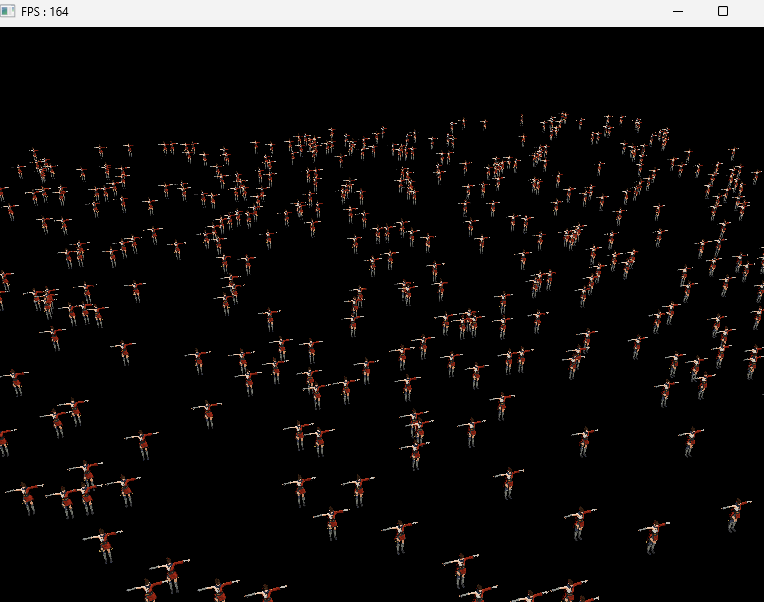
결과
- Kachujin캐릭을 불러오는 것만으로도 우선은 500개의 인스턴싱이 생성된다.
- 애니메이션은 아직 작동x
애니메이션 작동 시켜보기
instancingManager에서ReadAnimRenderer()생성ModelAnimator에서GetInstanceID()와REnderInstancing()생성
2-1. 현재 상태로 하게 되면 모든 캐릭터가 같은 애니메이션을 동작하게 되기에, 애니메이션도world와 동일하게 각각 따로 가지게끔 처리하자- 쉐이더는 Animation과 동일하게 작성하면서, 애니메이션 인스턴싱 추가
3-1. 쉐이더에 맞게끔RenderManger에서 버퍼 수정
1. InstancingManager
void InstancingManager::Render(vector<shared_ptr<GameObject>>& gameObjects)
{
	// 매 프레임마다 호출
	ClearData();

	RenderMeshRenderer(gameObjects);
	RenderModelRenderer(gameObjects);
	RenderAnimRenderer(gameObjects);
}

void InstancingManager::RenderAnimRenderer(vector<shared_ptr<GameObject>>& gameObjects)
{
	map<InstanceID, vector<shared_ptr<GameObject>>> cache;

	// 분류 단계
	for (shared_ptr<GameObject>& gameObject : gameObjects)
	{
		if (gameObject->GetModelAnimator() == nullptr)
			continue;

		const InstanceID instanceId = gameObject->GetModelAnimator()->GetInstanceID();
		cache[instanceId].push_back(gameObject);
	}

	for (auto& pair : cache)
	{
		shared_ptr<InstancedTweenDesc> instancedTweenDesc = make_shared<InstancedTweenDesc>();

		const vector<shared_ptr<GameObject>>& vec = pair.second;

		/*if (vec.size() == 1)
		{
		}
		else*/
		{
			const InstanceID instanceId = pair.first;

			for (int32 i = 0; i < vec.size(); i++)
			{
				const shared_ptr<GameObject>& gameObject = vec[i];
				InstancingData data;
				data.world = gameObject->GetTransform()->GetWorldMatrix();

				AddData(instanceId, data); // 개인의 월드정보를 가져오는

				// INSTANCE
				gameObject->GetModelAnimator()->UpdateTweenData();
				instancedTweenDesc->tweens[i] = gameObject->GetModelAnimator()->GetTweenDesc();
			}

			RENDER->PushTweenData(*instancedTweenDesc.get());

			// 그려주기 (한명만 대표적으로)
			shared_ptr<InstancingBuffer>& buffer = _buffers[instanceId];
			vec[0]->GetModelAnimator()->RenderInstancing(buffer);
		}
	}
}
2. ModelAnimator
- 생성해줘야 할 함수 :
UpdateTweenData(),RenderInstancing(),GetInstanceID(),GetTweenDesc() UpdateTweenData(): 각각의 모델이 개인으로 들고 있을 애니메이션RenderInstancing(): 공통적으로 가지고 있는 것들 (Bone, Mesh 등)
ModelAnimator.h
class ModelAnimator : public Component
{
public:
	void UpdateTweenData();
	void RenderInstancing(shared_ptr<class InstancingBuffer>& buffer);
	InstanceID GetInstanceID();
	TweenDesc& GetTweenDesc() { return _tweenDesc; }
}
ModelAnimator.cpp
void ModelAnimator::UpdateTweenData()
{
	TweenDesc& desc = _tweenDesc;

	desc.curr.sumTime += DT;

	// 현재 애니메이션
	{
		shared_ptr<ModelAnimation> currentAnim = _model->GetAnimationByIndex(desc.curr.animIndex);
		if (currentAnim)
		{
			float timePerFrame = 1 / (currentAnim->frameRate * desc.curr.speed);
			if (desc.curr.sumTime >= timePerFrame)
			{
				desc.curr.sumTime = 0;
				desc.curr.currFrame = (desc.curr.currFrame + 1) % currentAnim->frameCount;
				desc.curr.nextFrame = (desc.curr.currFrame + 1) % currentAnim->frameCount;
			}

			desc.curr.ratio = (desc.curr.sumTime / timePerFrame);
		}
	}

	// 다음 애니메이션이 예약되어 있다면
	if (desc.next.animIndex >= 0)
	{
		desc.tweenSumTime += DT;
		desc.tweenRatio = desc.tweenSumTime / desc.tweenDuration;

		if (desc.tweenRatio >= 1.f)
		{
			// 애니메이션 교체 성공
			desc.curr = desc.next;
			desc.ClearNextAnim();
		}
		else
		{
			// 교체
			shared_ptr<ModelAnimation> nextAnim = _model->GetAnimationByIndex(desc.next.animIndex);
			desc.next.sumTime += DT;

			float timePerFrame = 1.f / (nextAnim->frameRate * desc.next.speed);

			if (desc.next.ratio >= 1.f)
			{
				desc.next.sumTime = 0;

				desc.next.currFrame = (desc.next.currFrame + 1) % nextAnim->frameCount;
				desc.next.nextFrame = (desc.next.currFrame + 1) % nextAnim->frameCount;
			}

			desc.next.ratio = desc.next.sumTime / timePerFrame;
		}
	}
}

void ModelAnimator::RenderInstancing(shared_ptr<class InstancingBuffer>& buffer)
{
	if (_model == nullptr)
		return;

	if (_texture == nullptr)
		CreateTexture();


	// SRV를 통해 정보 전달
	_shader->GetSRV("TransformMap")->SetResource(_srv.Get());

	// Bone
	BoneDesc boneDesc;

	const uint32 boneCount = _model->GetBoneCount();
	for (uint32 i = 0; i < boneCount; i++)
	{
		shared_ptr<ModelBone> bone = _model->GetBoneByIndex(i);
		boneDesc.transforms[i] = bone->transform;
	}
	RENDER->PushBoneData(boneDesc);

	const auto& meshes = _model->GetMeshes();
	for (auto& mesh : meshes)
	{
		if (mesh->material)
			mesh->material->Update();

		// BoneIndex
		_shader->GetScalar("BoneIndex")->SetInt(mesh->boneIndex);

		mesh->vertexBuffer->PushData();
		mesh->indexBuffer->PushData();

		buffer->PushData();

		_shader->DrawIndexedInstanced(0, _pass, mesh->indexBuffer->GetCount(), buffer->GetCount());
	}
}

InstanceID ModelAnimator::GetInstanceID()
{
	return make_pair((uint64)_model.get(), (uint64)_shader.get());
}
3. 쉐이더 수정
ANimInstancing.fx
#include "00.Global.fx"
#include "00.Light.fx"


#define MAX_MODEL_TRANSFORMS 250
#define MAX_MODEL_KEYFRAMES 500
#define MAX_MODEL_INSTANCE 500


struct KeyframeDesc
{
    int animIndex;
    uint currFrame;
    uint nextFrame;
    float ratio;
    float sumTime;
    float speed;
    float2 padding;
};

struct TweenFrameDesc
{
    float tweenDuration;
    float tweenRatio;
    float tweenSumTime;
    float padding;

    KeyframeDesc curr;
    KeyframeDesc next;
};


cbuffer TweenBuffer
{
	// TweenFramse를 배열로 선언
    TweenFrameDesc TweenFrames[MAX_MODEL_INSTANCE];
};


cbuffer BoneBuffer
{
    matrix BoneTransforms[MAX_MODEL_TRANSFORMS];
};

uint BoneIndex;
Texture2DArray TransformMap;


struct VS_In
{
    float4 position : POSITION;
    float2 uv : TEXCOORD;
    float3 normal : NORMAL;
    float3 tangent : TANGENT;
    float4 blendIndices : BLEND_INDICES;
    float4 blendWeights : BLEND_WEIGHTS;
    // INSTANCING
    uint instanceID : SV_INSTANCEID;
    matrix world : INST;
};


struct VS_OUT
{
    float4 position : SV_POSITION;
    float3 worldPosition : POSITION1;
    float2 uv : TEXCOORD;
    float3 normal : NORMAL;
};

matrix GetAnimationMatrix(VS_In input)
{
    float indices[4] = { input.blendIndices.x, input.blendIndices.y, input.blendIndices.z, input.blendIndices.w };
    float weights[4] = { input.blendWeights.x, input.blendWeights.y, input.blendWeights.z, input.blendWeights.w };

    int animIndex[2];
    int currFrame[2];
    int nextFrame[2];
    float ratio[2];

    animIndex[0] = TweenFrames[input.instanceID].curr.animIndex;
    currFrame[0] = TweenFrames[input.instanceID].curr.currFrame;
    nextFrame[0] = TweenFrames[input.instanceID].curr.nextFrame;
    ratio[0] = TweenFrames[input.instanceID].curr.ratio;

    animIndex[1] = TweenFrames[input.instanceID].next.animIndex;
    currFrame[1] = TweenFrames[input.instanceID].next.currFrame;
    nextFrame[1] = TweenFrames[input.instanceID].next.nextFrame;
    ratio[1] = TweenFrames[input.instanceID].next.ratio;

    float4 c0, c1, c2, c3;
    float4 n0, n1, n2, n3;
    matrix curr = 0;
    matrix next = 0;
    matrix transform = 0;

    for (int i = 0; i < 4; i++)
    {
        c0 = TransformMap.Load(int4(indices[i] * 4 + 0, currFrame[0], animIndex[0], 0));
        c1 = TransformMap.Load(int4(indices[i] * 4 + 1, currFrame[0], animIndex[0], 0));
        c2 = TransformMap.Load(int4(indices[i] * 4 + 2, currFrame[0], animIndex[0], 0));
        c3 = TransformMap.Load(int4(indices[i] * 4 + 3, currFrame[0], animIndex[0], 0));
        curr = matrix(c0, c1, c2, c3);

        n0 = TransformMap.Load(int4(indices[i] * 4 + 0, nextFrame[0], animIndex[0], 0));
        n1 = TransformMap.Load(int4(indices[i] * 4 + 1, nextFrame[0], animIndex[0], 0));
        n2 = TransformMap.Load(int4(indices[i] * 4 + 2, nextFrame[0], animIndex[0], 0));
        n3 = TransformMap.Load(int4(indices[i] * 4 + 3, nextFrame[0], animIndex[0], 0));
        next = matrix(n0, n1, n2, n3);

        matrix result = lerp(curr, next, ratio[0]);

		// 다음 애니메이션
        if (animIndex[1] >= 0)
        {
            c0 = TransformMap.Load(int4(indices[i] * 4 + 0, currFrame[1], animIndex[1], 0));
            c1 = TransformMap.Load(int4(indices[i] * 4 + 1, currFrame[1], animIndex[1], 0));
            c2 = TransformMap.Load(int4(indices[i] * 4 + 2, currFrame[1], animIndex[1], 0));
            c3 = TransformMap.Load(int4(indices[i] * 4 + 3, currFrame[1], animIndex[1], 0));
            curr = matrix(c0, c1, c2, c3);

            n0 = TransformMap.Load(int4(indices[i] * 4 + 0, nextFrame[1], animIndex[1], 0));
            n1 = TransformMap.Load(int4(indices[i] * 4 + 1, nextFrame[1], animIndex[1], 0));
            n2 = TransformMap.Load(int4(indices[i] * 4 + 2, nextFrame[1], animIndex[1], 0));
            n3 = TransformMap.Load(int4(indices[i] * 4 + 3, nextFrame[1], animIndex[1], 0));
            next = matrix(n0, n1, n2, n3);

            matrix nextResult = lerp(curr, next, ratio[1]);
            result = lerp(result, nextResult, TweenFrames[input.instanceID].tweenRatio);
        }

        transform += mul(weights[i], result);
    }

    return transform;
}


VS_OUT VS(VS_In input)
{
    VS_OUT output;
    //output.position = mul(input.position, BoneTransforms[BoneIndex]); // Model Global
    matrix m = GetAnimationMatrix(input);

    output.position = mul(input.position, m); // W
    output.worldPosition = output.position;
    output.position = mul(output.position, VP);
    output.uv = input.uv;
    output.normal = input.normal;

	return output;
}

float4 PS(VS_OUT input) : SV_TARGET
{
	float4 color = DiffuseMap.Sample(LinearSampler, input.uv);
	return color;
}

technique11 T0
{
    PASS_VP(P0, VS, PS)
};
3-1. RenderManager
RenderManager.h
struct InstancedTweenDesc
{ 	//기존의 TweenDesc 구조체를 배열로 만들어줌
	TweenDesc tweens[MAX_MODEL_INSTANCE];
};

class RenderManager
{
	DECLARE_SINGLE(RenderManager);

public:
	// PushData를 배열단위로 변경
	void PushTweenData(const InstancedTweenDesc& desc);

private:
	InstancedTweenDesc _tweenDesc;
	shared_ptr<ConstantBuffer<InstancedTweenDesc>> _tweenBuffer;
	ComPtr<ID3DX11EffectConstantBuffer> _tweenEffectBuffer;
}
RenderManager.cpp
void RenderManager::Init(shared_ptr<Shader> shader)
{
	/// 위 내용은 생략


	_tweenBuffer = make_shared<ConstantBuffer<InstancedTweenDesc>>();
	_tweenBuffer->Create();
	_tweenEffectBuffer = _shader->GetConstantBuffer("TweenBuffer");
}

void RenderManager::PushTweenData(const InstancedTweenDesc& desc)
{
	_tweenDesc = desc;
	_tweenBuffer->CopyData(_tweenDesc);
	_tweenEffectBuffer->SetConstantBuffer(_tweenBuffer->GetComPtr().Get());
}
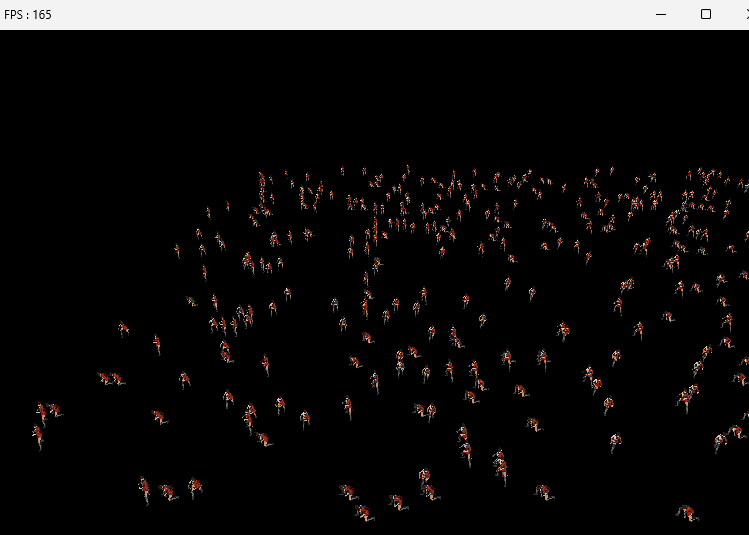
결과
- 각자 다 다른 애니메이션이 재생됨
참고 강의
https://www.inflearn.com/courses/lecture?courseId=329791&type=LECTURE&unitId=161158

게임 클라이언트 프로그래머 준비중 (공부 및 기록용)