Instancing - ModelRenderer
ModelInstanctingDemo
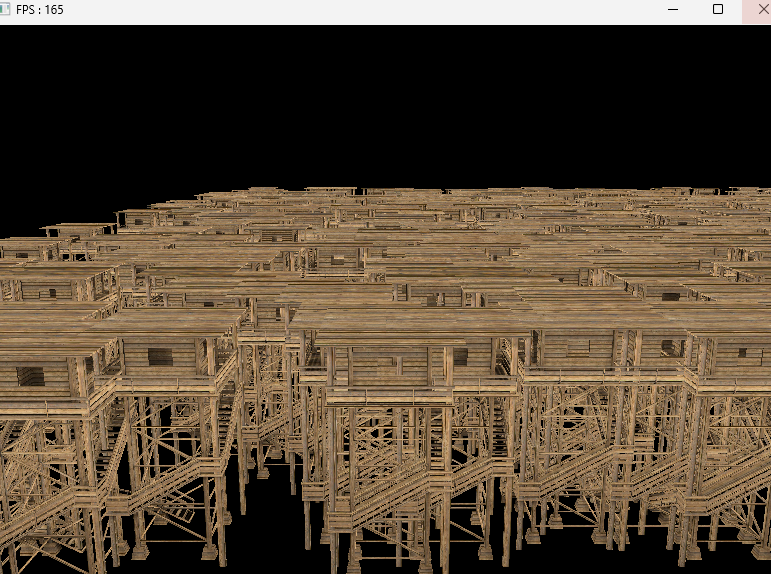
- 메인 함수에서 사용할 모델을 Tower로 사용
Init()수정
void ModelInstancingDemo::Init()
{
	RESOURCES->Init();
	_shader = make_shared<Shader>(L"21.ModelInstancing.fx");

	// Camera
	_camera = make_shared<GameObject>();
	_camera->GetOrAddTransform()->SetPosition(Vec3{ 0.f, 0.f, -10.f });
	_camera->AddComponent(make_shared<Camera>());
	_camera->AddComponent(make_shared<CameraScript>());

	shared_ptr<class Model> m1 = make_shared<Model>();
	m1->ReadModel(L"Tower/Tower");
	m1->ReadMaterial(L"Tower/Tower");

	for (int32 i = 0; i < 500; i++)
	{
		auto obj = make_shared<GameObject>();
		obj->GetOrAddTransform()->SetPosition(Vec3(rand() % 100, 0, rand() % 100));
		obj->GetOrAddTransform()->SetScale(Vec3(0.1f));
		obj->AddComponent(make_shared<ModelRenderer>(_shader));
		{
			obj->GetModelRenderer()->SetModel(m1);
		}
		_objs.push_back(obj);
	}
	RENDER->Init(_shader);
}
ModelInstancing.fx
- 이전 Model 작업했던 쉐이더와 동일하게 수정
#include "00.Global.fx"
#include "00.Light.fx"


#define MAX_MODEL_TRANSFORMS 250

cbuffer BoneBuffer
{
    matrix BoneTransforms[MAX_MODEL_TRANSFORMS];
};

uint BoneIndex;

struct VS_In
{
    float4 position : POSITION;
    float2 uv : TEXCOORD;
    float3 normal : NORMAL;
    float3 tangent : TANGENT;
    float4 blendIndices : BLEND_INDICES;
    float4 blednWeights : BLEND_WEIGHTS;
    // INSTANCING
    uint instanceID : SV_INSTANCEID;
    matrix world : INST;
};


struct VS_OUT
{
    float4 position : SV_POSITION;
    float3 worldPosition : POSITION1;
    float2 uv : TEXCOORD;
    float3 normal : NORMAL;
};

VS_OUT VS(VS_In input)
{
    VS_OUT output;
    output.position = mul(input.position, BoneTransforms[BoneIndex]); // Model Global
    output.position = mul(input.position, input.world); // W
    output.worldPosition = output.position;
    output.position = mul(output.position, VP);
    output.uv = input.uv;
    output.normal = input.normal;

	return output;
}

float4 PS(VS_OUT input) : SV_TARGET
{
	float4 color = DiffuseMap.Sample(LinearSampler, input.uv);
	return color;
}

technique11 T0
{
    PASS_VP(P0, VS, PS)
};
ModelRenderer
InstancingManager에서 사용할GetInstanceID()와RenderInstancing()함수 생성GetInstanceID()에서는Model과shader를 가져오기
void ModelRenderer::RenderInstancing(shared_ptr<class InstancingBuffer>& buffer)
{
	if (_model == nullptr)
		return;

	// Bones
	BoneDesc boneDesc;

	const uint32 boneCount = _model->GetBoneCount();
	for (uint32 i = 0; i < boneCount; i++)
	{
		shared_ptr<ModelBone> bone = _model->GetBoneByIndex(i);
		boneDesc.transforms[i] = bone->transform;
	}
	RENDER->PushBoneData(boneDesc);


	const auto& meshes = _model->GetMeshes();
	for (auto& mesh : meshes)
	{
		if (mesh->material)
			mesh->material->Update();

		// BoneIndex
		_shader->GetScalar("BoneIndex")->SetInt(mesh->boneIndex);

		// IA
		mesh->vertexBuffer->PushData();
		mesh->indexBuffer->PushData();

		buffer->PushData();

		_shader->DrawIndexedInstanced(0, _pass, mesh->indexBuffer->GetCount(), buffer->GetCount());
	}
}

InstanceID ModelRenderer::GetInstanceID()
{
	return make_pair((uint64)_model.get(), (uint64)_shader.get());
}
InstancingManager
- 오브젝트가 여러개 만들어지고,
INSTANCING->Render()가 진행되기에InstancingManager에서 Model 작업 추가 GetInstanceID()와RenderInstancing()을 Render마다 해줘야 하기에 나중에 더 상위 클래스인Render라는 클래스로 묶어줄 필요가 있다.
void InstancingManager::RenderModelRenderer(vector<shared_ptr<GameObject>>& gameObjects)
{
	map<InstanceID, vector<shared_ptr<GameObject>>> cache;

	// 분류 단계
	for (shared_ptr<GameObject>& gameObject : gameObjects)
	{
		if (gameObject->GetModelRenderer() == nullptr)
			continue;

		const InstanceID instanceId = gameObject->GetModelRenderer()->GetInstanceID();
		cache[instanceId].push_back(gameObject);
	}

	for (auto& pair : cache)
	{
		const vector<shared_ptr<GameObject>>& vec = pair.second;

		/*if (vec.size() == 1)
		{
		}
		else*/
		{
			const InstanceID instanceId = pair.first;

			for (int32 i = 0; i < vec.size(); i++)
			{
				const shared_ptr<GameObject>& gameObject = vec[i];
				InstancingData data;
				data.world = gameObject->GetTransform()->GetWorldMatrix();

				AddData(instanceId, data);
			}


			// 그려주기 (한명만 대표적으로)
			shared_ptr<InstancingBuffer>& buffer = _buffers[instanceId];
			vec[0]->GetModelRenderer()->RenderInstancing(buffer);
		}
	}
}
결과
참고 강의

게임 클라이언트 프로그래머 준비중 (공부 및 기록용)