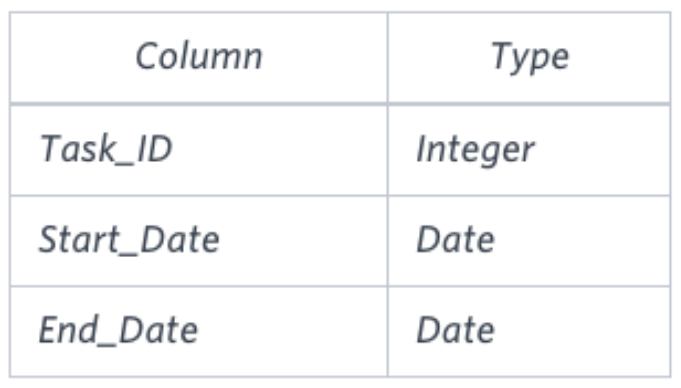
You are given a table, Projects, containing three columns: Task_ID, Start_Date and End_Date. It is guaranteed that the difference between the End_Date and the Start_Date is equal to 1 day for each row in the table.
If the End_Date of the tasks are consecutive, then they are part of the same project. Samantha is interested in finding the total number of different projects completed.
Write a query to output the start and end dates of projects listed by the number of days it took to complete the project in ascending order. If there is more than one project that have the same number of completion days, then order by the start date of the project.
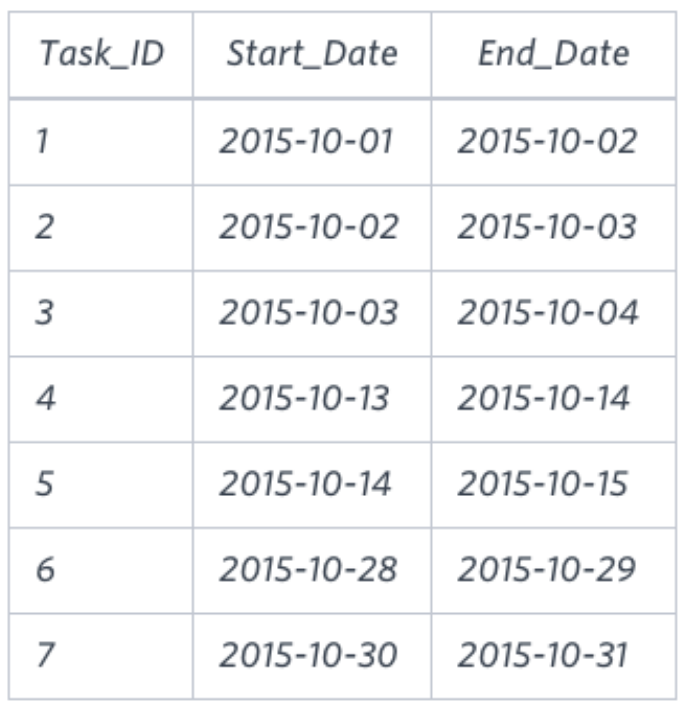
Sample Input
Sample Output
2015-10-28 2015-10-29
2015-10-30 2015-10-31
2015-10-13 2015-10-15
2015-10-01 2015-10-04
Explanation
The example describes following four projects:
-
Project 1: Tasks 1, 2 and 3 are completed on consecutive days, so these are part of the project. Thus start date of project is 2015-10-01 and end date is 2015-10-04, so it took 3 days to complete the project.
-
Project 2: Tasks 4 and 5 are completed on consecutive days, so these are part of the project. Thus, the start date of project is 2015-10-13 and end date is 2015-10-15, so it took 2 days to complete the project.
-
Project 3: Only task 6 is part of the project. Thus, the start date of project is 2015-10-28 and end date is 2015-10-29, so it took 1 day to complete the project.
-
Project 4: Only task 7 is part of the project. Thus, the start date of project is 2015-10-30 and end date is 2015-10-31, so it took 1 day to complete the project.
Answer :
/* A date is a start-date if it's not end-date for anyone */
WITH START_DATES AS (
    SELECT Start_Date
    FROM Projects
    WHERE Start_Date NOT IN (
        SELECT DISTINCT End_Date FROM Projects
    )
),
/* A date is a end-date if it's not start-date for anyone */
END_DATES AS (
    SELECT End_Date
    FROM Projects
    WHERE End_Date NOT IN (
        SELECT DISTINCT Start_Date FROM Projects
    )
)
SELECT
    S.Start_Date AS SD,
    /* For each start-date, corresponding end-date is the nearest end-date which is higher than start-date */
    (SELECT MIN(E.End_Date) FROM END_DATES E WHERE E.End_Date > S.Start_Date) AS ED
FROM
    START_DATES S
ORDER BY
    (ED - SD) ASC,
    SD ASC;