macOs, VSC, C++) error: unexpected token in '.section' directive 에러

처음에는 xcode가 자동으로 업데이트가 되면서 컴파일러가 꼬였는줄 알았다. 근데 동일한 환경에서 다른 파일은 잘 실행되어서 의문이 생김.
- 에러 안 난 코드
#include <bits/stdc++.h> using namespace std; int board[1002][1002]; int bwall[1002][1002]; int dis[1002][1002]; int dx[4] = {1, 0, -1, 0}; int dy[4] = {0, 1, 0, -1}; int n, m; int main() { ios_base::sync_with_stdio(false); cin.tie(NULL); // cin.tie(0); freopen("input.txt", "rt", stdin); cin >> n >> m; for (int i = 0; i < n; i++) { fill(dis[i], dis[i] + m, -1); } queue<tuple<int, int, int>> q; for (int i = 0; i < n; i++) { string s; cin >> s; for (int j = 0; j < m; j++) { board[i][j] = s[j] - '0'; } } q.push({0, 0, 0}); dis[0][0] = 1; int flag = 0; while (!q.empty()) { auto cur = q.front(); int curx, cury, wall; tie(curx, cury, wall) = cur; q.pop(); if (curx == n - 1 && cury == m - 1) { cout << dis[curx][cury]; flag = 1; break; } for (int i = 0; i < 4; i++) { int nx = curx + dx[i]; int ny = cury + dy[i]; if (nx < 0 || nx > n - 1 || ny < 0 || ny > m - 1) continue; // if (dis[nx][ny] > -1 && bwall[nx][ny] == 1 && wall == 0) if ((dis[nx][ny] > -1 && wall == 1) || bwall[nx][ny] == 1) continue; if (board[nx][ny] == 1) { if (wall == 0) { bwall[nx][ny] = 1; dis[nx][ny] = dis[curx][cury] + 1; q.push({nx, ny, 1}); // cout << "wall o : " << nx << " " << ny << " " << 1 << " " << dis[nx][ny] << '\n'; } else continue; } else { dis[nx][ny] = dis[curx][cury] + 1; q.push({nx, ny, wall}); if (wall == 0) bwall[nx][ny] = 1; // cout << "wall x : " << nx << " " << ny << " " << wall << " " << dis[nx][ny] << '\n'; } } } if (flag == 0) cout << "-1\n"; return 0; } - 에러난 코드
#include <time.h>

#include <bits/stdc++.h>
using namespace std;

typedef long long ll;
typedef pair<int, int> pii;
typedef vector<int> vi;
typedef tuple<int, int, int> ti3;

//위부터 시계반대반향. 위 오른쪽 아래 왼쪽
const int dr[4] = { -1, 0, 1, 0 };
const int dc[4] = { 0, 1, 0, -1};
const int ddr[8] = { 0,0,1,1,1,-1,-1,-1 }, ddc[8] = { 1,-1,1,0,-1,1,0,-1 };

bool OOB(ll x, ll y, ll N, ll M) { return 0 > x || x >= N || 0 > y || y >= M; }

#define F first
#define S second
#define rep(i, a, b) for(int i = (a); i < (b); ++i)
#define pb push_back
#define pf1(a) cout << (a) << ' '
#define pf2(a,b) cout << (a) << ' ' << (b) << ' '
#define pf3(a,b,c) cout << (a) << ' ' << (b) << ' '<< (c) << ' '
#define pf4(a,b,c,d) cout << (a) << ' ' << (b) << ' '<< (c) << ' '<< (d) << ' '
#define pf5(a,b,c,d,e) cout << (a) << ' ' << (b) << ' '<< (c) << ' '<< (d) << ' '<< (e) << ' '
#define pf6(a,b,c,d,e,f) cout << (a) << ' ' << (b) << ' '<< (c) << ' '<< (d) << ' '<< (e) << ' ' << (f) << ' '
#define pf0l() cout << '\n'
#define pf1l(a) cout << (a) << '\n'
#define pf2l(a,b) cout << (a) << ' ' << (b) << '\n'
#define pf3l(a,b,c) cout << (a) << ' ' << (b) << ' '<< (c) << '\n'
#define pf4l(a,b,c,d) cout << (a) << ' ' << (b) << ' '<< (c) << ' '<< (d) << '\n'
#define pf5l(a,b,c,d,e) cout << (a) << ' ' << (b) << ' '<< (c) << ' '<< (d) << ' '<< (e) << '\n'
#define pf6l(a,b,c,d,e,f) cout << (a) << ' ' << (b) << ' '<< (c) << ' '<< (d) << ' '<< (e) << ' ' << (f) << '\n'
#define pfvec(V) for(auto const &t : V) pf1(t)
#define pfvecl(V) for(auto const &t : V) pf1(t); pf0l()
#define sf1(a) cin >> a
#define sf2(a,b) cin >> a >> b
#define sf3(a,b,c) cin >> a >> b >> c
#define sf4(a,b,c,d) cin >> a >> b >> c >> d
#define sf5(a,b,c,d,e) cin >> a >> b >> c >> d >> e
#define sf6(a,b,c,d,e,f) cin >> a >> b >> c >> d >> e >> f

// const int MOD = 1000'000'005;
const int MAX_N = 100'005;
const int MAX_M = 500'005;
const int INF = 0xfffffff;
int N, M, P, Q, T, K, V, E;

vector<pii> adj[MAX_N]; //비용, 정점
int interview[MAX_N], d[MAX_N];

// int solve(int st, int en) {
// }

void code() {
    fill(d, d+N+1, INF);
    priority_queue<pii, vector<pii>, greater<pii>> pq;
    rep(i, 0, K) {
        int u = interview[i];
        d[u] = 0;
        pq.push({d[u], u});
    }
    int u, v, w, dw;
    while(!pq.empty()) {
        tie(w, u) = pq.top(); pq.pop();
        if(d[u] != w) continue;
        for(auto nxt : adj[u]) {
            tie(dw, v) = nxt;
            if(d[v] <= d[u] + dw) continue;
            d[v] = d[u] + dw;
            pq.push({d[v], v});
        }
    }
    rep(i, 0, N) pf1(d[i]);
}

void input() {
    sf3(N, M, K);
    int u, v, c;
    rep(i, 0, M) {
        sf3(u, v, c);
        adj[u].pb({c, v});
    }
    rep(i, 0, K) {
        sf1(interview[i]);
    }
}

void with_time_check() {
    freopen("input.txt", "rt", stdin);
    clock_t start, end; double result;
    start = clock();  // 시간 측정 시작
    cout << "=============\n";
    input();
    code();
    end = clock();  // 시간 측정 끝
    result = (double)(end - start);
    cout << "\n=============\n총 걸린 시간 : " << result << "ms\n";  // 결과 출력
}

int main() {
    ios_base::sync_with_stdio(false);
    cin.tie(NULL);
    with_time_check();
    // input(); code();
    return 0;
}
ChatGPT 님의 말씀 →
1. .data.rel.ro.local 섹션의 역할
.data.rel.ro.local 섹션은 읽기 전용 데이터의 위치 독립적인 주소를 관리하기 위해 사용됩니다. 이는 주로 다음 경우에 생성됩니다:
- STL 컨테이너 사용:
vector,priority_queue등의 동적 컨테이너는 위치 독립적인 실행 파일(PIE)을 위해 이 섹션에 메타데이터를 저장할 수 있습니다.
- 정적 초기화:
- 두 번째 코드에서
vector및fill초기화를 수행하는 방식이 이 섹션을 생성하도록 유도할 수 있습니다.
- 두 번째 코드에서
- C++17 표준 라이브러리:
- GCC가
C++17표준 라이브러리를 처리하는 과정에서.data.rel.ro.local섹션을 생성할 수 있습니다.
- GCC가
2. 첫 번째 코드에서 문제가 발생하지 않는 이유
- 첫 번째 코드는 단순히 정적 배열과 기본 타입을 사용하며, 컴파일러가
.data.rel.ro.local섹션을 생성할 필요가 없습니다. - STL 컨테이너나 C++17의 고급 기능을 사용하지 않으므로 어셈블리 코드에서 이 섹션이 포함되지 않습니다.
3. 두 번째 코드에서 문제가 발생하는 이유
- 두 번째 코드는:
vector<pii>와 같은 동적 컨테이너를 사용.priority_queue를 사용하여 정렬 및 관리.- C++17의 STL 및 표준 라이브러리를 활용.
- 이러한 요소가 GCC가
.data.rel.ro.local섹션을 포함한 어셈블리 코드를 생성하게 만듭니다. 그러나 macOS의 기본 어셈블러(Clang)는 이 섹션을 처리하지 못합니다.
요약하자면, 벡터처럼 동적으로 생성하는 코드가 에러를 발생한 거였고, 맥 기본 어셈블러는 처리하지 못한다는 것이였다.
해결 1)cmd 에서 실행해봤을때 되는지 확인
-
macOS의 기본 어셈블러를 GNU 어셈블러로 변경
brew install binutils -
설치 후, GNU
as(어셈블러)를 기본으로 사용하도록 설정export PATH="/usr/local/opt/binutils/bin:$PATH" -
macOS에서 GCC 대신 Clang을 사용
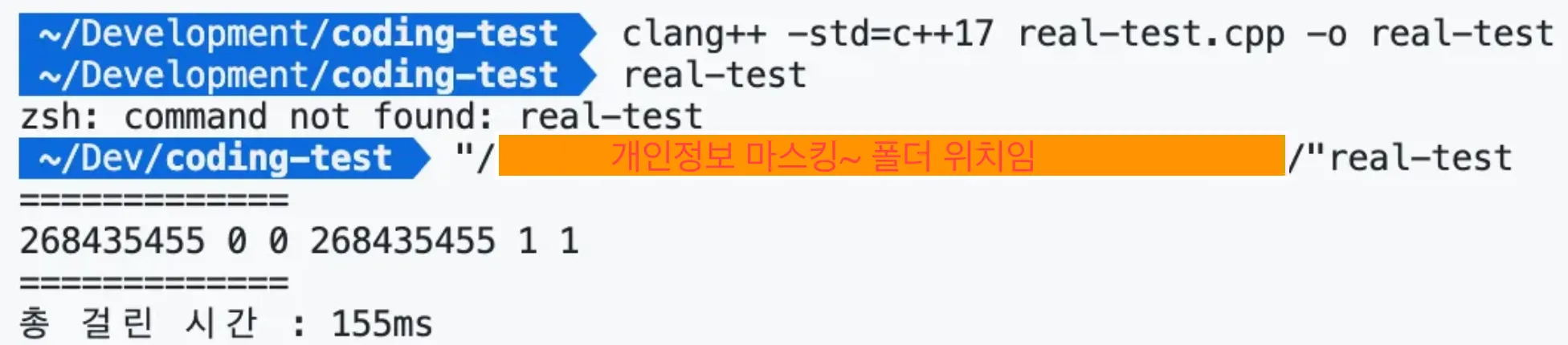
clang++ -std=c++17 real-test.cpp -o real-test
먼저 커맨드창으로 컴파일하고 실행해봤더니 되는 것 확인.
해결 2) Code runner 확장에서 설정 변경
그러나 나는 code runner로, cmd + R 을 누르면 컴파일부터 실행이 되게끔 설정했었다.
cd "/(폴더 위치)/" && g++ -std=c++17 real-test.cpp -o real-test && "/(폴더 위치)/"real-test다른점은 g++이 아니라 clang++로 실행하게 하면 된다.
-
vsc 설정에서 Code runner Executor Map 을 찾은 후, Edit in settings.json 클릭
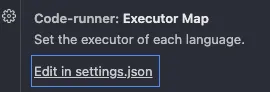
cpp에서
&& g++→&& clang++로 바꾸면 됨...., "code-runner.executorMap": { "javascript": "node", "java": "cd $dir && javac $fileName && java $fileNameWithoutExt", "c": "cd $dir && gcc $fileName -o $fileNameWithoutExt && $dir$fileNameWithoutExt", "zig": "zig run", "cpp": "cd $dir && **clang++** -std=c++17 $fileName -o $fileNameWithoutExt && $dir$fileNameWithoutExt", "objective-c": "cd $dir && gcc -framework Cocoa $fileName -o $fileNameWithoutExt && $dir$fileNameWithoutExt", "php": "php", ...
정상작동 확인!


간단한것들 정리