1. Binomial Distribution
Binomial Distribution은 success의 확률에 대한 distribution이다. 아래와 같이 표현한다.
- : 양의 정수 , : probability ( )
강의에서 교수님이 Binomial distribution을 설명하실 때 3가지로 해석하신다. 하나씩 살펴보자.
1) Story
- : number of successes in independent trials.
- : probability of success
→ Every trial results in success or failure, but not both.
2) Sum of Indicator Random Variables
- , (i.i.d = independent, identically distributed )
- = have the same distribution.
- = 1 if jth trial = success, =0 otherwise
→ Indicator variable indicates whether the jth trial was a success or not.
→ exactly same as 1). (counting # of successes)
Random Variable VS Distribution
- distribution : explains how the probabilities of X will behave in different situations.
- multiple r.v.s can have the same distriution.
3) PMF (Probability Mass Function)
- def) probability of X on any particular value
(PMF for binomial dist.)
4) Binomial Distribution의 조건
- N identical trials.
- each trial being success or failure.
- probability of success must be same in all trials.
- each trial must be independent.
2. PMF (Probability Mass Function)
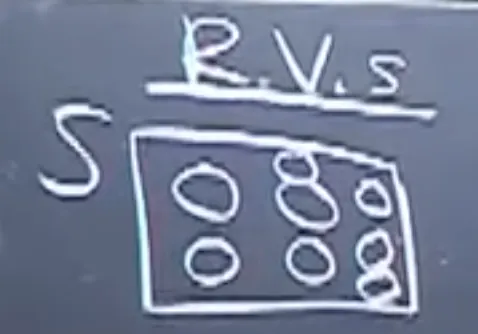
- S: sample space → different possible outcomes
- random variable : assigning a number to each pebble.
- ex) is an event.
- event = subset of sample space.
- Can interpret this as a function.
- Function that maps Sample space → interger (this case, 7)
- ex) is an event.
1) CDF (Cumulative Distribution Function)
- is an event.
- : CDF of .
- one way to describe a distribution.
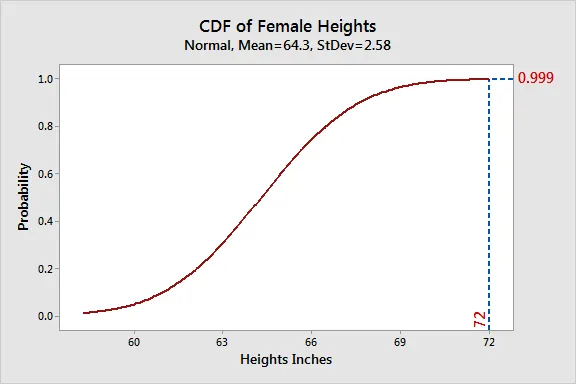
Continuous r.v.s' CDF
Discrete r.v.s' CDF
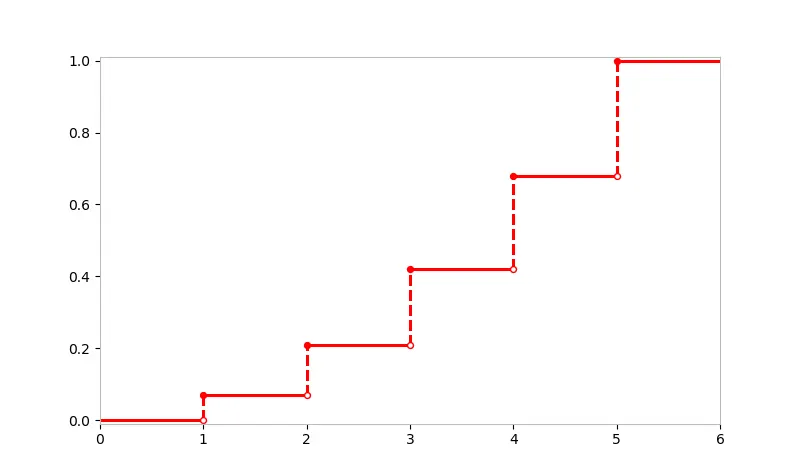
→ Good to have a visual idea of a CDF.
2) PMF - Discrete r.v.s
- Discrete r.v.s : possible values should be something you can list.
- : could be infinite or finite
- PMF = for all j.
- 가능한 모든 값들에 대한 확률을 정의해야 함.
- 로 많이 표현함.
- blueprint for X.
- 조건 : (for discrete r.v.s)
Binomial Distribution PMF (revisit)
- ,
- 위의 조건 확인
- sum : , by Binomial Theorem.
Arithmetics between two distributions
- , independent. Then,
- If the random variables are in the same sample space, you can add, subtract, multiply, divide.. etc. them.
- Distributions should be Independent, probability of success must be same to use this property!
해석
1) Story
- adding two dist. is same as adding the number of successes from each trials.
2) Sum of Indicator Random Variables
→ sum of =
3) PMF
- (Law of total probability)
( → use PMF directly)
→ are independent, so (X has no impact on Y.)
=
= (VanderMonde Identity)
-> so PMF proves that is TRUE.
3. Common Mistakes - Thinking that it is a Binomial when it’s not.
- Ex1) 5 card hand from a 52 card deck. → Find distribution of the number of aces in the hand. → PMF or CDF
- Let
- PMF
- Find , This is 0 except if
- Distribution is NOT Binomial.
- trials are not independent.
- if one ace comes out, prob. of success changes in the next trial.
- trials are not independent.
- Distribution is NOT Binomial.
- for
- same as elk problem (from h.w.)
- some elks are tagged, some are not. → when collecting a sample, what is the prob. of the collected sample has exactly k tagged elks?
- same as elk problem (from h.w.)
- Find , This is 0 except if
- Ex) Have b black, and w white marbles , pick simple random samples(= all subsets of that size are equally likely)of size n.
→ Find the Distribution of # of white marbles in the sample (pretty much the same as ex1.)
- ,
- This Distribution is called Hypergeometric distribution.
- sampling without replacement. (trials are not independent, so not binomial)
- If you sample with replacement, it will be Binomial!
Validation of the Hypergeometric Dist. PMF
,
- Sum = 1?
- (via VanderMonde)