1. Classification
1.1 Definition
- a data analysis task learns a model
- classifier
- predicts categorical (discreate) class labels
E.g.,
- loan approaval
- medical diagnosis
- spam detection
- autonomous driving
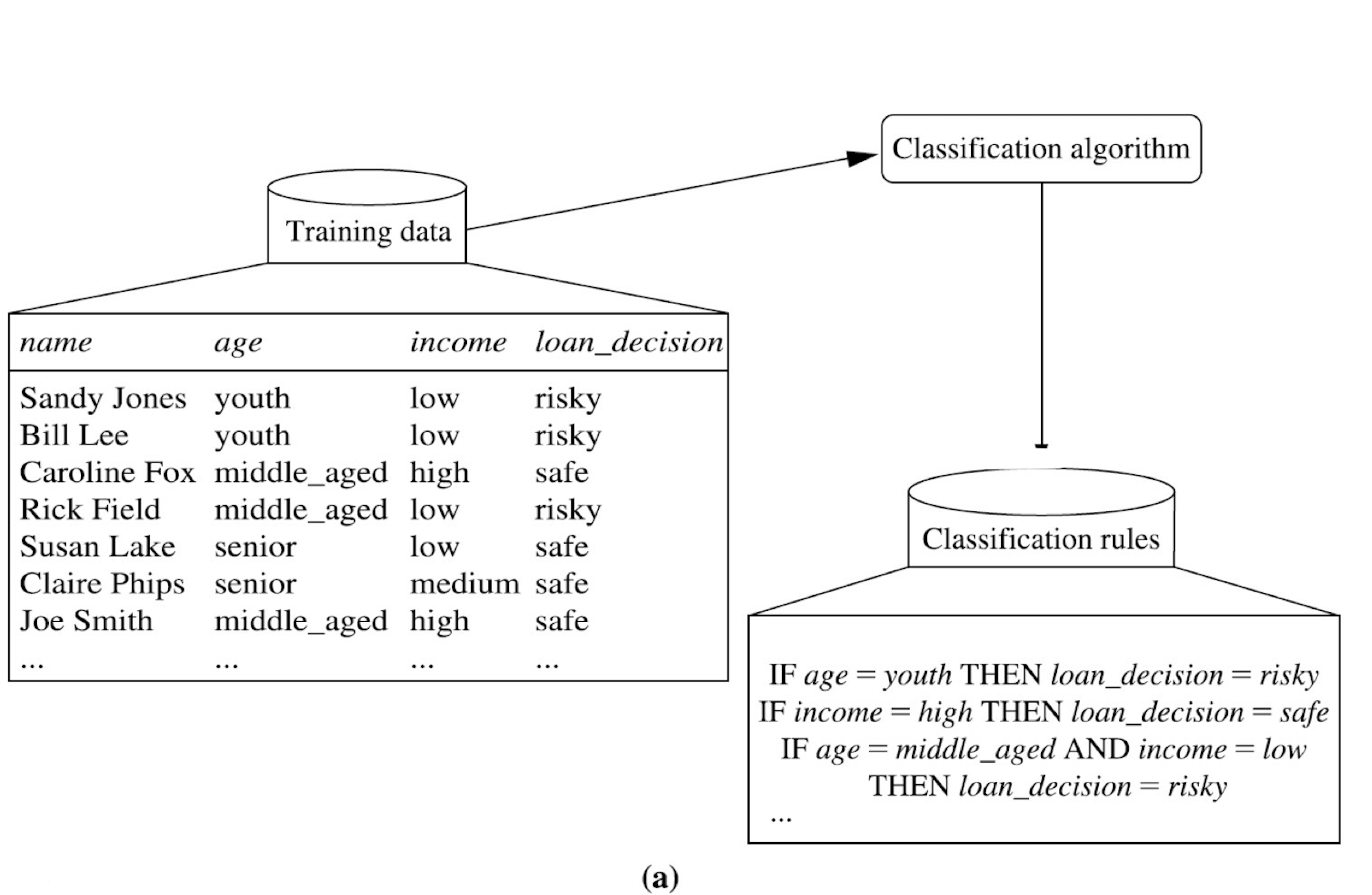
Training
Evaluation & Prediction
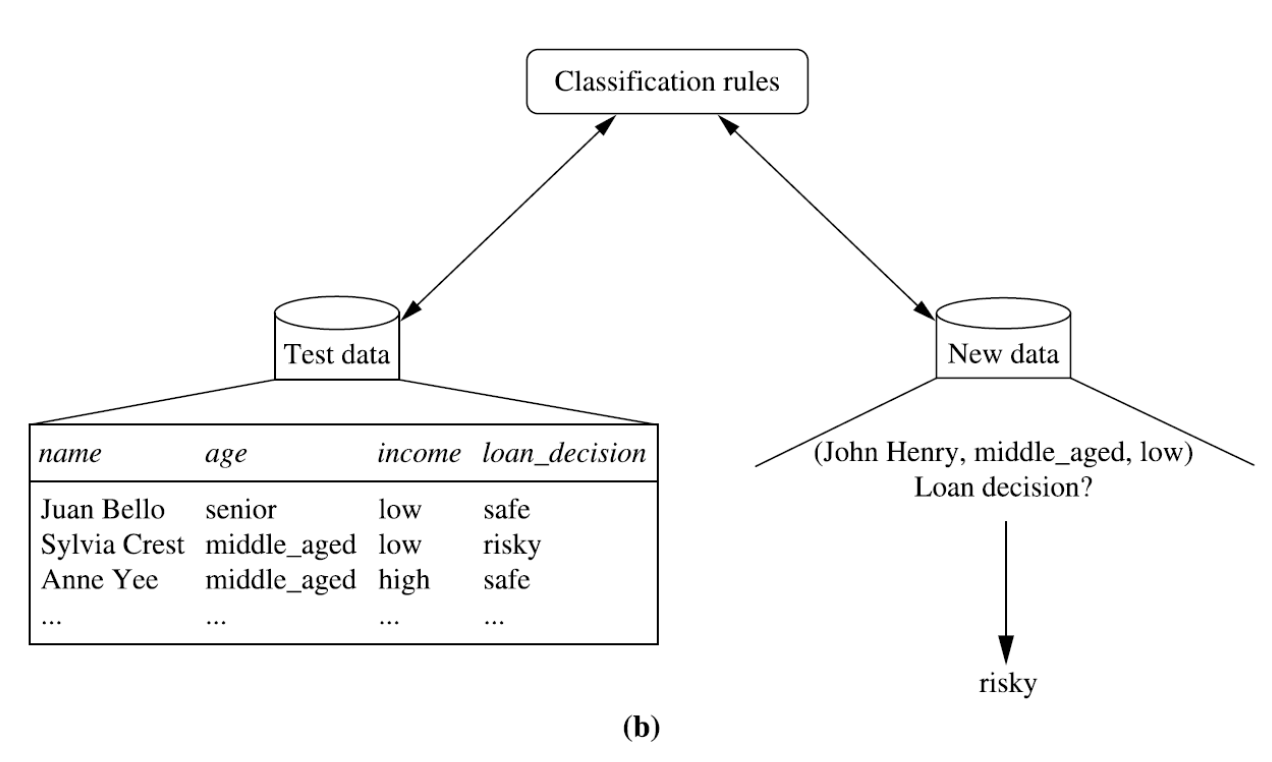
사전에 정의된 클래스를 예측하는 모델(classifier)을 학습하는 것으로 입력 특징 분류기 의 흐름으로 동작한다.
1.2 Classification vs. Prediction
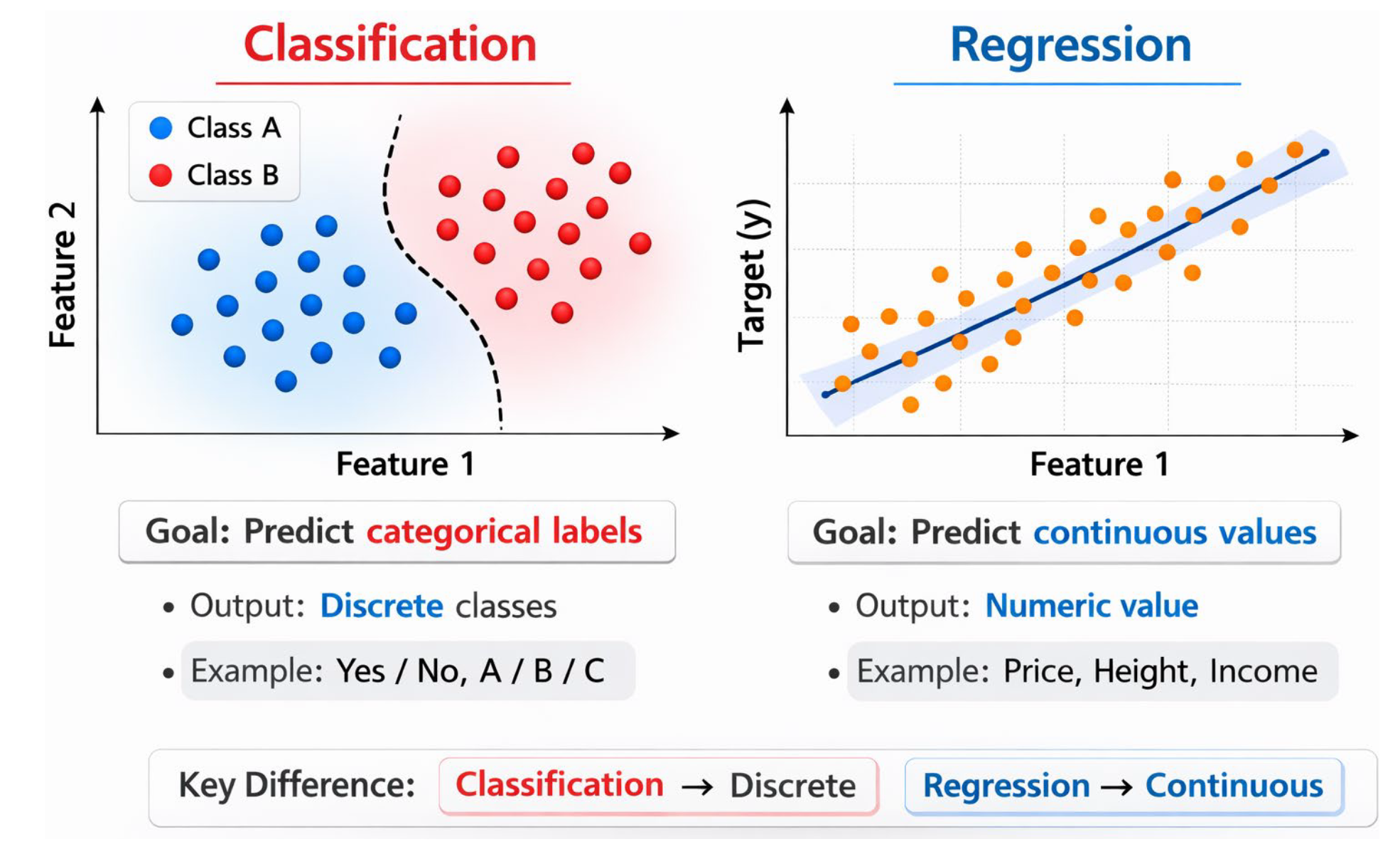
Classification
- output: categorical labels
- e.g., yes/no, pos/neg, class A, B, C
Numerical Prediction
- output: continous values
- e.g., house price, income, sales amounts
1.3 Supervised Learning
Setup
- input: feature vector
- output: label
Learning objective
- learning mapping from to
Training data
- labeled dataset
the model is learned from labeled data and then applied to unseen inputs
1.4 Process of Classification
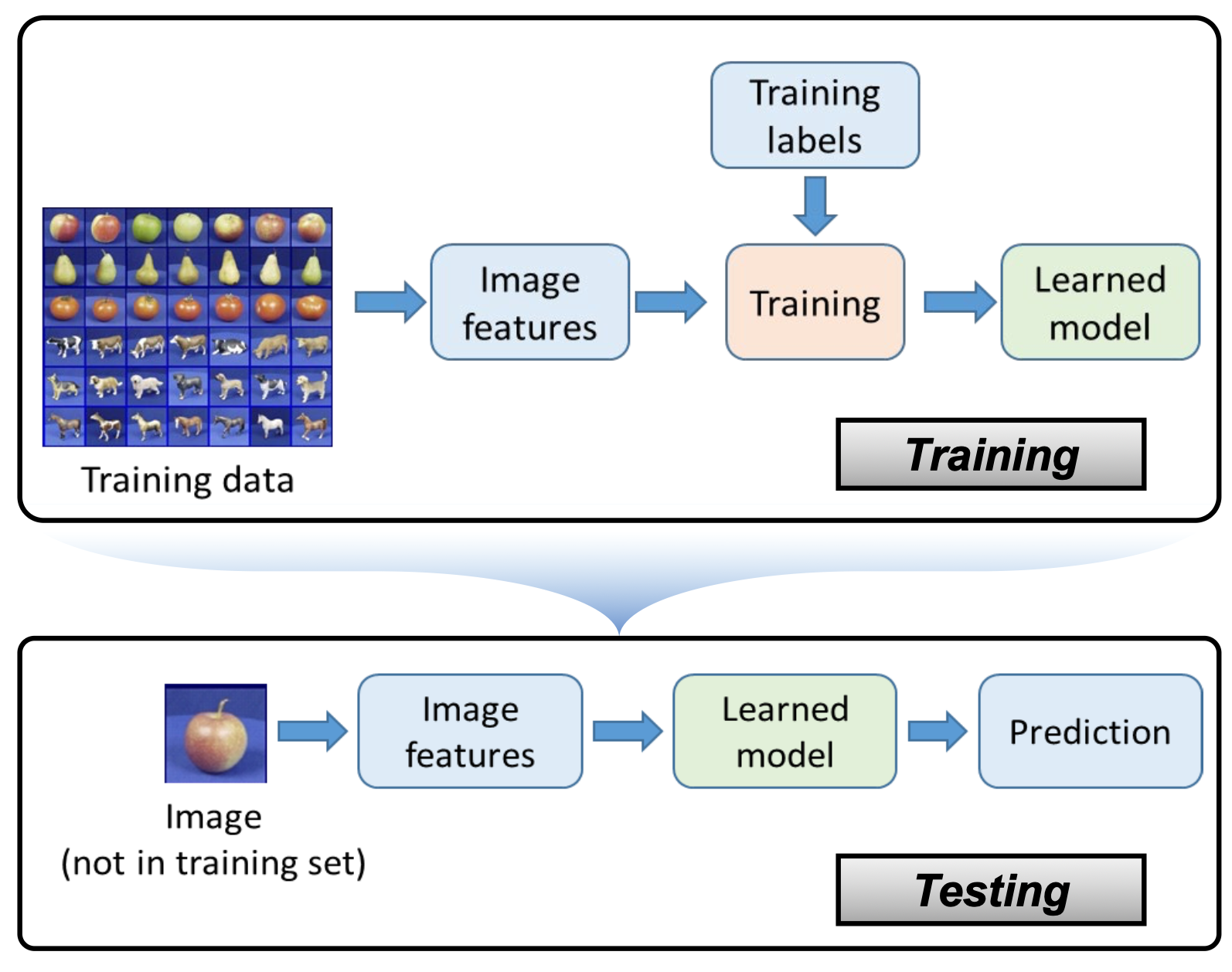
1. Model Construction
- learn classifier from training data
2. Model Evaluation
- test accuracy on unseen data
- if acceptable deploy model
3. Prediction
- apply model to new data
Applications
- fraud detection
- medical diagnosis
- intrusion detection
- sentiment analysis
- recommendation systems
2. Decision Tree
2.1 Definition
- a supervised learning method for classification and regression
- predicts output from inputs
- uses a sequence of simple decision rules
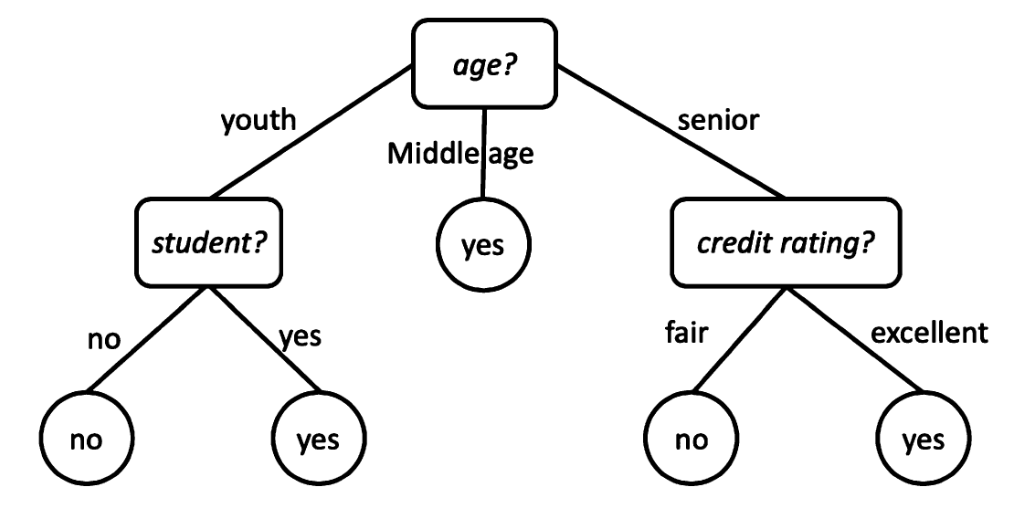
- ask a series of questions
- from a set of if-then rules
- map input to output through hierachical decisions
Pros
- not require domain knowledge or parameter tuning
- can handle multidimensional data
- intuitive and easy
- computationally efficient and often achieve good performance
Cons
- overfitting
- noise of outliers
2.2 Induction
머신러닝은 데이터에서 패턴을 뽑아 일반화하기 때문에 Inductive Learning에 해당한다. 학습 데이터에서 패턴을 뽑아서 본 적 없는 데이터에도 적용할 수 있도록 일반화하는 것을 의미한다.
- a decision tree is flowchart-like structure
- each internal node represents a test on an attribute
- each branch corresponds to an outcome of that test
- each leaf node contains a class label
root도 leaf도 아닌 node를 internal node라 한다.
- how decision trees perform classification
- to classify a new instance
- we start at the root node
- evaluate the test condition at each node
- follow the corresponding branch based on the feature values
- continue this process until reaching a leaf node
- the label stored in the leaf node is the predicted class
- classification is essentially a path traversal from root to leaf
2.3 Representative Algorithms
ID3
- iterative dichotomiser 3
- uses information gain for splitting
- handles categorical attributes only
- dose not perform pruning
C4.5
- extension of ID3
- supports continous attributes
- uses gain ratio
- includes post-pruning
편향을 줄이기 위해 gain ratio를 사용한다.
CART(Classification and Regression Trees)
- generate binary trees only
- supports both classification and regression
- uses gini index for classification, and MSE/RSS for regression
Common Characteristics
- uses greedy strategy
- constructs trees in a top-down recursive manner
- aims to produce pure paritions at each node
2.4 Basic Algorithm
Supervisesd Learning이므로 , 정답에 해당하는 클래스 라벨이 포함된 학습용 데이터셋을 사용한다.
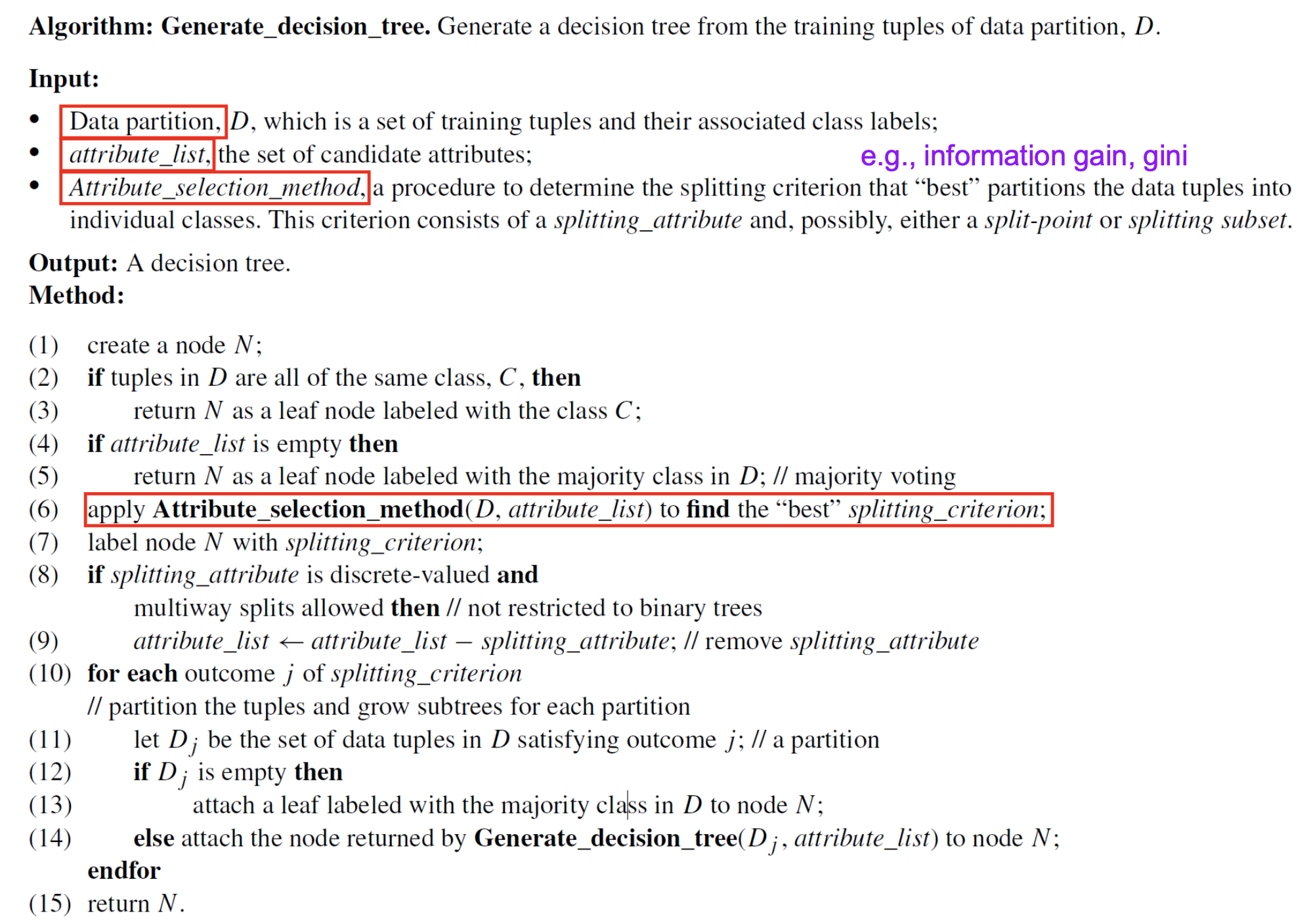
- 노드 생성
- 종료 조건 (1): 모든 항목이 이미 같은 정답이라면
- 종료 조건 (2): 더 이상 나눌 기준이 남아있지 않다면, 다수결 원칙에 따라 가장 많은 항목이 속한 클래스를 정답으로 선택
- 최선의 기준 찾기
- 가지치기: 선택된 기준에 따라 하위 그룹으로 분할
- 재귀적 반복
모든 가지가 리프 노드에 도달할 때까지 하향식 재귀 방식으로 반복된다. 속성이 남아있지 않은 경우, 데이터가 혼합된 상태일지라도 다수결 원칙을 적용하여 가장 우세한 클래스로 최종 결론을 내린다.
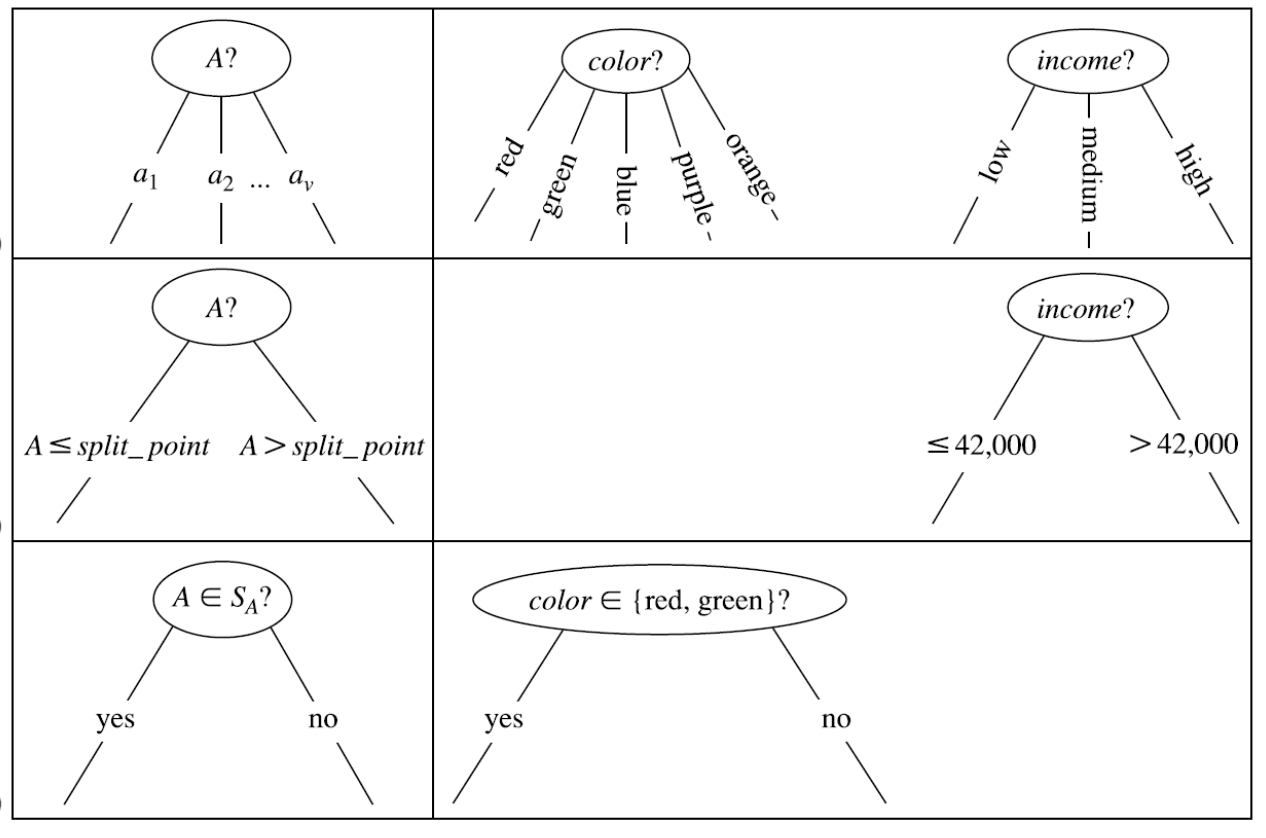
2.5 Partitioning
- discrete attribute
- multi-way split
- continous attribute
- threshold split
- binary split on discrete attribute
2.6 Attribute Selection Measures
- a heuristic used to select the best splitting attribute at each node
- determines how the dataset is partitioned into smaller subsets
objective
- create subsets that are as pure(homogeneous) as possible
- a pure node contains tuples from only one class
pure하게 만든다는 것은 서로 다른 것들이 섞이지 않은 동질적인 상태로 만드는 것과 같은 의미이다.
1. Entropy
- 단, ; 에서 각 클래스 가 차지하는 비율
- impurity of the dataset
2. Information Gain (ID3)
-
- ; 속성 로 분할한 후의 기대 정보량
- how much uncertainty is reduced after splitting
- selects attributes with maximum gain
특정 속성 로 데이터를 나누었을 때 불확실성이 얼마나 감소하는지 측정한다. 원래의 엔트로피에서 분할 후의 엔트로피를 뺀다.
3. Gain Ratio (C4.5)
-
- nomalized version of information gain
- reduces bias toward attributes with many values
정보 이득이 값이 많은 속성을 선호하는 편향을 해결하기 위해 정규화한 지표이다. 속성이 얼마나 잘게 쪼개지는지를 분모로 두어 벌점을 준다.
4. Gini Index (CART)
-
- 단,
- measures the impurity of a dataset
모든 데이터가 하나의 클래스에 속해 있다면 지니 지수는 0(최소 불순도)이다. CART 알고리즘은 오직 이진 트리만을 생성하며 이 지수가 가장 낮은 방향으로 가지친다.
Entropy vs. Gini Index
| 구분 | Entropy | Gini Index |
|---|---|---|
| 주요 알고리즘 | ID3, C4.5 | CART |
| 수식 | ||
| 트리 구조 | 다중 분할 가능 | 이진 트리만 |
| 계산 효율성 | 로그 계산으로 상대적으로 느림 | 제곱 합 계산으로 연산 속도 빠름 |
| 주요 목표 | 불확실성의 최소화 및 정보 이득 최대화 | 데이터셋의 불순도 측정 및 최소화 |
3. Information Gain
3.1 Information Gain
- compute entropy of
- partition by attribute
- compute entropy for each partition
- compute conditional entropy
- compute information gain
the attribute with the highest information gain is selected, and pure partitions directly becomes leaf nodes
3.2 Gain Ratio
Limitation of Information Gain
- bias toward many-valued attributes
- information gain prefers attributes with many distinct values
- each value a seperate partition, each partition contains one tuple
- entropy = 0, gain = info(D) - 0 maximum
Split Information
- measures how evenly data is split
- similar to entropy, but not class-based
Gain Ratio
- overcome bias of information gain
- information gain normalized by how evenly data is split
- better generalization than pure information gain
3.3 Gain Impurity
Gini Impurity
- measures the impurity of dataset
Interpretation
- gini = 0 completely pure (all same class)
- gini more mixed classes
Binary splitting in CART
- e.g., low vs. medium, high 4
Process
- compute the gini impurity of the dataset
- try a binary split on the attribute
- compute the weighted gini after the split
- interpretation
지니 불순도는 데이터셋에서 임의로 선택한 요소에 임의로 라벨을 지정했을 때, 얼마나 자주 틀릴지를 수치화한 것이다. 즉 데이터가 얼마나 섞여 있는지를 보여주는 지표이다.