New goal: fairness
simple: 모든 process에게 똑같은 CPU time 나눠주기
but, MLFQ는 queue의 종류가 여러가지
We have examined schedulers designed to optimize performance
- Minimum response times
- Minimun turnraound times
MLFQ achives these goals, but it's complicated - Non-trivial to implement
- Challenging to parameterize and tune
What about a simple algorithm that achives fairness?**
Lottery Scheduling
Key idea: give each process a bunch of tickes
- Each time slice, scheduler holds a lottery
- Process holding the winning ticket gets to run
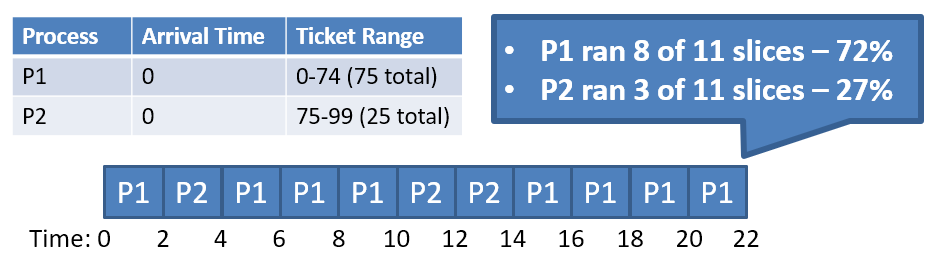
Probabilistic scheduling - Over time, run time for each process converges to the corret value
- i.e. the # of tickets it holds
Implementation Advantages
Vary fast scheduler execution
- All the scheduler needs to do is run random()
- No need to manage priority queeus
No need to store lots of stae
- Scheduler needs to know the total number of tickets
- No need to track process behavior or history
Automatically balances CPU time across processes
- New processes get some tickets, adjust the overall size of the ticket pool
Easy to prioritize processes
- Give high priority processes many tickets
- Give low priority processes a few tickets
Is Lottery scheduling fair?
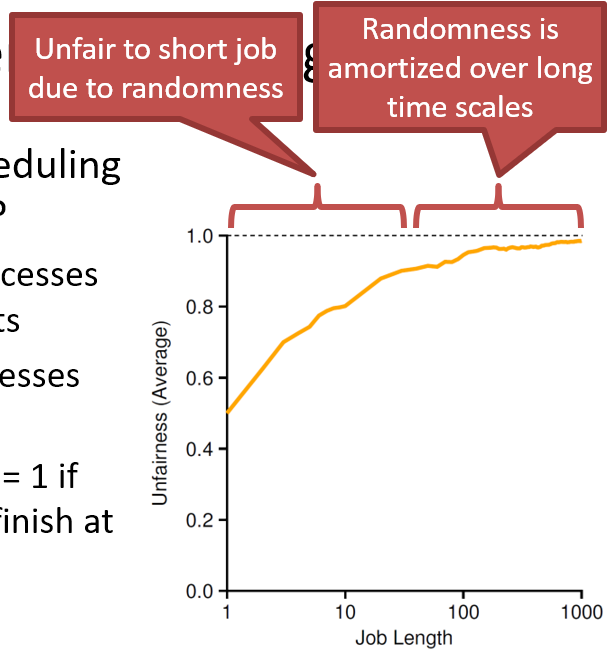
Does lottery scheduling achieve fairness?
- Assume two processes with eqaul tickets
- Runtime of processes varies
- Unfairness ratio=1 if both processes finish at the same time
Stride scheduling
Randomness is lets us build a simple and approximately fair scheduler
- But fairness is not guaranteed
- 임의의 시간은 fair한 게 아니다 -> interval로 fair하게 하자
Why not build a deterministic, fair scheduler?
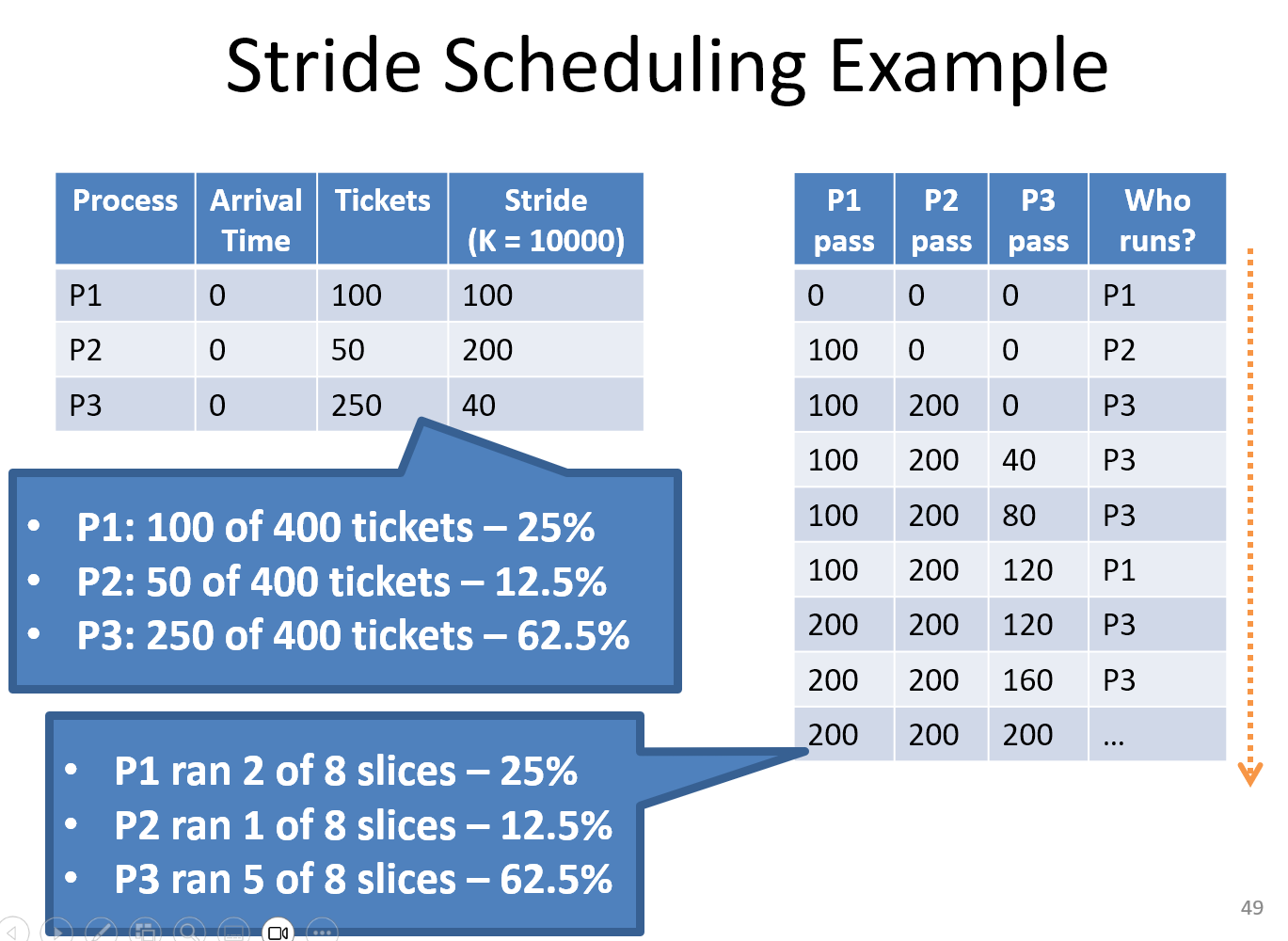
Stride scheduling
- Each process is given some tickets
- Each process has a strid = a big of tickets
- Each time a process runs, its pass +=stride
- Scheduler chooses process with the lowest pass to run next
Lingering Issues
티켓을 몇장 줄 것인가? -> 사용자에게 일임 or 동일한 숫자 계속 주기
Why choose lottery over stride scheduling?
- Stride schedulers need to store a lot more state
- How does a stride scheduler deal with new processes?
- Pass = 0, will dominate CPU until it catches up
- 제일 간단한 방법이지만, 전체 티켓이 변화하면 pass에도 영향
- Pass = 0, will dominate CPU until it catches up
Both schedulers require tickets assignment
- How do you know how many tickets to assign to each process?
- This is an open problem

갓생호소인