Priority Scheduling
- SJF, STCF are both priority schedulers
- Priority = CPU burst time
Problem with priority scheduling
- Starvation: high priority tasks can dominate the CPU
Possible solution: dynamically vary priorities
- Vary based on process behavior
- Vary based on wait time (i.e. length of time spent in the ready queue)
- 오래 기다리면 우선순위 증가
Simple Priority Scheduler
Associate a priority with each process
- Schedule high priority tasks first
- Low numbers = high priority
- No preemption
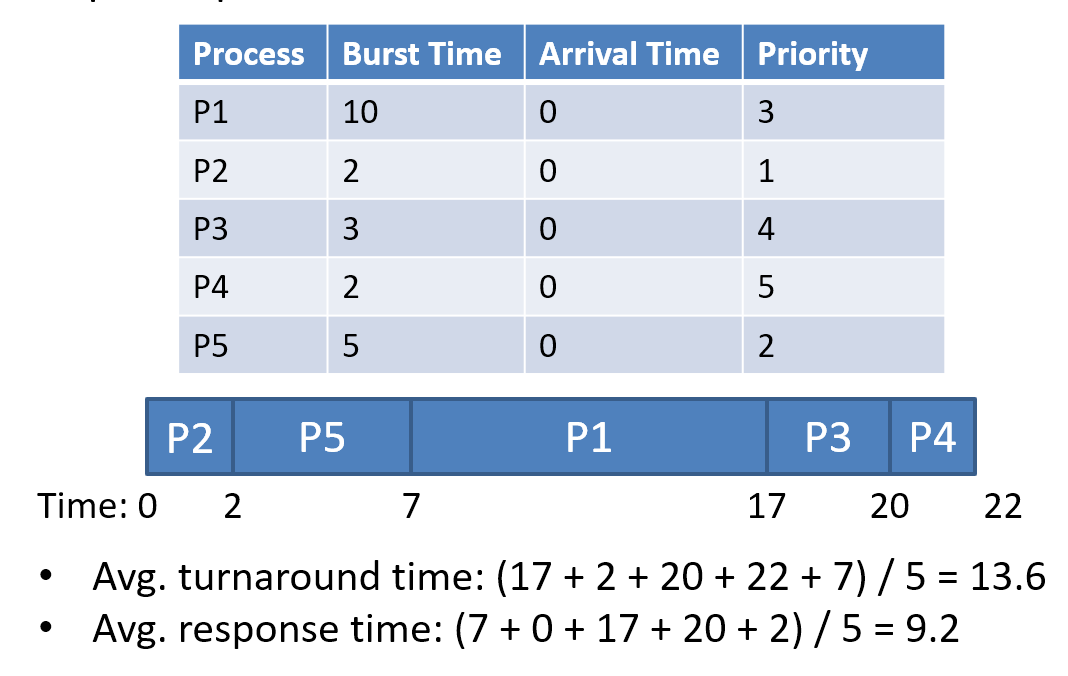
1. Cannot automatically balance response vs turnaround time
2. Prone to starvation
Earliest Deadline First (EDF)
Each process has a deadline it must finish by
Priorites are assigned according to deadlines
- Tighter deadlines are given higher prioirty
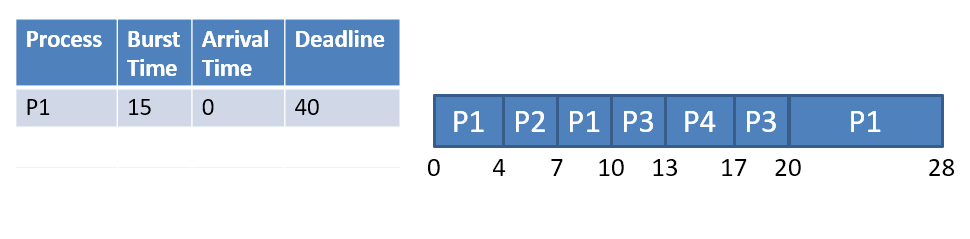
EDF is optimal (assuming preemtion) - cpu 1개 & deadline을 반드시 알아야 함
- EDF로 스케줄링이 안 되면 어떤 기법으로도 deadline을 만족시킬 수 없음
But, it's only useful if processes have known deadlines- Typically used in real-time OSes
Multilevel Queue (MLQ)
Key idea: divide the ready queue in two
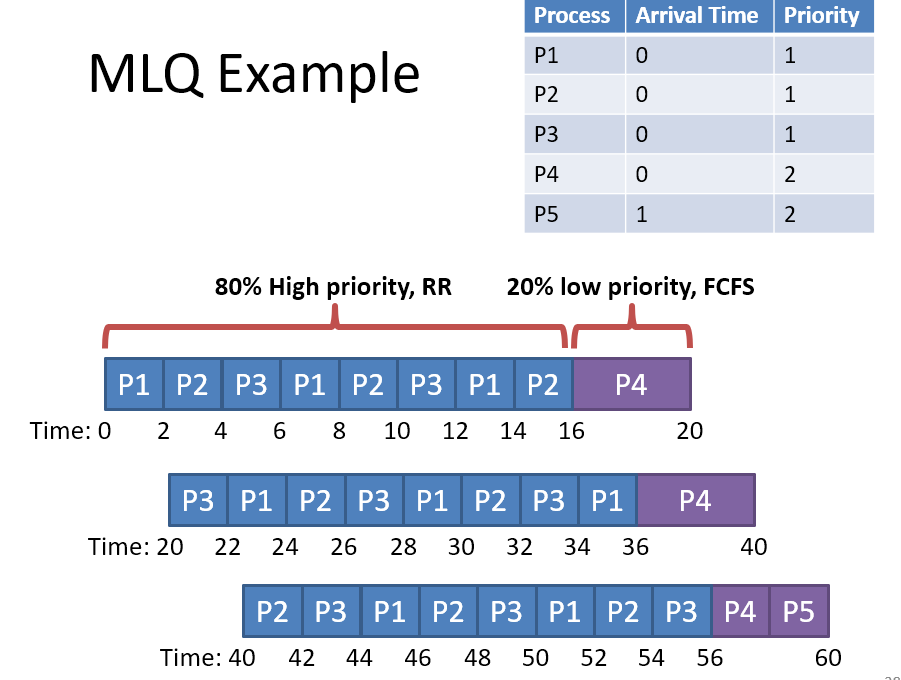
1. High priority queue for interactive processes
- RR scheduling
- 사용자 레벨은 빠른 응답이 중요
- 우선순위 같을 때 & interactive면 RR
- Low priority queue for CPU bound
- FCFS schedulinh
Simple, static configuration - Each process is assigned a priority on start up
- Each queue is given a fixed amount of CPU tume
- 80% to processes in the high priority queue
- 20% to processes in the low priority queue
Problem with MLQ
Assumes you can classify processes into high and low priority
- How could you actually do this at run time?
- What of a processes' behavior changes over time?
- i.e. CPU bound protion, followed by interactive portion
- CPU, interactive 중 무슨 작업인지 명확하지 않은데, 안다고 가정
- 알아도 중간에 CPU<-> interactive or CPU, interactive 혼합 작업 존재
- 80% 20% 어떻게 나누는가?
Highly biased use of CPU time
- i.e. CPU bound protion, followed by interactive portion
- Potentially too much time dedicated to interactive processes
- Convoy problems for low priority tasks
Multilevel Feedback Queue (MLFQ)
Goals
- Minimize response time and turnarround time
- Dynamically adjust process priorities over time
- dynamically: 여러 큐를 둔다, 움직일 수 있는 큐
- No assumptions or prior knowledge about burst times or process behavior
High level design: generalized MLQ
- Serveral priority queues
- Move processes between queu based on observed behavior (i.e. ther history)
First 4 Rules of MLFQ
Rule1: If Priority(A) > Priority(B), A runs, B doesn't
Rule2: If Priority(A) = Priority(B), A & B run in RR
- 같은 큐에 있으면 Round Robin
Rule3: Processes start at the highest priority - 뭔지 모르니까 interactive로 가정하고 아니면 낮춤
Rule4 - Rule 4a: If a process uses an entire time slice while running, its priority is reduced
- queue의 time slice를 다 쓰면 우선순위 낮추기
- Rule 4b: If a process gives up the CPU before its time slice is up it remains at the same priority - for interactive, time slice 다 쓰기 전에 종료하면 순위 유지
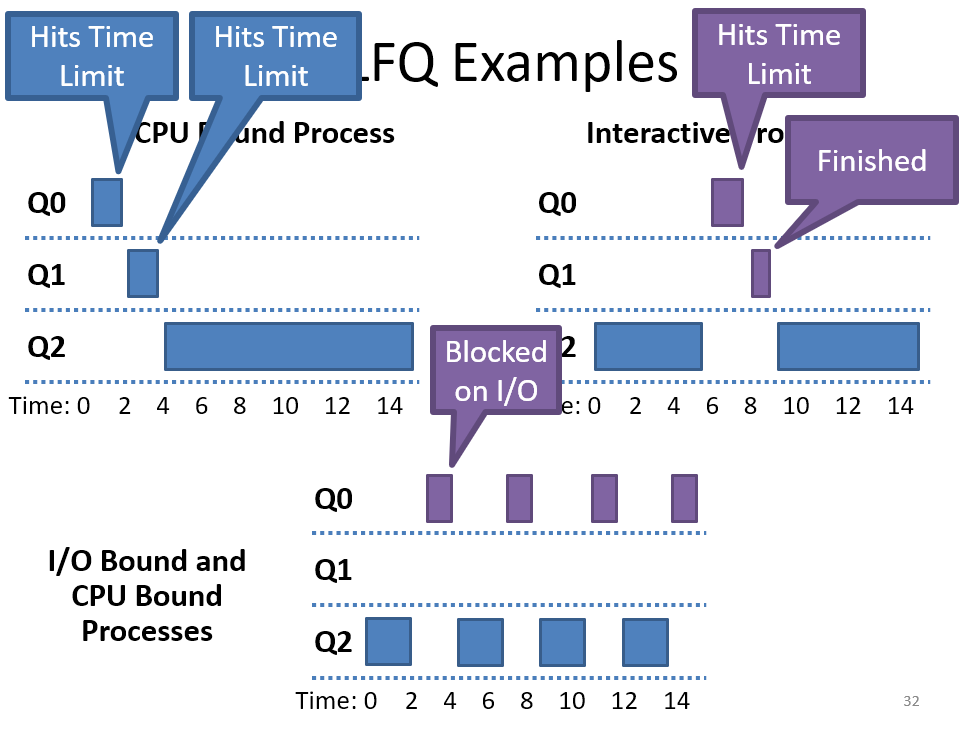
- queue의 time slice를 다 쓰면 우선순위 낮추기
- time slice 끝나기 전에 I/O 수행 -> 우선순위 낮아지지 않고 (해당 큐에서) 계속 수행 -> response time 빠르게 유지
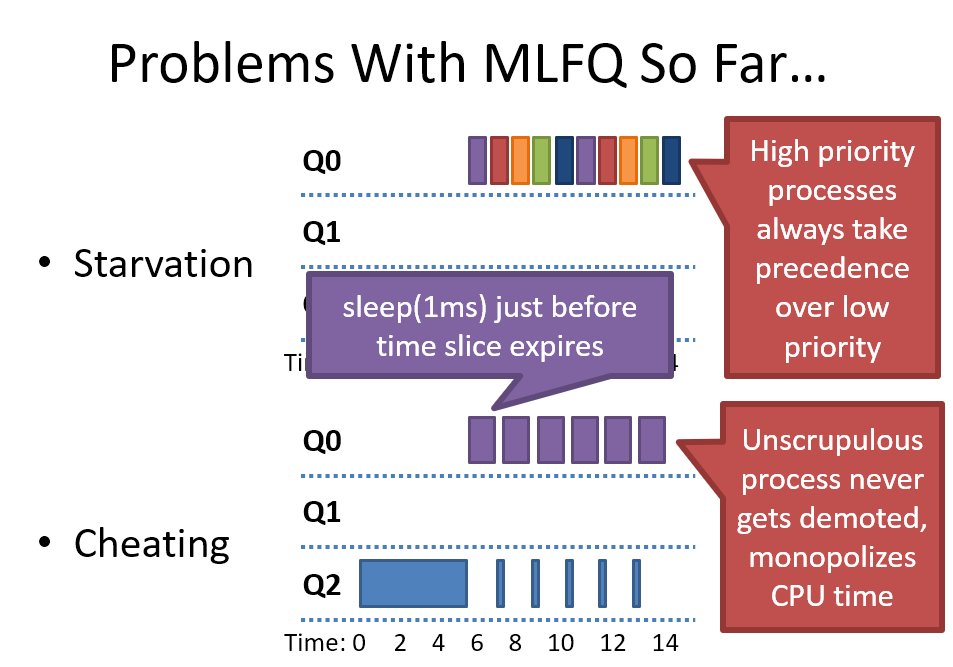
- 우선순위 높은 게 계속 들어오면 Q2는 굶주림
MLFQ Rule 5: Priority Boost
Rule 5: After some time period S, move all processes to the highest priority queue
- Rule 4 까진 우선순위를 내리기만 했음
Solve the problems - Starvation: low priority processes will eventually become high priority, acquire CPU time
- Dynamic behavior: a CPU bound process that has become interactive will now be high priority
- CPU -> interactive된 애가 있으면 순위를 올려줌
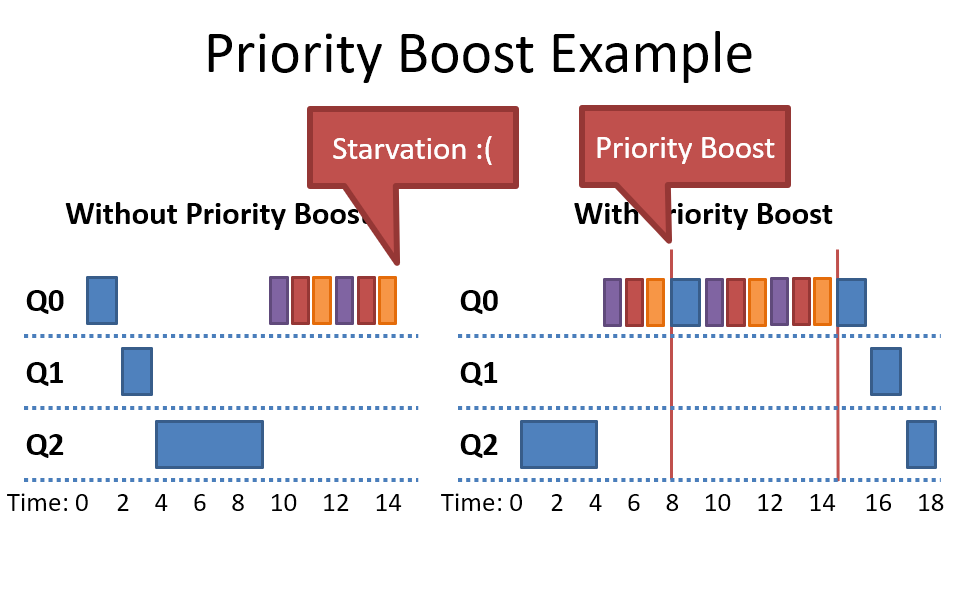
- CPU -> interactive된 애가 있으면 순위를 올려줌
Revised Rule 4: Cheat Prevention
time slice마다 얼마나 썼는지 체크하는 게 문제
-> 현재 queue에서 얼마나 작업했는지 체크를 계속 유지하여 정도 넘으면 넘겨주기
Rule 4a and 4b let a process game the scheduler
- Repeatedly yield just before the time limit expires
Solution: better accounting
- Rule 4: Once a process uses up its time allotment at a given priority (regardless of whether it gave up the CPU), demote its priority
- Basically, keep track of total CPU time used by each process during each time interval S instead of just blocking at continous CPU time
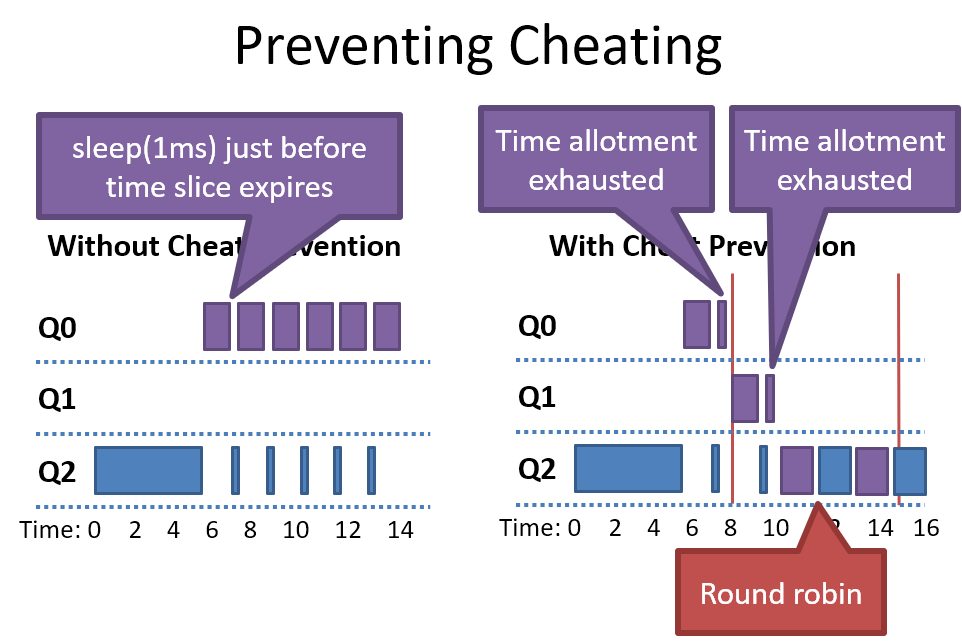
- 마지막 Q2 queue에서는 Round Robin
MLFQ Rule Review
Rule 1: If Priority(A) > Priority(B), A runs, B doesn't
Rule 2: If Priority(A) = Priority(B), A & B run in RR
Rule 3: Processes start at the highest priority
Rule 4: Once a process uses up its time allotment at a given priority, demote it
After some time period S, move all processes to the highest priority queue
Parameterizing MLFQ
MLFQ meets out golas
- Balance response time and turnaround time
- Doest not require prior knowledge abount processes
But, it has many knobs to tune
- Number of queues?
- typically, 4
- How to divide CPU time between the queues?
- For each queue:
- Which scheduling regime to use?
- Time slice/quantime?
- 각 queue마다 time slice 다름
- priority low이면, time slice 길게, CPU bound 작업으로 context switching , overhead
- 마지막 줄에는 FCFS가 됨
- Method for boosting priorities?
- 얼마나 자주?
MLFQ in Practice
Many OSes use MLFQ-like schedulers
OSes ship with "reasonable" MLFQ parameters
- Variable length time slices
- High priority queues - short time slices
- Low priority queues - long time slices
- Priority 0 sometimes reserved for OS processes
- interrupt는 우선순위로
Giving Adivce
Some OSes allow users/processes to give the scheduler "hints" about priorities
Example: nice command on Linux
- $ nice <command [args..]>
- Run the command with adjusted priority
- Values range form -20 (high) to 19 (low)
- Added to the process priority