23.08.04 최초 작성
1. Files of Linux
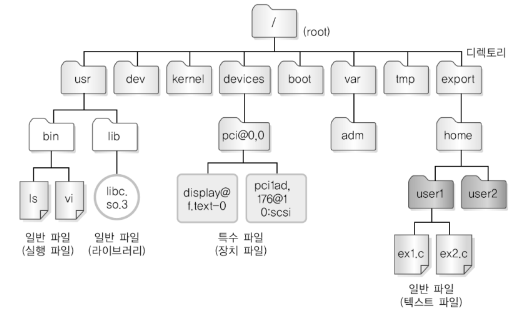
일반 파일 (Regular File) [-]
텍스트 & 바이너리 파일특수 파일 (Special File) [b] [c]
장치와 데이터를 주고 받는 통로디렉토리 [d]
파일의 목록을 저장 하는 파일심볼릭 링크 [s]
이미 존재하는 파일이나 디렉토리에 접근할 수 있는 파일
1.1 Special File
- 데이터 블록이 없으며 장치 번호(종류, 수)를 inode에 저장한다.
1.1.1 Character Device File [c]
- Character 단위 데이터 전송
1.1.2 Block Device File [b]
- Block 단위 데이터 전송
2 File Organization
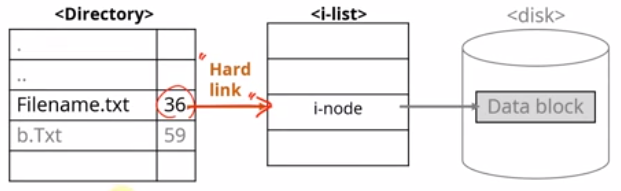
File Name(Hard Link): 사용자가 파일에 접근할 때 사용Inode: 파일에 대한 정보 저장. 번호를 통해 관리/접근 함 (ls -i를 통해 확인 가능)Data Block: 실제 데이터가 저장된 저장장치의 공간
2.1 파일의 정보 확인
#include <fcntl.h>
#include <sys/types.h>
#include <sys/stat.h>

int stat(const char *pathname, struct stat *buf);
int lstat(const char *pathname, struct stat *buf);
int fstat(int fd, struct stat *buf);

///
pathname/fd : 파일의 경로 / File Descriptor
buf : 파일의 정보를 저장할 주소

Return
(0 : Success, -1 : Error)
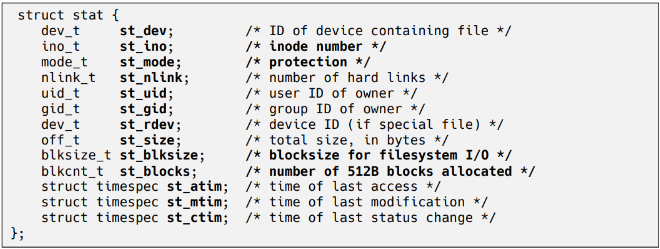
stat structure의 구조
ex) 예제
t_stat:stat명령어를 통해 얻은 정보 출력
`
#include <sys/sysmacros.h>
#if defined(_AIX)
#define _BSD
#endif
#if defined(__sgi) || defined(__sun)            /* Some systems need this */
#include <sys/mkdev.h>                          /* To get major() and minor() */
#endif
#if defined(__hpux)                             /* Other systems need this */
#include <sys/mknod.h>
#endif
#include <sys/stat.h>
#include <time.h>
#include "file_perms.h"
#include "tlpi_hdr.h"

static void
displayStatInfo(const struct stat *sb)
{
    printf("File type:                ");

    switch (sb->st_mode & S_IFMT) {
    case S_IFREG:  printf("regular file\n");            break;
    case S_IFDIR:  printf("directory\n");               break;
    case S_IFCHR:  printf("character device\n");        break;
    case S_IFBLK:  printf("block device\n");            break;
    case S_IFLNK:  printf("symbolic (soft) link\n");    break;
    case S_IFIFO:  printf("FIFO or pipe\n");            break;
    case S_IFSOCK: printf("socket\n");                  break;
    default:       printf("unknown file type?\n");      break;
    }

    printf("Device containing i-node: major=%ld   minor=%ld\n",
                (long) major(sb->st_dev), (long) minor(sb->st_dev));

    printf("I-node number:            %ld\n", (long) sb->st_ino);

    printf("Mode:                     %lo (%s)\n",
            (unsigned long) sb->st_mode, filePermStr(sb->st_mode, 0));

    if (sb->st_mode & (S_ISUID | S_ISGID | S_ISVTX))
        printf("    special bits set:     %s%s%s\n",
                (sb->st_mode & S_ISUID) ? "set-UID " : "",
                (sb->st_mode & S_ISGID) ? "set-GID " : "",
                (sb->st_mode & S_ISVTX) ? "sticky " : "");

    printf("Number of (hard) links:   %ld\n", (long) sb->st_nlink);

    printf("Ownership:                UID=%ld   GID=%ld\n",
            (long) sb->st_uid, (long) sb->st_gid);

    if (S_ISCHR(sb->st_mode) || S_ISBLK(sb->st_mode))
        printf("Device number (st_rdev):  major=%ld; minor=%ld\n",
                (long) major(sb->st_rdev), (long) minor(sb->st_rdev));

    printf("File size:                %lld bytes\n", (long long) sb->st_size);
    printf("Optimal I/O block size:   %ld bytes\n", (long) sb->st_blksize);
    printf("512B blocks allocated:    %lld\n", (long long) sb->st_blocks);

    printf("Last file access:         %s", ctime(&sb->st_atime));
    printf("Last file modification:   %s", ctime(&sb->st_mtime));
    printf("Last status change:       %s", ctime(&sb->st_ctime));
}

int
main(int argc, char *argv[])
{
    struct stat sb;
    Boolean statLink;           /* True if "-l" specified (i.e., use lstat) */
    int fname;                  /* Location of filename argument in argv[] */

    statLink = (argc > 1) && strcmp(argv[1], "-l") == 0;
                                /* Simple parsing for "-l" */
    fname = statLink ? 2 : 1;

    if (fname >= argc || (argc > 1 && strcmp(argv[1], "--help") == 0))
        usageErr("%s [-l] file\n"
                "        -l = use lstat() instead of stat()\n", argv[0]);

    if (statLink) {
        if (lstat(argv[fname], &sb) == -1)
            errExit("lstat");
    } else {
        if (stat(argv[fname], &sb) == -1)
            errExit("stat");
    }

    displayStatInfo(&sb);

    exit(EXIT_SUCCESS);
}
2.2 권한 확인
#include <unistd.h>

int access(const char * pathname, int mode);

///
pathname : 파일의 경로
mode : 확인 할 권한 (R_OK, W_OK, X_OK, F_OK -> 파일 존재 여부)

Return
(0 : 권한 있음, -1 : Error 권한 없음 or 파일 없음)
2.3 접근권한 변경
#include <sys/stat.h>

int chmod(const char * pathname, mode_t mode);
int fchmod(int fd, mode_t mode);

///
pathname/fd : 파일의 경로 / File Descriptor
mode : 적용하려는 접근 권한

Return
(0 : Success, -1 : Error)
2.4 파일 소유권 변경
#include <unistd.h>

int chown(const char *pathname, uid_t owner, gid_t group);
int lchown(const char *pathname, uid_t owner, gid_t group);
int fchown(int fd, uid_t owner, gid_t group);

///
pathname/fd : 파일의 경로 / File Descriptor
uid_t owner : 파일에 대한 새로운 소유자의 사용자 ID(-1이면 변경 취소)
gid_t group 파일에 대한 새로운 소유자의 그룹 ID(-1이면 변경 취소)

Return
(0 : Success, -1 : Error)
2.5 파일 시스템 마운트
mount,umount: 파일 시스템을 마운트 / 해제
#include <sys/mount.h>
int mount(const char *specialfile, const char * dir , const char * filesystemtype, unsigned long rwflag , const void * data);

int umount(const char *specialfile);

int umount(const char *dir);

///
specialfile : 장치 이름
dir : mount/umount 할 경로
filesystemtype : /proc/filesystems 에 정의된 값
	 MS_RDONLY    1 :  읽기-전용 마운트
	 MS_NOSUID    2 : suid 그리고 sgid 비트를 무시
	 MS_NODEV     4 : 특별 파일 장치 접근을 허용하지 않는다
	 MS_NOEXEC    8 : 프로그램 실행을 허용하지 않는다
	 MS_SYNC     16 : 쓰기를 일단 동기화
	 MS_REMOUNT  32 : 마운트된 FS의 플래그를 수정

Return
(0 : Success, -1 : Error)
3. Directory
File Name들과 File Name이 가리키는 inode 번호를 담고 있는 파일
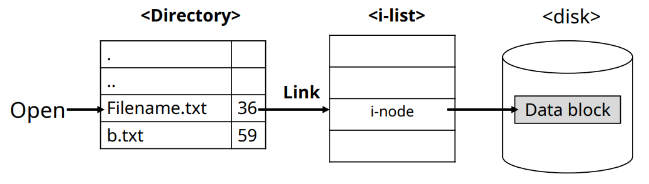
1. Sub Directory : Directory에 포함된 Directory
2. Special Directory : 모든 Directory가 포함하는 Directory들
(. : 최근 Directory, .. : 부모 Directory)
3. Pathname
Absolute Pathname: Root Directory(/)로 시작하는 파일 경로Relative Pathname: Current Directory(.)로 시작하는 파일 경로
3.1 Directory 생성, 삭제, 이름 변경
#include <sys/stat.h>
#include <sys/types.h>

int mkdir(const char *pathname, mot_t mode);#include <unistd.h>
int rmdir(const char * pathaname);#include <stdio.h>
int rename(const char *oldpath, const char *newpath);
///
Return
(0 : Sucess, -1 : Fail)3.2 Directory 현재 위치, 이동
#include <unistd.h>

char *getcwd(char *buf, size_t size);

///
buf : 현재 디렉토리의 절대 경로를 저장 할 주소
size : 버퍼의 크기

Return : Path가 저장된 buf의 주소
(NULL : Error)#include <unistd.h>
int chdir(const char *path);
///
path : 변경할 Directory의 경로
Return
(0: Success, -1 : Fail)3.3 Directory 정보 검색
#include <sys/types.h>
#include <dirent.h>

DIR *opendir(const char * name);
///
name : 열려는 Directory 이름

Return : 열린 Directory의 DIR 포인터
(NULL : Error)#include <sys/types.h>
#include <dirent.h>
int closedir(DIR *dirp)
///
dirp : 닫으려는 Directory의 포인터
Return
(0 : Sucess, -1 : Fail)#include <dirent.h>
struct dirent *readdir(DIR *dirp) // Directory의 내용을 하나씩 읽어옴
///
dirp : 읽으려는 Directory의 포인터
Return : 현재 읽어온 항목의 dirent 구조체를 가리키는 포인터
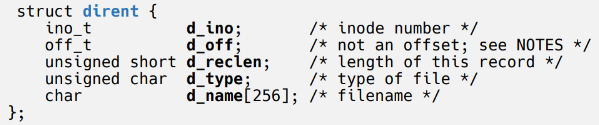
(NULL : 더이상 읽을 항목이 없음)- dirent 구조체
ex) 예제
list_dir: 디렉토리 안의 파일 목록 출력
#if defined(__APPLE__)
        /* Darwin requires this header before including <dirent.h> */
#include <sys/types.h>
#endif
#include <dirent.h>
#include "tlpi_hdr.h"

static void             /* List all files in directory 'dirpath' */
listFiles(const char *dirpath)
{
    DIR *dirp;
    struct dirent *dp;
    Boolean isCurrent;          /* True if 'dirpath' is "." */

    isCurrent = strcmp(dirpath, ".") == 0;

    dirp = opendir(dirpath);
    if (dirp  == NULL) {
        errMsg("opendir failed on '%s'", dirpath);
        return;
    }

    /* For each entry in this directory, print directory + filename */

    for (;;) {
        errno = 0;              /* To distinguish error from end-of-directory */
        dp = readdir(dirp);
        if (dp == NULL)
            break;

        if (strcmp(dp->d_name, ".") == 0 || strcmp(dp->d_name, "..") == 0)
            continue;           /* Skip . and .. */

        if (!isCurrent)
            printf("%s/", dirpath);
        printf("%s\n", dp->d_name);
    }

    if (errno != 0)
        errExit("readdir");

    if (closedir(dirp) == -1)
        errMsg("closedir");
}

int
main(int argc, char *argv[])
{
    if (argc > 1 && strcmp(argv[1], "--help") == 0)
        usageErr("%s [dir-path...]\n", argv[0]);

    if (argc == 1)              /* No arguments - use current directory */
        listFiles(".");
    else
        for (argv++; *argv; argv++)
            listFiles(*argv);

    exit(EXIT_SUCCESS);
}
3.4 Directory Offset
#include <dirent.h>

long telldi(DIR *dirp); // 현재 offset 반환
void seekdir(DIR *dirp, long loc); // offset을 loc으로 이동
void rewinddir(DIR *dirp); // offset을 0으로 변경

///
loc : 이동 할 위치
4. Link
- Hard Link : 디렉토리의 파일 이름과 inode를 매핑해 놓은 것. 다른 파일 시스템에 있는 inode에 대한 Hard Link는 불가능하다. Hard Link의 갯수는 링크의 갯수이며 링크의 갯수가 0이 될 시 파일이 삭제된다. (확장자 명은 *.ln)
#include <unistd.h>

int link(const char *existing, const char *new);

///
existing : 기존 파일 경로
new : 새로 생성할 링크의 경로

Return
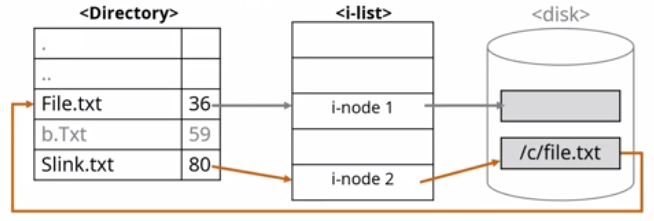
(0 : Sucess, -1 : Fail)- Soft Link(Symbolic Link) : 실제 파일의 경로명을 저장하는 파일. 다른 파일 시스템의 inode를 Link 할 수 있다. (확장자 명은 *.sym)
#include <unistd.h>

int symlink(const char *name1, const char * name2);

///
name1 : 기존 파일의 경로
name2 : 새로 생성할 링크의 경로

Return
(0 : Success, -1 : Fail)
4.1 Removing a Link
# include <unistd.h>

int unlink(const char *pathname); // Directory에 사용 불가
///
pathname : 삭제하려는 HardLink의 경로

Return
(0 : Sucess, -1 : Fail)
# include <unistd.h>
int remove(const char * pathname); // 비어있는 Directory에 사용 가능
///
pathname : 삭제하려는 HardLink의 경로
Return
(0 : Sucess, -1 : Fail)4.2 Symbolic Link의 정보 가져오기
#include <sys/types.h>
#include <sys/stat.h>
#include <unistd.h>

int lstat(const char *pathname, struct stat *buf);
// Symbolic Link File 자체의 파일 정보를 가져옴
// stat : Symbolic Link가 가리키는 파일의 정보를 가져옴

///
pathname : 읽어오려는 Symbolic Link의 경로
buf : 파일의 정보를 담을 공간

Return
(0 : Sucess, -1 : Fail)#include <unistd.h>
ssize_t readlink(const char *pathname, char *buf, size_t bufsize);
///
pathname : 읽어오려는 Symbolic Link의 경로
buf / bufsize : 데이터를 저장할 buffer의 주소 및 읽을 크기
Return : 읽은 byte 수
(-1 : Error)#include <limits.h>
#include <stdlib.h>
char* realpath(const char *path, char *resolved_path);
///
pathname : Symbolic Link File의 경로
resolved_path : 결과 값을 저장할 buffer
Return : 결과가 저장된 buffer의 포인터
(NULL : Error)
